


If you're running talent acquisition or program staffing for a federal contractor heading into 2026, the math has already shifted under your feet. Defense spending is climbing. Clearance investigations are still slow. Your candidate pool is finite. And the contractor sitting across from you in the next bid is recruiting from the same 50 people you are.
This is the operating reality of cleared sourcing in 2026. The contractors who win programs this year are the ones who stopped treating sourcing as a reactive function and started treating it as the front end of their proposal strategy.
Here's what you need to know, and what you need to do.
The Challenge of Cleared Talent Scarcity
Start with the budget. The FY 2026 national defense budget request came in at $1.01 trillion, a 13.4% increase over FY 2025, according to the Department of Defense's official briefing on the proposed budget. That money flows directly into contract vehicles, which flow directly into cleared headcount requirements at companies like yours.
The supply side hasn't caught up. There are an estimated 500,000 to 700,000 open cleared positions nationwide right now, a number that already exceeds the active job-seeking cleared workforce by a wide margin.
The same analysis points out that filling cleared IT roles takes 41 to 60 days even when you find the right person, and TS/SCI roles now take 12 to 18 months to fully process from sponsorship to a billable seat.
If you're staffing against a contract that goes into execution in 90 days, that timeline is the problem. Your proposal said you'd staff X seats by Y date. The clearance process said no.
You also can't recruit them if you don't understand what they're optimizing for. The post-pandemic cleared workforce has shifted expectations, and the traditional contractor employment offer is losing ground.
Compensation expectations have climbed sharply. TS/SCI with Full-Scope Polygraph holders in cybersecurity and SIGINT disciplines now command $150,000 to $220,000 or more in base salary in the DC metro market, per iQuasar's 2026 analysis of the NSA-cleared talent shortage.
If your salary band caps below that range, you're not in the conversation. You're filling lower-tier roles or running out the clock on a candidate who already has two other offers.
Flexibility is the second pressure point. The cleared workforce noticed which contractors found ways to offer hybrid schedules, compressed work weeks, and remote-eligible unclassified hours. They also noticed which ones didn't bother.
A 9/80 schedule and one work-from-home day for unclassified tasks is now the bare minimum cleared candidates expect when the contract environment allows it.
Then there's the cybersecurity premium. The global cybersecurity workforce gap sits at 4.8 million professionals and cleared cyber talent commands top-of-market compensation regardless of agency or contract, per Federal News Network's January 2026 commentary.
If you're staffing a cyber-heavy program, you're competing with more than other contractors. You're competing with commercial firms paying $250,000-plus for the same skill set without requiring a clearance.
Read more- Cleared Talent Recruitment: Key Trends Federal Contractors Need to Know in 2026
Importance of Cleared Talent in Federal Contracting
Compliance with security clearance requirements
The federal solicitation specifies the clearance needed for each labor category, which is verified by the government. The TS/SCI billet requires someone who currently possesses TS/SCI clearance or whose clearance investigation can be sponsored and adjudicated within the timeframe of the contract.
Polygraph qualifications reduce the number of potential candidates; an individual who has both TS/SCI and a Full-Scope Polygraph reduces the number of candidates to a small portion of the cleared community.
Prior to submitting the name of a candidate, ensure that their clearance qualification, current status, last clearance investigation date, and a Full-Scope Polygraph (if applicable) are correct.
Meeting key personnel obligations for contracts
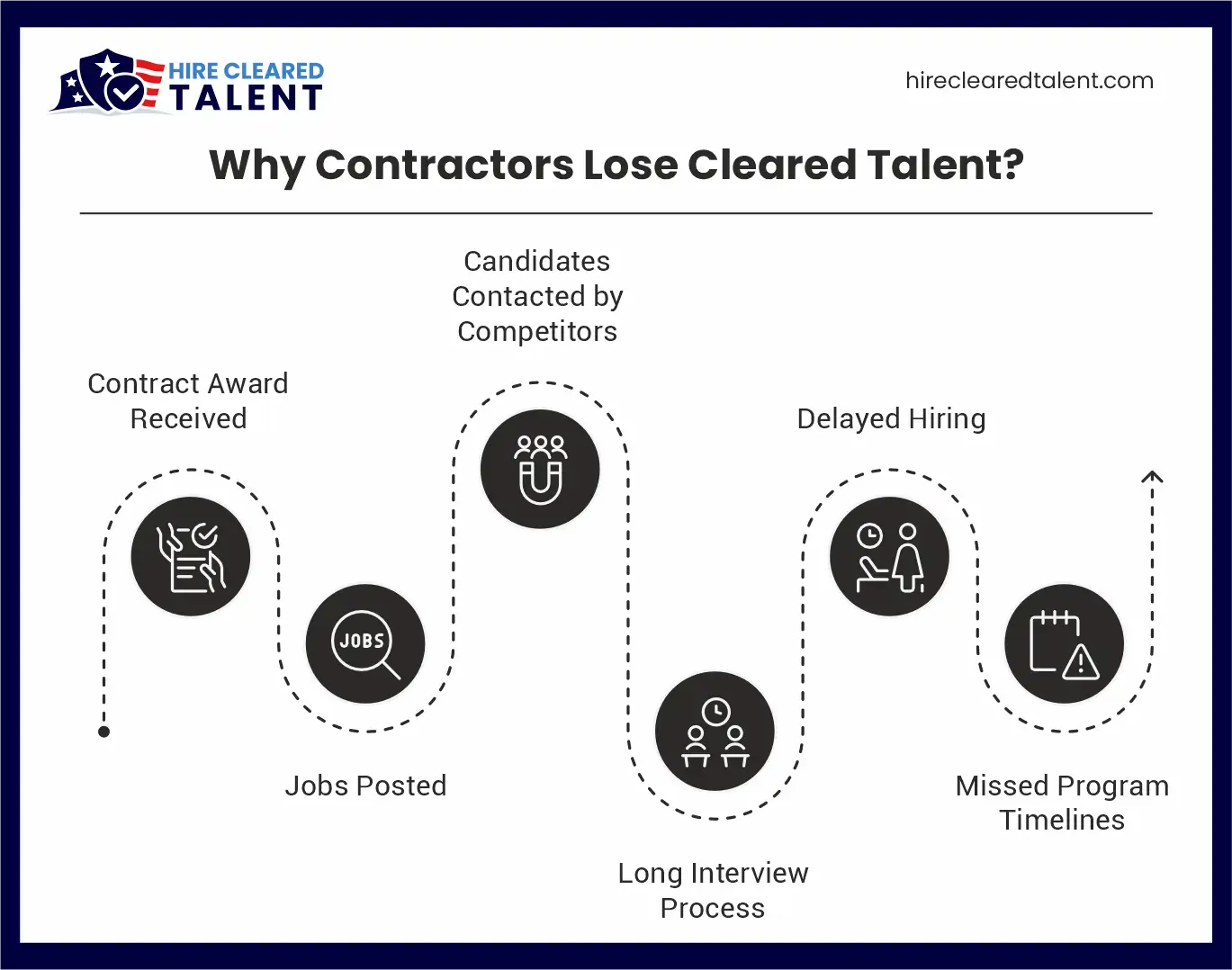
The old model worked like this. You win the award and you post jobs. You hire and pay your bill.
That model is dead in 2026. Contractors who try it run into the same brick wall every quarter: post-award sourcing means you start recruiting against the same talent pool as everyone else who just lost, and you do it on a contract clock that's already running.
The new model treats cleared sourcing as a capture activity. You identify named candidates before submission. You confirm their availability and clearance status. You include them in your proposal as key personnel or named resources where the solicitation allows. You build a written bench of pre-cleared talent ready to start on day one of execution.
This isn't theoretical. Federal contractors who move candidates from interest to offer in days rather than weeks are winning both talent and contracts in 2026, per Federal News Network's January 2026 commentary on cleared recruiting trends.
Speed is a competitive moat. The contractors closing offers in 10 business days are the ones holding past performance ratings of "Exceptional." The ones taking 45 days are losing competitions.
Risks of Inadequate Cleared Talent Sourcing
When you can't staff a cleared seat, the government has options.
Contract performance delays
The first is a Stop-Work Order. If you can't fill positions according to the Contract Work Breakdown Structure, the government can halt revenue recognition on the program while your fixed costs keep running, as detailed in CCS Global Tech's analysis of the DoD acquisition process.
Consistently failing to meet deliverable schedules due to staffing gaps drops you from "Exceptional" to "Satisfactory," which directly impacts your win probability on the next bid.
Increased costs and penalties
You burn cash, fast, with no offsetting revenue. The second cost is your CPARS rating.
You don't recover from those scores in a single recompete cycle but procurement officers always remember.
That's why sourcing is now a financial risk function. Every cleared seat you fail to fill on time has a documented dollar cost, a documented schedule impact, and a documented past-performance consequence.
Strategies for Effective Cleared Talent Sourcing
Building a resilient talent pipeline
Stop running your sourcing strategy out of generic job boards. The candidates you want aren't there. Approximately 92% of cleared professionals are already employed, which means most of your real targets aren't actively applying to anything.
Here's where contractors winning the sourcing game are spending their time and budget in 2026-
Pre-cleared talent marketplaces- Platforms purpose-built around the cleared workforce filter candidates by clearance level, polygraph status, agency background, and contract availability before you ever see them.
The screening work is done. Your recruiters spend their time evaluating fit, not chasing whether someone actually holds the clearance they claim.
Capture-phase sourcing- During proposal capture, your BD team and recruiters should be identifying named candidates against draft labor categories.
You confirm their interests and make their documents available. You feed real names into your proposal staffing plan. When the award lands, you call them.
Transitioning military networks- Service members start their job search 12 to 18 months before separation. Show up at base transition assistance programs early. Build relationships with installation career centers near your work sites.
The candidate who's six months out from terminal leave is the one your competitor will hire if you wait until they're four weeks out.
Apprenticeship and consult-to-clear pipelines- Sponsoring clearances for high-potential candidates with adjacent skills is now cheaper and faster than chasing pre-cleared perfect fits in many functional areas, according to CCS Global Tech's 2026 pipeline analysis.
You bring someone on in an unclassified role, initiate the investigation immediately, and they transition to billable status when adjudication completes. This isn't fast, but it's controllable, and it builds bench depth your competitors don't have.
Employee referral programs with real money attached- Most contractor referral bonuses are still set at 2019 levels. A $2,500 referral payout doesn't move a cleared engineer to introduce you to her former colleague, a $10,000 payout does.
Compare that against the cost of a six-month vacancy on a billable seat, and the math is straightforward.
Retention is also a sourcing strategy- Every cleared employee you keep is a cleared employee your competitor can't hire. That sounds obvious, and it isn't, because most contractor retention programs are still designed for a pre-2024 market.
Cleared workforce mobility is rising. The contractors keeping their talent are doing three things in parallel. They're running market-rate salary adjustments mid-year rather than waiting for annual cycles, because a 3% raise in March looks like an insult against the 10% offer your engineer just received from a competitor.
They're having real career-path conversations every six months instead of annual reviews that nobody believes. And they're offering program rotations, so senior engineers can move between contracts without leaving the company.
That last one matters more than people realize. A senior TS/SCI engineer doesn't quit a company. He quits a contract he's been on for four years that's gone stale.
If your bench policy lets him rotate to a new mission area within your portfolio, you keep the clearance, the institutional knowledge, and the past performance. If it doesn't, your competitor gets all three.
There's also a quiet retention lever most contractors ignore: contract stability transparency. Cleared candidates ask about contract end dates and recompete status during interviews because they've been laid off before.
If your program is funded through 2028 with a high probability of recompete win, tell them. If the contract has 9 months left and the recompete is uncertain, tell them that too. The candidates who join under false pretenses are the ones who leave fastest when reality lands.
Optimizing the security clearance lifecycle
Even when sourcing works, internal friction can kill your cycle time. The contractors closing fast aren't doing anything magical. They've audited their own process and removed the things that don't add value.
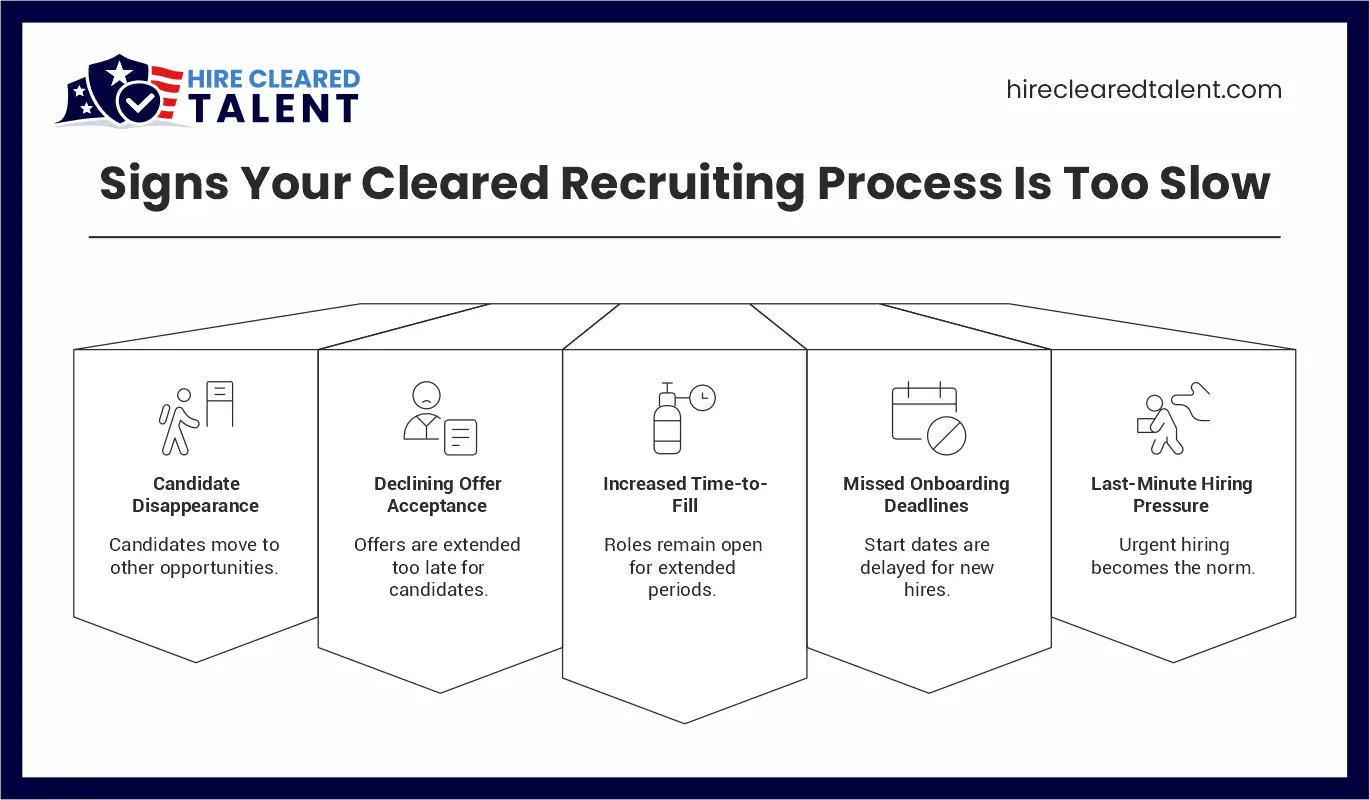
Your interview loop is probably too long. Three interviewers is enough. Five is a theater. Every additional voice in the loop adds three to five days of scheduling delay and rarely improves the hiring decision. You can just cut the loop. Measure the time-to-offer the same way you measure time-to-fill and hold your TA team accountable for both.
Your hiring manager response time matters more than your sourcing volume. If candidates are sitting in your pipeline for seven days waiting for a hiring manager to review their resume, you don't have a sourcing problem. You have an internal accountability problem. Build a service-level agreement between TA and program leadership- 48-hour resume review, 5-business-day interview scheduling, 24-hour offer turnaround after panel completes.
Your job descriptions probably read like compliance documents. Cleared candidates can spot a generic posting in 30 seconds. They can tell whether the company understands the contract or is fishing in the dark.
Get your program managers involved in writing JDs for cleared roles. The technical detail that comes from someone who's actually worked the contract is the difference between a posting that draws qualified applicants and one that gets ignored.
Read more- Security Cleared Staffing Shortages 2026: Why Hiring Timelines Are Breaking
The honest math on speed
Here's a quick scenario worth thinking through. You have an open TS/SCI cyber engineer role. Your sourcing team identifies a qualified candidate on day one. Your competitor identifies the same candidate on day three.
If you close in 10 business days and your competitor closes in 25, you win. Period. The candidate signed your offer before your competitor's hiring manager finished reviewing the resume.
Now run the same math on a bench of 12 pre-identified candidates. Your competitor is starting from scratch on every requisition. You're calling people who already said yes in concept. Your fill rate is 60% and Theirs is 18%. Your past performance rating stays "Exceptional" but theirs slips.
That's the entire business case for sourcing as a proactive function. It's not about being clever; it's about being ready.
Partnering with cleared recruitment agencies
HireClearedTalent was built for this market. The cleared workforce shows up on our marketplace because we've stripped out the friction generic job boards leave in place.
Candidates self-identify their clearance level, polygraph status, last investigation date, and contract availability. Employers see filtered, verified profiles. Recruiters spend their time evaluating fit, not screening for basic eligibility.
If you're staffing cleared programs in 2026 and your current sourcing approach isn't keeping up with your award velocity, you have two choices. You can keep posting and waiting, or you can move to a sourcing model built for how cleared hiring actually works now.
Are you looking for cleared professionals who are actively looking for jobs? Check here.
Conclusion
The contractors winning in 2026 aren't waiting for the talent to find them. They're building the pipeline before they need it. Yours can be next. Need more clarity?
Book a FREE Consultation Call Now
FAQ
Q1: Why are federal contractors struggling more to find cleared talent in 2026?
A: Federal contractors face a smaller available talent pool because most cleared professionals are already employed. Increased competition, specialized skill requirements, polygraph requirements, and faster hiring cycles have made sourcing more difficult than previous years.
Q2: Why is cleared talent sourcing becoming part of the proposal process?
A: Many contractors now identify and engage cleared candidates before contract award. Building a pre-qualified talent pipeline during capture and proposal stages helps reduce staffing delays and supports faster contract execution.
Q3: How does slow hiring affect federal contract performance?
A: Slow hiring can create staffing gaps, delayed onboarding, missed milestones, and increased project pressure. Contract execution often starts immediately after award, leaving limited time to recruit key personnel.
Q4: How early should federal contractors start sourcing cleared candidates?
A: Contractors increasingly begin sourcing during the capture phase, months before proposal submission. Early engagement creates a stronger candidate bench and improves readiness after award.
Q5: What causes federal contractors to lose cleared candidates during hiring?
A: Long interview cycles, delayed feedback, multiple approval layers, and slow offer decisions frequently lead candidates to accept other opportunities.
Q6: How do federal contractors build a stronger cleared talent pipeline?
A: Strong pipelines often combine recruiter networks, passive candidate outreach, referral programs, talent communities, and continuous relationship-building instead of relying only on job postings.
Q7: Why do traditional job boards produce weaker results for cleared recruiting?
A: Many cleared professionals are passive candidates who are not actively searching on public job platforms. Cleared hiring often depends more on recruiter relationships and specialized talent networks.
Q 8: How does faster hiring improve contract competitiveness?
A: Faster hiring supports quicker onboarding, stronger staffing plans, reduced program risk, and improved confidence during proposal evaluations.
Q 9: What should contractors validate before adding candidates to proposal teams?
A: Contractors should verify clearance level, current status, technical experience, availability, location requirements, and willingness to support the program.
Q 10: What cleared workforce trends are influencing federal contractors in 2026?
A: Major trends include increased demand for cybersecurity and cloud talent, growth in AI-related skills, stronger competition for passive candidates, and a shift toward capture-stage recruiting strategies.
Weekly newsletter
Get the latest blog updates, practical hiring insights, and featured reads delivered straight to your inbox.
Read about our Privacy Policy.