


The task order came through late on a Friday afternoon. By the time Monday arrived, the timeline had already started tightening.
A program manager now had sixty days to assemble a cyber and cloud team, most of them requiring active clearances. The work itself was not new. The scope had been finalized months earlier. Job requisitions were ready. Recruiters had resumes in hand and outreach underway.
But progress moved slower than the contract schedule expected. Three weeks in, only a handful of positions were filled. As the calendar moved closer to the deployment window, attention shifted from planning to pressure. Stakeholders began asking when the remaining roles would be staffed and how the team would meet the original start date.
Situations like this are no longer rare across federal programs. In the current environment, cleared talent recruitment is not simply an HR challenge. It has become a direct execution risk. Contractors entering 2026 are finding that recruiting strategies that once worked no longer keep pace with the realities of today’s cleared hiring market.
Why Cleared Hiring Feels Harder Than It Used to Be?
Talk to any federal contractor and you’ll hear the same story.
The cleared workforce is smaller than it was a decade ago. Retirements are accelerating. Clearance timelines are unpredictable. And demand, especially for cybersecurity, cloud, and AI-adjacent skills keeps climbing.
In 2025, more than half of federal recruiters (56%) said limited cleared talent was their biggest hiring challenge, making it the most cited constraint across defense and federal IT programs.
At the same time, demand hasn’t slowed. According to the U.S. Bureau of Labor Statistics Occupational Outlook Handbook, employment of information security analysts, a core cybersecurity profession is projected to grow 29% from 2024 to 2034, much faster than the average for all occupations.
Clearance timelines haven’t kept pace with this demand. In 2025, clearance processing times routinely stretched six to twelve months, even for Secret-level roles. For contractors expected to deploy teams in 30, 60, or 90 days, that mismatch breaks traditional hiring models.
The result is a familiar trade-off: delayed delivery, overworked teams covering gaps, or expensive short-term fixes that drive up costs and increase execution risk. Cleared hiring didn’t get harder because recruiters forgot how to recruit. It got harder because the environment fundamentally changed.
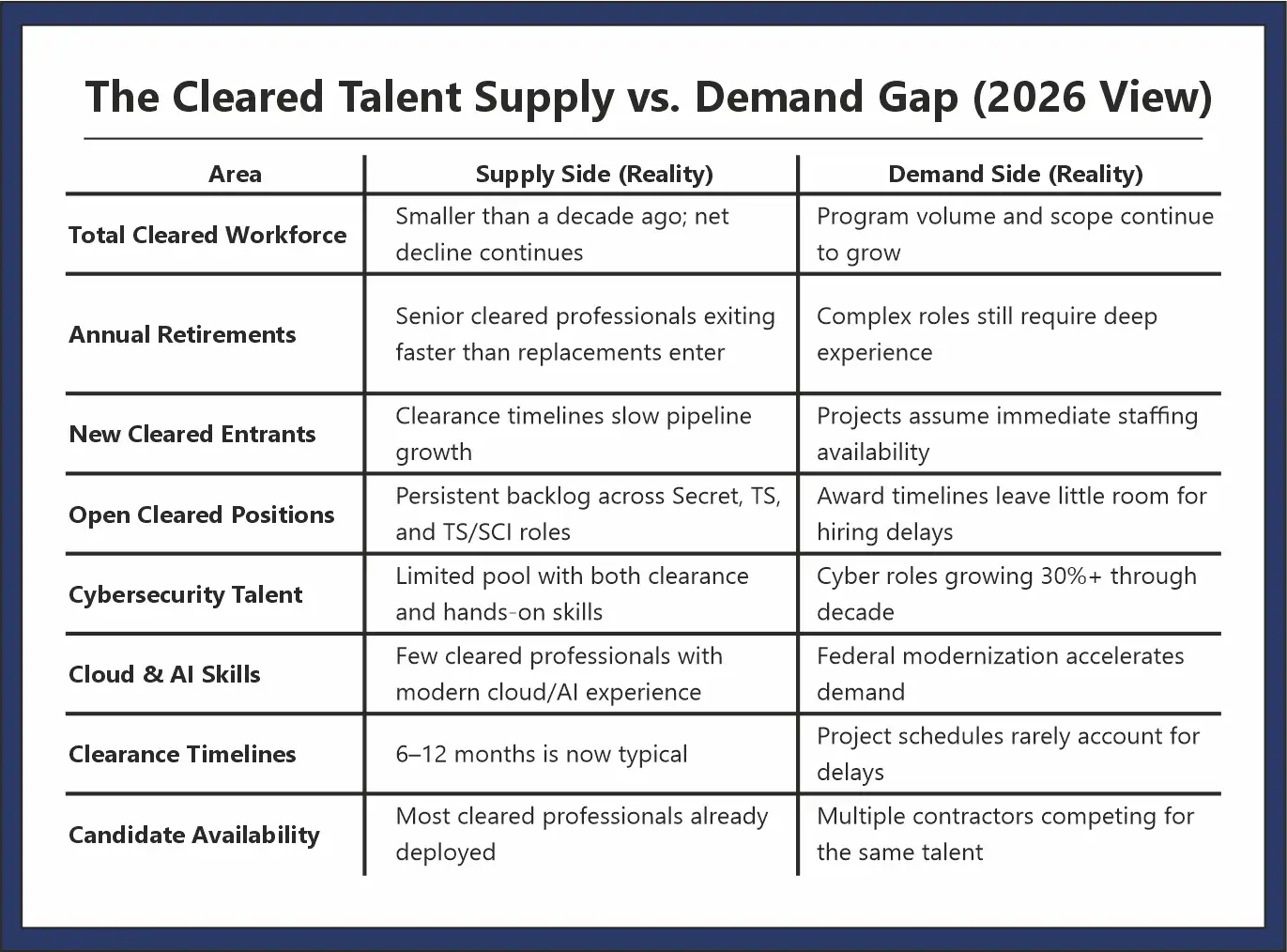
The contractors who are winning in 2026 aren’t ignoring these constraints. They’re building their hiring strategies around them.
Cleared talent Recruitment Trends
Lets begin....
Trend 1: AI Is Finally Being Used Where It Actually Helps
A few years ago, “AI recruiting” mostly meant buzzwords. In 2026, it’s much more practical.
Smart contractors are using AI to remove friction from the earliest stages of cleared hiring, resume screening, eligibility checks, and candidate prioritization. Instead of recruiters manually reviewing hundreds of resumes, AI tools flag candidates who meet baseline clearance criteria and highlight potential risk factors early.
The impact is measurable. Teams using AI-assisted workflows are cutting time-to-hire by 30 to 50 percent, without taking shortcuts on security or compliance.
What’s changed is how AI is being applied. It’s not making clearance decisions. It’s helping recruiters avoid dead ends, candidates who look good on paper but are unlikely to clear due to known disqualifiers.
In 2026, predictive clearance screening is becoming standard for Secret and Top Secret roles. The takeaway is simple: AI isn’t replacing recruiters. It’s helping them focus their time where it actually matters.
Trend 2: Skills Matter More Than Pedigree
There was a time when cleared hiring followed a rigid formula.
Degree from the “right” school.
Prior agency experience.
Specific job titles.
That formula is breaking down.
Contractors who shifted to skills-based hiring in 2025 filled cleared roles faster and with stronger long-term results. Instead of filtering candidates by credentials, they evaluated what candidates could actually do: secure cloud environments, manage DevSecOps pipelines, respond to incidents, or support classified systems.
This shift opened the door to a broader pool of talent. Veterans transitioning into civilian roles. Technologists from commercial environments. Bootcamp graduates with hands-on experience and strong clearance potential.
Agencies that embraced skills-based hiring didn’t lower standards. They clarified them.
In 2026, the question isn’t “Where did you work?” It’s “Can you do the job on day one?”
Trend 3: Remote Work Is No Longer Off the Table
For years, cleared work meant on-site, full stop.
That’s no longer true.
Secure collaboration platforms, hardened networks, and better access controls have changed what’s possible. In 2025, many agencies tested remote and hybrid models for non-SCI roles and the results were strong.
Candidates noticed.
Roughly 40 percent of cleared professionals now expect some level of flexibility. Contractors offering hybrid options saw higher acceptance rates and lower attrition, especially among mid-career talent.
This doesn’t mean classified work is going fully remote. It means contractors who understand where flexibility is allowed have a recruiting advantage over those who default to rigid models. In 2026, flexibility isn’t a perk. It’s part of the hiring equation.
Trend 4: Compensation Is Decided Earlier, and Candidates Know Their Worth
One of the most common reasons offers fall apart is simple: money.
In 2025, nearly half of cleared candidates walked away from offers because of competing compensation. Cybersecurity, cloud, and engineering professionals routinely commanded 15 to 20 percent premiums, especially in high-cost regions.
Candidates are also less patient.
If salary ranges aren’t discussed early, they disengage. Contractors who published pay bands upfront saw significantly higher acceptance rates and fewer late-stage surprises.
The market has shifted power toward the candidate, and in 2026 that trend isn’t reversing.
Winning contractors are transparent, competitive, and realistic about what it takes to close cleared talent.
Trend 5: Pre-Cleared Talent Is No Longer a Nice-to-Have
When clearance timelines stretch into months, waiting is not a strategy.
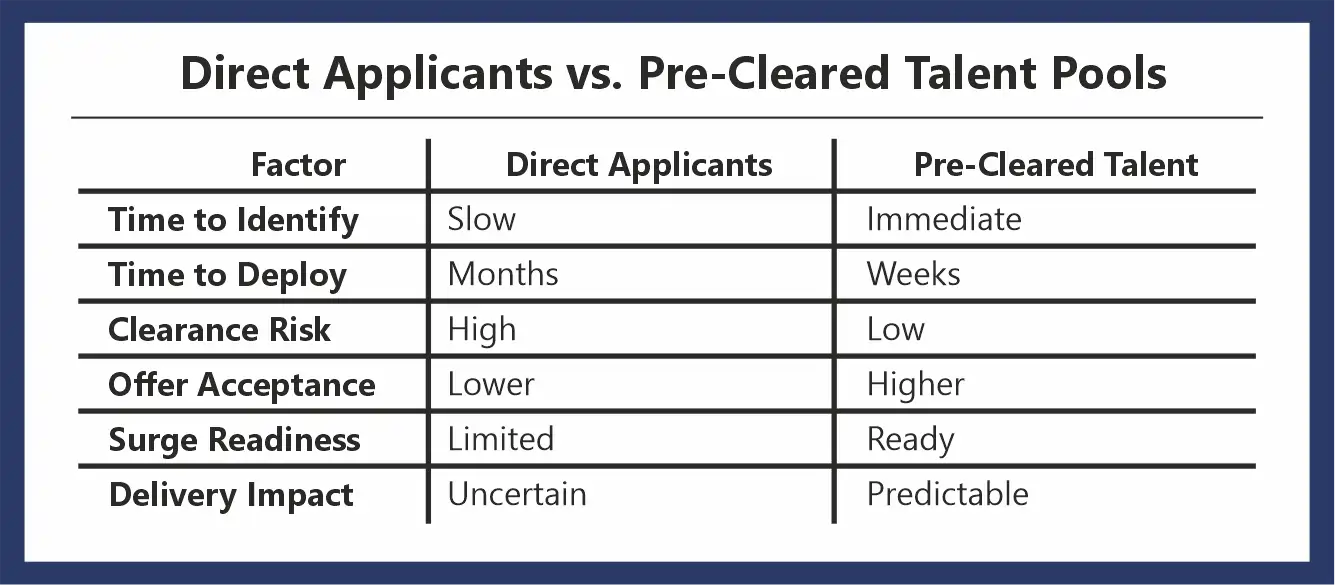
In 2025, staffing partners and pre-cleared talent networks filled a majority of high-priority cleared roles in areas like cyber and cloud. Contractors who relied only on direct applicants struggled to keep pace with award timelines.
Pre-cleared talent pools allow contractors to deploy teams quickly, reduce risk, and protect delivery commitments, especially during surge periods.
This isn’t about outsourcing recruiting. It’s about having bench strength before you need it.
In 2026, contractors that build relationships with cleared talent partners aren’t reacting to demand. They’re planning for it.
Trend 6: Diversity Is Expanding the Cleared Pipeline
Cleared hiring has long drawn from the same narrow networks. That’s changing.
Contractors that invested in broader outreach-veterans, underrepresented communities, and alternative training pathways, saw measurable gains in both diversity and retention.
More importantly, they expanded their available talent pool at a time when every cleared hire counts.
Diversity initiatives aren’t just about optics. They’re about resilience. Teams with varied backgrounds bring different problem-solving approaches, which matters in complex federal environments.
In 2026, inclusive hiring is a practical strategy for growing the cleared workforce.
What Still Trips Contractors Up?
Even with better tools and strategies, some challenges persist.
Clearance denials increased in 2025, often tied to financial issues or foreign influence concerns. Geopolitical tensions led to tighter scrutiny. Delays remained unpredictable.
The contractors who navigated these challenges best had a few things in common:
They pre-screened candidates intelligently.
They hired uncleared staff for non-sensitive work when appropriate.
They monitored clearances continuously instead of treating them as one-time events.
They sourced talent across multiple channels instead of relying on a single job board.
They treated cleared hiring as a system, not a transaction.
How Federal Contractors Are Adjusting in 2026?
The most effective contractors are making deliberate changes:
They map clearance requirements to project timelines early.
They build pre-cleared benches instead of scrambling post-award.
They prioritize skills over credentials.
They communicate compensation clearly and early.
They invest in recruiting technology that reduces friction.
They measure retention and diversity, not just hires.
These aren’t dramatic shifts. They’re disciplined ones.
The Reality of Cleared Hiring in 2026
Cleared talent recruitment is more competitive, more complex, and more consequential than ever.
Contractors who treat hiring as an afterthought feel the impact in delayed deployments, strained teams, and performance risk. Those who modernize their approach move faster, spend less, and deliver with confidence.
In 2026, cleared hiring isn’t about finding people. It’s about being ready when the work starts.
So, are you ready to hire cleared talent without the wait?
Hire Cleared Talent connects federal contractors with pre-screened, cleared professionals across cybersecurity, IT, engineering, and mission-critical roles.
No long clearance queues.
No last-minute scrambling.
Just talent that’s ready when you need it.
Post your job or partner with us at www.hireclearedtalent.com because in federal contracting, speed and readiness make all the difference. Still facing any challenge?
Schedule a consultation with our experts
FAQ
Q1. How are federal contractors reducing time-to-hire for cleared roles in 2026?
A-Federal contractors are shortening hiring cycles by using AI-assisted screening, building pre-cleared talent benches, and partnering with cleared staffing networks. These approaches reduce dependency on long clearance timelines and help deploy candidates in weeks instead of months.
Q2. Why is pre-cleared talent becoming more important than clearance sponsorship?
A-Clearance sponsorship timelines are increasingly unpredictable, often exceeding six months. Pre-cleared talent allows contractors to meet task order deadlines, avoid deployment delays, and reduce delivery risk, especially for surge hiring and recompete transitions.
Q3. What types of cleared roles are hardest to fill right now?
A-Cybersecurity, cloud engineering, DevSecOps, and data platform roles remain the most difficult to fill due to overlapping commercial demand, higher compensation expectations, and stricter security requirements at the Secret, TS, and TS/SCI levels.
Q4. How are contractors using AI in cleared recruiting without increasing security risk?
A-AI is primarily used for resume screening, eligibility pre-checks, and candidate prioritization, not clearance adjudication. When implemented correctly, it reduces manual workload while maintaining compliance with federal security standards.
Q5. Is skills-based hiring actually working for cleared positions?
A-Yes. Contractors that focus on validated technical skills instead of credentials alone are filling cleared roles faster and retaining talent longer. Skills-based hiring also expands the candidate pool without lowering security or performance standards.
Q6. How does remote or hybrid work affect cleared hiring in 2026?
A-For non-SCI roles, hybrid and limited remote work options significantly improve candidate acceptance and retention. Secure collaboration tools now support distributed cleared teams where security policies allow.
Q7. What compensation trends are influencing cleared talent decisions?
A-Cleared professionals in high-demand roles expect transparent pay ranges and competitive premiums. Contractors offering clear compensation upfront are seeing higher acceptance rates and fewer late-stage offer declines.
Q8. Why are cleared candidates rejecting offers late in the hiring process?
A-The most common reasons include compensation misalignment, lack of flexibility, slow hiring timelines, and competing offers from agencies or primes that move faster or communicate more clearly.
Q9. How are clearance denials impacting federal contractors in 2026?
A-Clearance denials have increased due to stricter financial and foreign influence reviews. Contractors are mitigating risk by pre-vetting candidates earlier and avoiding reliance on clearance sponsorship for time-sensitive roles.
Q10. What sourcing channels are performing best for cleared hiring?
A-High-performing contractors use a mix of clearance-specific job boards, veteran networks, LinkedIn, niche cleared platforms, and direct partnerships with vetted cleared talent providers rather than relying on a single chann
Weekly newsletter
Get the latest blog updates, practical hiring insights, and featured reads delivered straight to your inbox.
Read about our Privacy Policy.