


Security Cleared Staffing Shortages 2026: Why Hiring Timelines Are Breaking
In early 2026, a mid-sized defense contractor in Virginia won a prime subcontract supporting a DoD modernization initiative. The scope was clear. The funding was approved. The technical stack was defined.
The only problem?
They needed 18 security-cleared cybersecurity engineers within 90 days.
By day 120, only six positions were filled. Two candidates withdrew after counteroffers. Three were still in adjudication. One failed to disclose foreign financial ties, restarting the investigation process.
The contract timeline did not shift. The staffing pipeline did.
This story is not unusual. It reflects a broader reality in the cleared hiring ecosystem: security-cleared staffing shortages are extending hiring timelines beyond what programs can tolerate.
At HireClearedTalent, we see this pattern across defense contractors, intelligence community suppliers, aerospace firms, and federal IT integrators. The demand is real. The talent pool is finite. And the traditional hiring model is breaking under pressure.
The 2026 Cleared Workforce Reality
The cleared workforce remains one of the most specialized labor segments in the United States.
According to the Office of the Director of National Intelligence’s Annual Report on Security Clearance Determinations, approximately 4.2 million individuals hold security clearances at various levels.
However, holding clearance eligibility does not mean those individuals are actively seeking new roles. A significant percentage are already embedded in programs, under non-compete restrictions, or unwilling to relocate.
At the same time, compensation continues to rise.
The 2025 Security Clearance Compensation Report states that average total compensation for cleared professionals hit an all-time high of $119,131, a nearly 4% rise from the prior year.
For employers, this signals sustained competition. For programs operating on federal contract timelines, it signals risk.
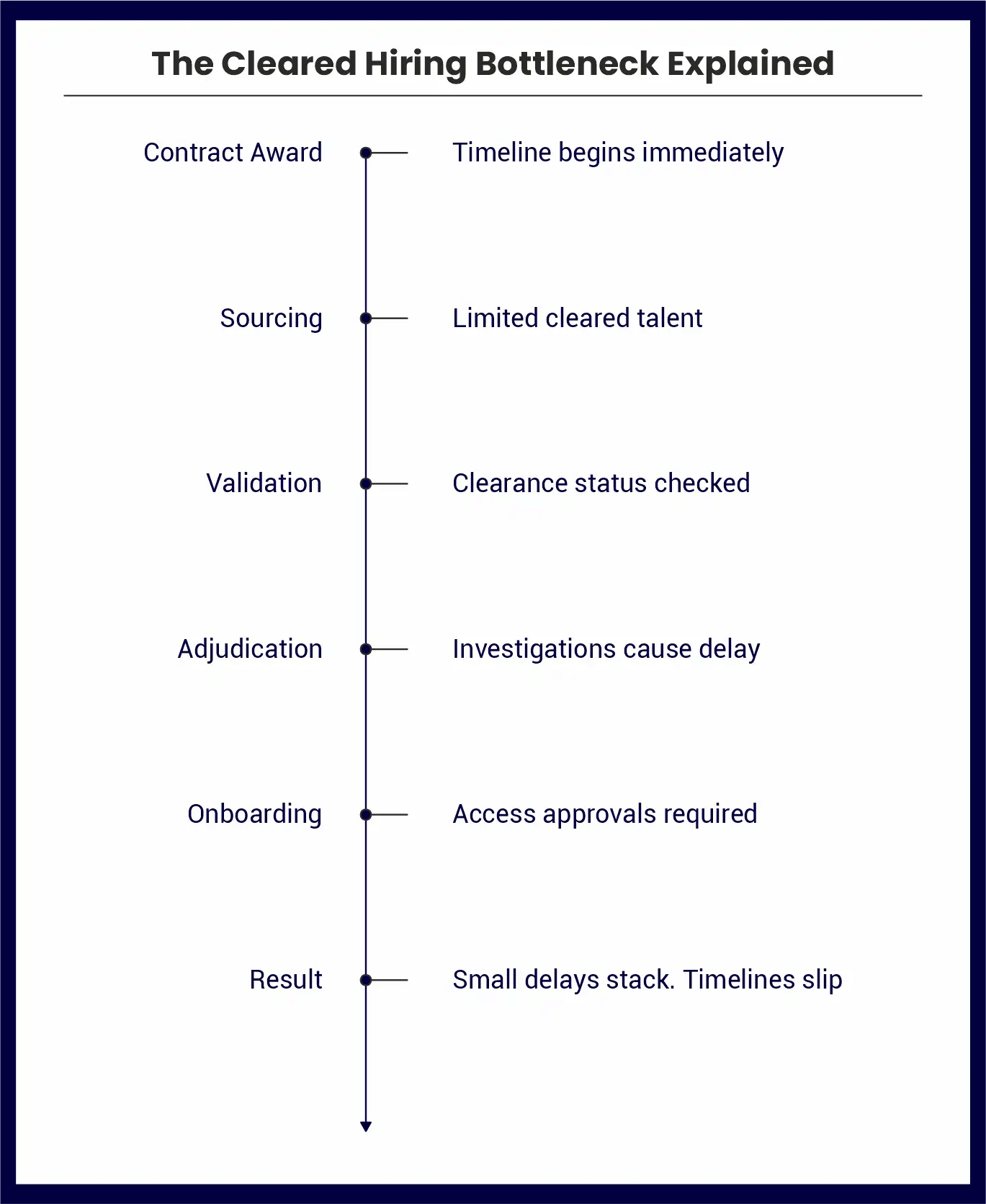
Why Hiring Timelines Are Breaking?
Cleared hiring delays are not caused by one factor. They are the result of structural pressure points converging at once.
1. Clearance Processing Still Takes Time
Although the government has reduced investigation backlogs significantly since peak delays in 2018–2019, clearance adjudication still requires months depending on level and case complexity.
Top Secret and SCI investigations remain more intensive than Secret-level reviews.
Investigations involve SF-86 disclosures, reference interviews, financial reviews, and foreign contact verification. Even minor omissions can delay adjudication.
Contractors that depend on “clearance-eligible” hires often underestimate the time required to convert eligibility into access.
2. Cybersecurity Demand Outpaces Supply
The Bureau of Labor Statistics projects 29 percent growth for information security analysts through 2032, far faster than the national average.
When you overlay this national cybersecurity shortage with clearance requirements, the talent pool narrows dramatically.
A cleared DevSecOps engineer is not just a cybersecurity professional. They are a cleared cybersecurity professional with experience in federal environments.
That intersection is limited.
3. Compensation Inflation Is Accelerating Turnover
Nearly half of cleared professionals now earn six figures, according to ClearanceJobs compensation reporting.
In practical terms, this means candidates receive multiple offers. Counteroffers are common. Signing bonuses are increasing.
We recently worked with a contractor that lost three cleared network engineers in the final negotiation phase because a competitor offered remote flexibility and a 12 percent salary premium.
Hiring timelines break when offer acceptance becomes uncertain.
Read more: Cleared Talent Recruitment: Key Trends Federal Contractors Need to Know in 2026
4. Geographic Constraints Limit Mobility
Many classified programs require on-site presence in secure facilities. Unlike commercial IT roles, cleared professionals cannot always work remotely.
If a program requires relocation to Colorado Springs, Huntsville, or Northern Virginia, the candidate pool shrinks further.
Remote flexibility is no longer a perk. It is a competitive differentiator. In cleared environments, that flexibility is limited.
5. Certification and Compliance Requirements Add Friction
DoD 8140 baseline certification requirements continue to influence hiring decisions. Many contractors require certifications such as CompTIA Security+ before onboarding.
Candidates without required baseline credentials cannot access networks even if technically strong.
This creates a compliance bottleneck layered on top of clearance requirements.
Real Example: A Delayed Federal Program
In Q1 2026, a systems integrator supporting a federal cloud migration program needed 12 cleared cloud security engineers.
They assumed active clearance alone would be sufficient.
What they overlooked:
• Half of shortlisted candidates lacked DoD 8140 baseline certifications.
• Two candidates failed to fully disclose foreign financial ties.
• Three candidates withdrew after extended adjudication timelines.
The result was a four-month staffing delay that triggered contractual performance concerns.
The problem was not a lack of resumes. It was a lack of fully qualified, compliant, ready-to-deploy cleared talent.
The Financial Impact of Cleared Staffing Delays
Cleared hiring delays impact more than HR metrics.
They affect:
• Contract performance
• Award eligibility for recompetes
• Program milestone delivery
• Client trust
When positions remain unfilled, overtime costs rise. Burnout increases. Team morale declines. In competitive federal contracting, timeline slippage carries real revenue consequences.
The Sponsorship Bottleneck
Many employers attempt to solve shortages by hiring clearance-eligible candidates and sponsoring investigations.
While this can work, it introduces additional risk:
• Investigation timelines remain variable.
• Adjudication outcomes are not guaranteed.
• Program access cannot begin until clearance is finalized.
This approach requires pipeline forecasting, not reactive hiring.
The Veteran Transition Opportunity
Veterans represent a critical pipeline for the cleared workforce. Many exiting service members hold active or recently expired clearances.
However, transition friction remains.
Veterans often struggle with:
• Translating military experience into contractor language
• Understanding certification requirements
• Identifying programs aligned to clearance level
Organizations that proactively support veteran transition shorten hiring cycles.
What Is Breaking the Timeline Model?
The traditional cleared hiring model assumes:
Post job → Screen resumes → Extend offer → Begin work
In 2026, the model looks more like:
Forecast contract award → Pre-engage talent → Validate certification compliance → Confirm clearance level → Structure offer quickly → Secure acceptance before counteroffers
Speed is no longer optional. It is strategic.
Read more: How to Recruit Cleared Talent Faster: A Practical Playbook for 2026
How Employers Can Adapt?
1. Build Pre-Cleared Talent Pipelines
Develop relationships with cleared professionals before contracts are awarded. Maintain an active bench so hiring begins immediately when requisitions open.
2. Validate Certification Alignment Early
Confirm DoD 8140 and other baseline certifications during initial screening. This prevents late-stage offer delays due to compliance gaps.
3. Shorten Interview Cycles
Limit interview rounds and accelerate decision-making. Extended timelines increase the risk of counteroffers and candidate withdrawal.
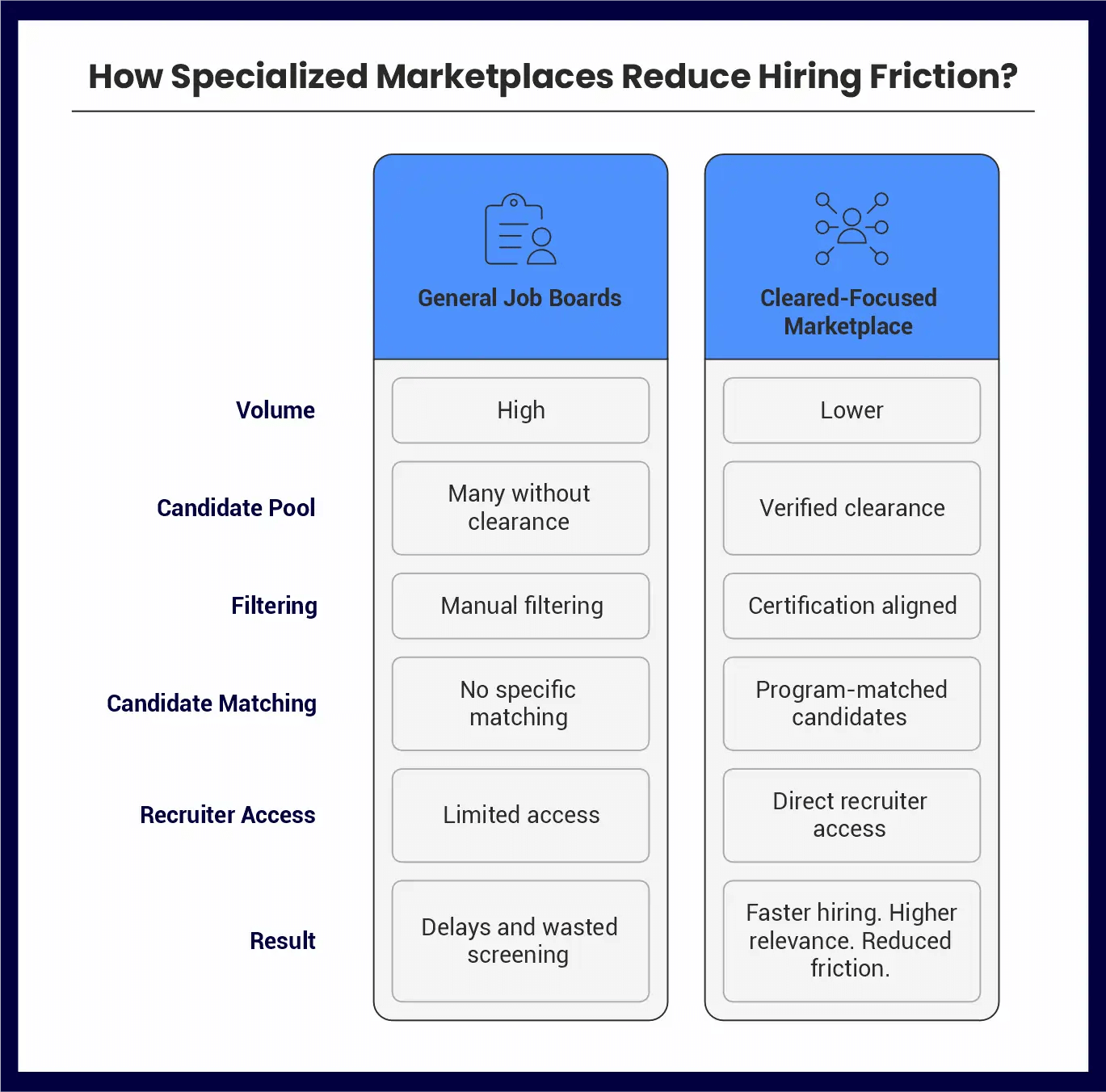
4. Leverage Specialized Cleared Hiring Marketplaces
Use platforms focused exclusively on cleared talent. Targeted visibility improves relevance, speeds sourcing, and reduces wasted screening effort.
How HireClearedTalent Helps?
HireClearedTalent was built to address the inefficiencies that slow down security-cleared hiring. Our platform connects active clearance holders, clearance-eligible professionals, and verified federal contractors within one focused marketplace.
By enabling clearance level verification, contract-aligned role matching, and direct recruiter engagement, we reduce sourcing friction and shorten hiring timelines. Instead of broad outreach across general job boards, employers gain access to a targeted cleared ecosystem. For candidates, this means fewer irrelevant applications and stronger visibility within programs that align with their clearance level and experience.
Conclusion: The Cleared Hiring Model Must Evolve
Security-cleared staffing shortages in 2026 are not temporary. They are structural.
Compensation is rising. Cyber threats are expanding. Clearance requirements remain stringent. And federal contract timelines are not slowing down.
Hiring timelines break when employers rely on outdated sourcing models.
They improve when organizations:
• Forecast early
• Align certification and clearance strategy
• Use specialized marketplaces
• Engage candidates before urgency hits
For contractors navigating competitive federal programs, the margin for staffing delay is shrinking. If you are hiring cleared professionals, create an employer profile on HireClearedTalent and connect with verified clearance-ready talent today.
If you are preparing to enter the cleared cybersecurity workforce, explore CCS Learning Academy’s Security+ eLearning pathway and position yourself for DoD-compliant roles.
Remember, the cleared workforce is not growing fast enough to meet demand. Preparation and precision will define who wins in 2026. Ready to discuss more about the security-cleared hiring strategy or career path?
Schedule a call with our experts
FAQ-
Q1: Why are security-cleared hiring timelines longer in 2026?
A: Hiring timelines are extending due to a limited cleared talent pool, rising compensation competition, certification compliance requirements, and ongoing clearance investigation processing times.
Q2: How long does it take to hire a cleared professional in 2026?
A: Timelines vary by clearance level and role complexity, but hiring can take several weeks to several months, especially when clearance sponsorship or certification alignment is required.
Q3: What is causing the shortage of cleared cybersecurity professionals?
A: The shortage is driven by growing national cybersecurity demand, limited clearance holders in high-demand specialties, and federal contract requirements that restrict the available talent pool.
Q4: Does clearance sponsorship slow down hiring?
A: Yes. When employers hire clearance-eligible candidates instead of active clearance holders, investigation and adjudication timelines can delay onboarding.
Q5: Why are security-cleared candidates receiving multiple offers?
A: Compensation growth, program urgency, and limited supply create strong competition. Cleared professionals often receive counteroffers and competing contract opportunities.
Q6: How do DoD 8140 certification requirements impact hiring timelines?
A: Baseline certification requirements can delay hiring if candidates lack required credentials such as Security+. Compliance gaps discovered late in the process often stall onboarding.
Q7: Are federal contractors struggling more than government agencies with staffing delays?
A: Contractors often face more timeline pressure because contract performance deadlines remain fixed while cleared talent availability fluctuates.
Q8: What roles are most affected by cleared staffing shortages?
A: Cybersecurity engineers, cloud security specialists, DevSecOps professionals, systems administrators, and intelligence analysts are among the hardest roles to fill.
Q9: How can employers reduce cleared hiring delays?
A: Employers can build pre-cleared pipelines, validate certification requirements early, shorten interview cycles, and use specialized cleared hiring marketplaces.
Q10: Is remote work helping solve cleared staffing shortages?
A: Remote flexibility helps attract candidates, but many classified programs require on-site access, limiting full remote options in cleared environments.
Weekly newsletter
Get the latest blog updates, practical hiring insights, and featured reads delivered straight to your inbox.
Read about our Privacy Policy.