


Everything looked aligned at the outset. The task order was awarded on schedule. Funding cleared without delay. The kickoff date was confirmed and shared across the team. And yet, by week four, half the roles remained unfilled.
Recruiting activity was not the issue. Job postings were active. Candidates moved through screening. Interviews were conducted. On paper, the process appeared disciplined. But cleared hiring rarely fails in process. It fails in timing.
By the time clearance eligibility was verified, competing offers had already closed. By the time onboarding was scheduled, project milestones had slipped. The program manager was no longer asking if positions would be filled, only how much delay the contract could tolerate.
This pattern surfaced repeatedly across federal contracting in 2025. It is why many contractors are reevaluating how they secure cleared talent in 2026. Speed now determines delivery. Delay drives disruption.
Why Cleared Hiring Slowed Down-Even as Demand Increased?
Cleared hiring didn’t suddenly become harder because recruiters forgot how to recruit. It became harder because the environment changed.
The total number of people with security clearances in the U.S. declined from a peak of about 5.1 million in 2013 to roughly 4.3 million in 2015, reflecting a broader downward trend in the cleared population over recent years. At the same time, demand accelerated.
The Bureau of Labor Statistics projects strong growth for cybersecurity roles - with employment of information security analysts expected to increase about 29% from 2024 to 2034, much faster than the average for all occupations.
Recruiting cleared talent became less about finding candidates, and more about removing friction from every step of the process.
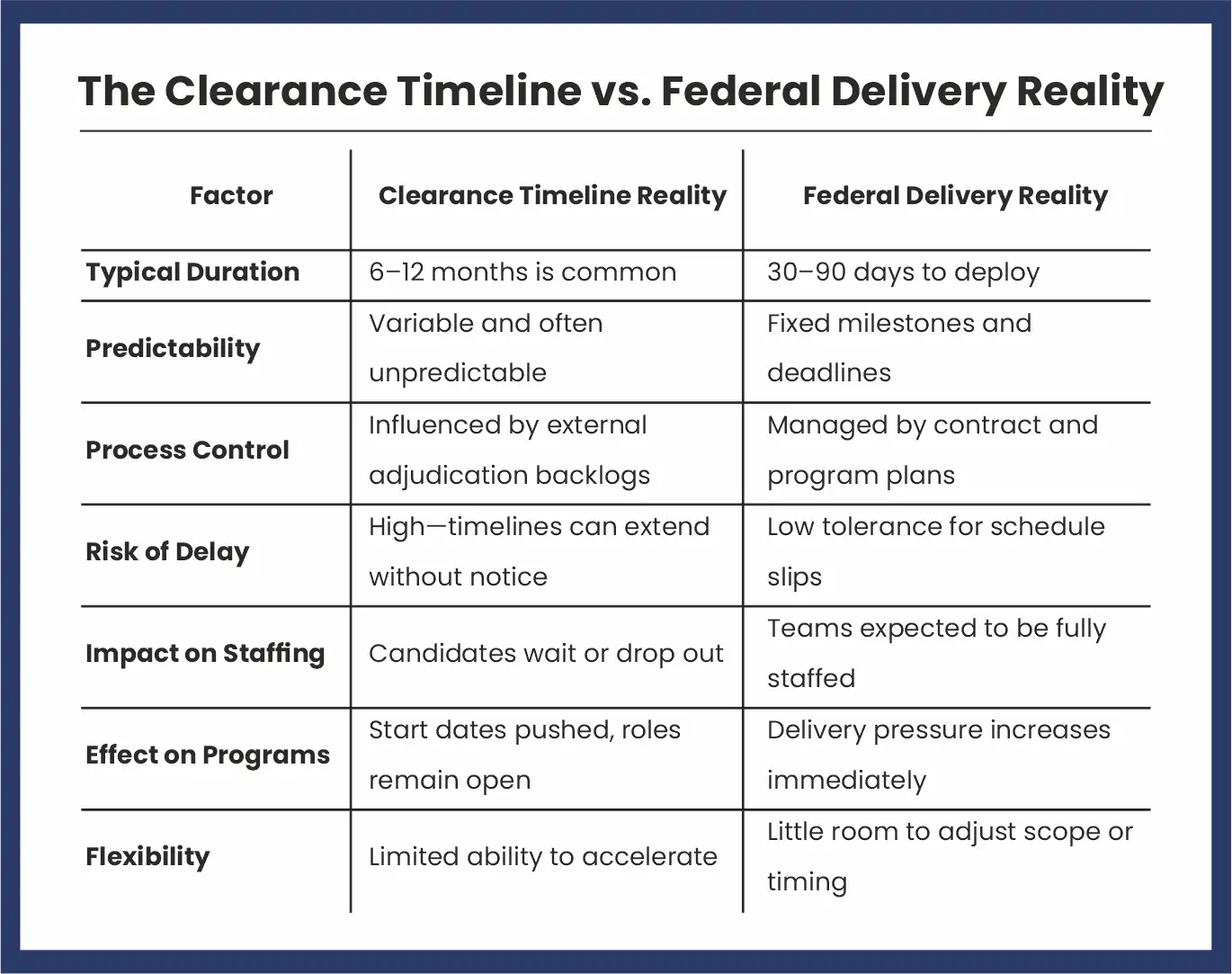
The Core Problem: Traditional Recruiting Models Move Too Slowly
Most cleared hiring delays don’t start at interviews. They start upstream.
In 2025, many contractors relied heavily on direct applicants. Job postings generated volume, but volume didn’t translate into readiness. Candidates lacked active clearances, had expired investigations, or carried eligibility risks that surfaced late in the process.
Recruiters spent weeks validating clearance claims. Program teams waited. Candidates disengaged as timelines stretched. Competing offers moved faster.
The result was predictable:
Open roles stayed open.
Delivery pressure increased.
Costs crept up quietly.
The contractors that moved faster in 2025 didn’t work harder. They worked differently.
The 2026 Mindset Shift: Speed Is Designed, Not Chased
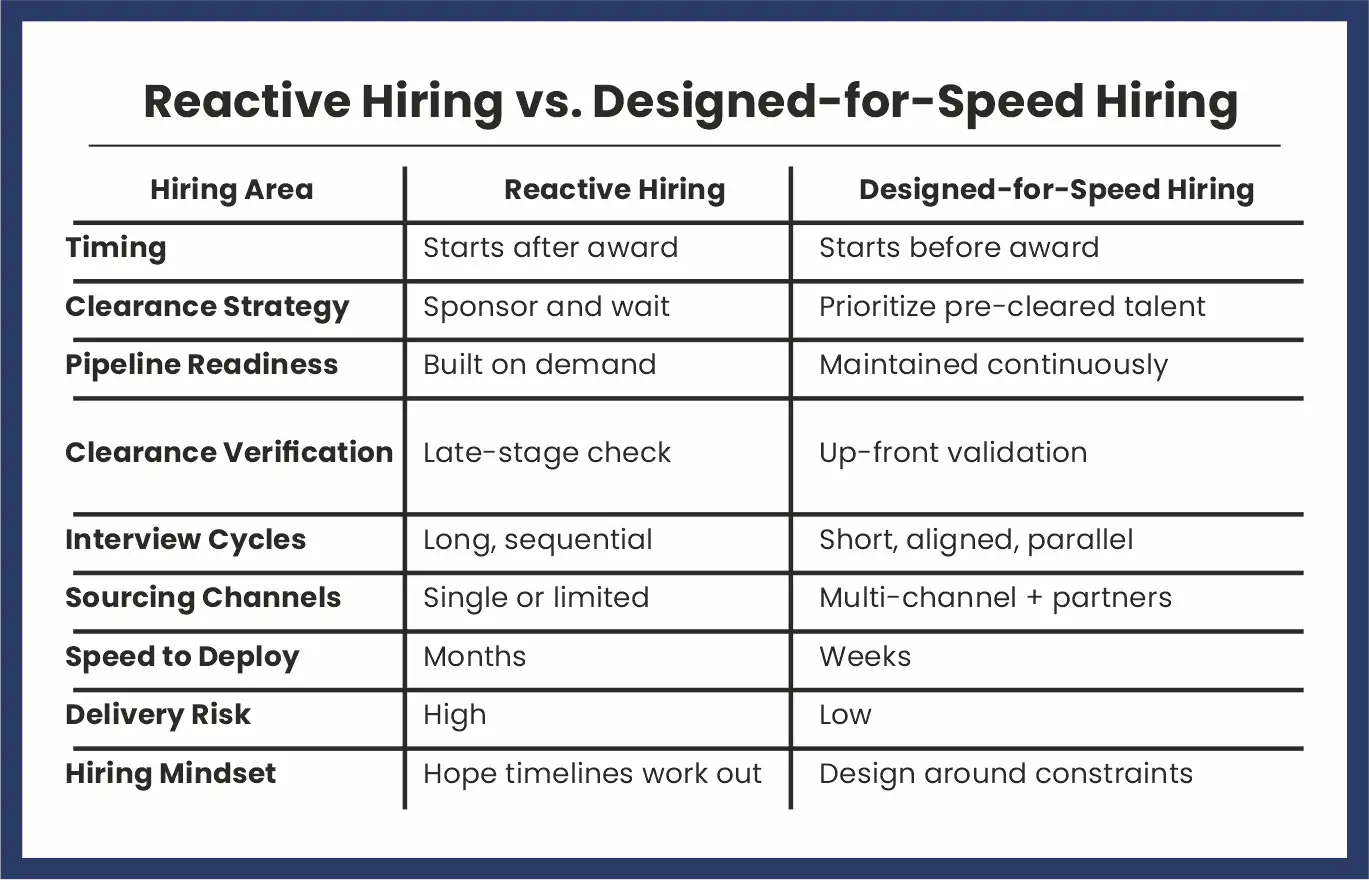
The fastest-cleared hiring teams don’t scramble after awards. They plan before them.
In 2025, staffing partners and pre-cleared talent networks filled the majority of high-priority cleared roles in cyber and cloud. This wasn’t outsourcing recruiting, it was redesigning the pipeline.
The shift was subtle but powerful:
From reactive hiring → to pipeline readiness.
From clearance sponsorship → to clearance certainty.
From post-award scrambling → to pre-award planning.
This mindset is the foundation of recruiting cleared talent faster in 2026.
Playbook Step 1: Identify “Speed-Critical” Roles Early
Not every cleared role needs to be filled immediately. The fastest recruiters know which ones do. In 2025, high-performing contractors began classifying roles during capture and proposal stages:
Speed-critical roles: Cybersecurity, cloud, DevSecOps, intelligence support.
Flexible roles: Positions that can ramp later or tolerate interim coverage.
By identifying speed-critical roles early, recruiting teams focused their fastest pipelines where delays would hurt most. This one step alone reduced last-minute hiring pressure.
Playbook Step 2: Build Access to Pre-Cleared Talent-Before You Need It
Waiting for clearance processing is not a strategy when timelines stretch into months.
In 2025, contractors that partnered with pre-cleared talent networks consistently deployed teams faster than those relying only on applicants. The advantage wasn’t volume-it was certainty.
Pre-cleared talent pools offered:
Verified active clearances
Known availability
Lower denial risk
Faster onboarding
Time to identify candidates dropped from weeks to days. Time to deploy shrank from months to weeks. Offer acceptance improved because candidates weren’t waiting indefinitely to start.
Bench strength became a competitive advantage.
Playbook Step 3: Reduce Friction in the First 10 Days
In cleared hiring, the first 10 days decide the outcome.
In 2025, contractors who streamlined early-stage steps-resume review, clearance validation, and scheduling-filled roles significantly faster. Those who didn’t lost candidates before interviews even finished.
Practical changes that worked:
Verifying clearance status up front.
Shortening interview cycles.
Aligning hiring managers before sourcing began.
Making compensation ranges clear early.
Speed didn’t mean cutting corners. It meant removing unnecessary delays.
Playbook Step 4: Compete on Transparency, Not Just Pay
Compensation matters, but clarity matters just as much.
In 2025, nearly 43% of cleared candidates disengaged late in the hiring process due to compensation misalignment or unclear timelines. Contractors who published salary ranges and realistic start dates saw higher acceptance rates.
Candidates with active clearances had leverage. They chose employers who respected their time and communicated clearly. Faster recruiting isn’t only about sourcing speed. It’s about decision speed.
Playbook Step 5: Use Partners to Absorb Surge, Not Replace Recruiting
The fastest contractors didn’t replace internal recruiting teams. They reinforced them.
During surge periods-Q2 and Q4, when multiple task orders landed at once, internal teams handled core hiring while staffing partners absorbed overflow. This prevented burnout and kept timelines intact.
In 2025, contractors that used partners strategically:
Reduced delivery risk.
Maintained consistent deployment timelines.
Avoided premium last-minute staffing costs.
The key was partnership, not dependency.
What Slows Contractors Down the Most?
Across 2025, the same mistakes surfaced repeatedly:
Waiting until after award to source cleared talent.
Treating clearance verification as a late-stage task.
Running long interview cycles for speed-critical roles.
Relying on one sourcing channel.
Assuming clearance timelines would “work themselves out”.
The fastest contractors didn’t avoid challenges. They designed around them.
The Hidden Cost of Slow Cleared Hiring
When cleared roles stay open, the cost isn’t always visible on a hiring dashboard.
It shows up as:
Overtime and burnout
Interim contractor premiums
Missed milestones
Increased customer scrutiny
Long-term CPARS exposure
In 2025, many contractors learned that slow hiring quietly erodes margins and trust.
Faster recruiting protects more than schedules, it protects relationships.
What Recruiting Cleared Talent Faster Really Means in 2026?
Recruiting cleared talent faster doesn’t mean rushing decisions. It means eliminating uncertainty.
The contractors winning in 2026 are:
Planning pipelines during capture.
Building access to pre-cleared talent.
Reducing early-stage friction.
Communicating clearly with candidates.
Treating cleared hiring as a strategic function.
The Bottom Line
Cleared hiring in 2026 rewards preparation, not panic.
Federal contractors that rely on traditional recruiting models will continue to feel pressure from clearance delays and candidate competition.
Those that follow a practical, speed-focused playbook will deploy teams faster, reduce risk, and deliver with confidence.
Recruiting cleared talent faster isn’t about doing more. It’s about doing the right things earlier.
Ready to Recruit Cleared Talent Faster?
Hire Cleared Talent helps federal contractors access pre-screened, actively cleared professionals across cybersecurity, cloud, engineering, and mission-critical roles.
If you want to reduce hiring delays, protect delivery timelines, and build cleared bench strength for 2026, visit here.
Want to discuss your cleared hiring strategy and upcoming needs, because in federal contracting, speed and readiness decide who wins?
FAQ
Q1. What slows cleared hiring down the most in 2026?
A-The biggest slowdowns come from late clearance verification, long interview cycles, post-award sourcing, and relying on a single candidate pipeline. Clearance timelines didn’t change, but hiring models often haven’t adapted to that reality.
Q2. How can federal contractors reduce time-to-hire for cleared roles?
A-Contractors reduce time-to-hire by verifying clearance status upfront, prioritizing speed-critical roles, shortening interview cycles, and maintaining access to pre-cleared talent instead of starting from scratch after award.
Q3. Why is waiting until after award no longer viable for cleared hiring?
A-Post-award sourcing collides with clearance timelines that can stretch six to twelve months. Contractors who wait often miss deployment windows and are forced into costly stopgap measures.
Q4. What role does pre-cleared talent play in faster hiring?
A-Pre-cleared talent removes clearance uncertainty from the timeline. Contractors can deploy candidates in weeks instead of months, reducing risk and improving offer acceptance rates.
Q5. When should clearance verification happen in the hiring process?
A-Clearance verification should happen before interviews begin. Late-stage verification is one of the most common causes of lost time and candidate drop-off in cleared hiring.
Q6. How do fast contractors handle interview cycles for cleared roles?
A-They align hiring managers early, limit interview rounds for speed-critical roles, and run parallel interviews when possible. Top cleared candidates rarely wait through long, sequential interview processes.
Q7. What sourcing strategies work best for cleared talent in 2026?
A-The fastest teams use multi-channel sourcing that includes cleared job boards, talent networks, referrals, and staffing partners. Relying on one channel limits both speed and coverage.
Q8. Why do cleared candidates disengage late in the hiring process?
A-Late disengagement is often driven by compensation misalignment, unclear timelines, and slow decision-making. Candidates with active clearances typically have multiple options.
Q9. How does compensation affect speed in cleared recruiting?
A-Competitive and transparent compensation speeds decisions. Contractors who publish ranges and discuss pay early see higher acceptance rates and fewer late-stage drop-offs.
Q10. What hiring metrics matter most for recruiting cleared talent faster?
A-Beyond time-to-hire, contractors should track clearance verification time, offer acceptance rates, candidate drop-off points, and time-to-deploy after offer acceptance
Weekly newsletter
Get the latest blog updates, practical hiring insights, and featured reads delivered straight to your inbox.
Read about our Privacy Policy.