


Most clearance problems start small. They get serious when they go unreported, or when someone tries to explain them away after the fact.
That's why any useful list of security clearance do's and don'ts starts with reporting. The rules aren't complicated, but the system behind them changed in 2026. Continuous vetting now flags problems much more quickly than the old five- and ten-year reinvestigation cycle did.
At HireClearedTalent, our recruiters work with cleared professionals every day and the people who keep their clearances in good standing tend to have similar habits. This is what they do, and what they don’t.
Security Clearances and Continuous Vetting- A Quick Look
A security clearance means that the government has determined you are eligible to access classified information up to a certain level, i.e., Confidential, Secret or Top Secret.
SCI and special access programs sit on top of those levels as extra controls. Eligibility alone doesn't give you access. You also need a job that requires it, a need-to-know, a security briefing, and a signed nondisclosure agreement.
Adjudicators make eligibility decisions using the 13 adjudicative guidelines in SEAD 4. They cover personal conduct, finances, foreign influence, drug involvement, handling protected information, and use of IT systems, among others. Nearly every item on this list ties back to one of them.
Two changes in 2026 affect how you keep your clearance.
Periodic reinvestigations are over for contractors
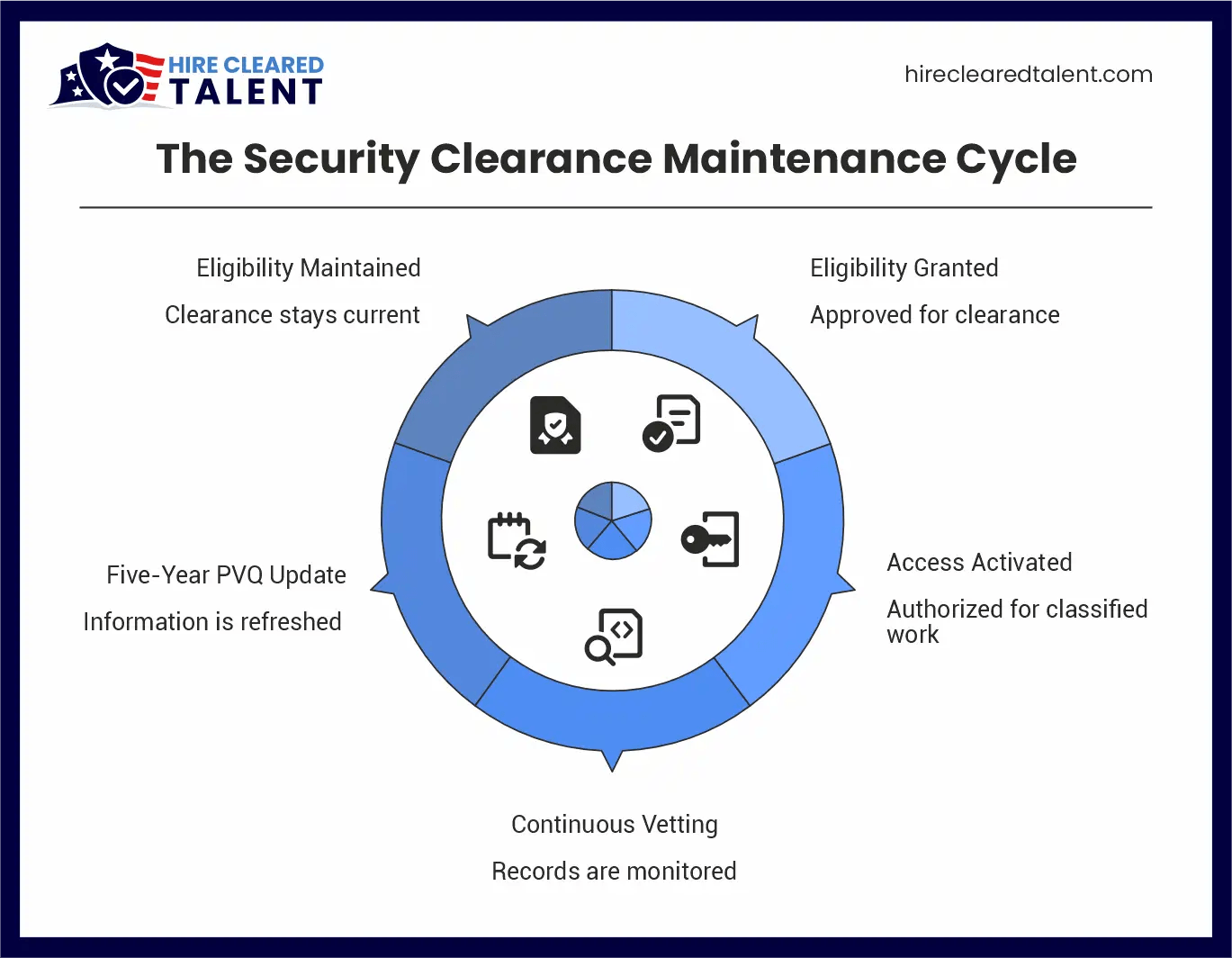
DCSA's April 2026 guidance says periodic reinvestigations for NISP contractor national security personnel will no longer be conducted. Instead, you'll submit an updated Personnel Vetting Questionnaire, currently the SF-86 eApp and releases, every five years at every clearance level. The clock runs from the PVQ date in DISS. Intelligence community and special access customers may ask for more.
Continuous vetting never stops
Automated checks pull criminal, financial, and public records between questionnaires, and the volume is significant.
At a recent industry advisory meeting, the Energy Department reported that for its roughly 121,000 enrolled cleared individuals, the continuous evaluation system flagged 502,385 alerts in a single quarter.
Security Clearance Do's for Cleared Employees
Follow All Security Protocols and Procedures
Security procedures are there to prevent the kind of incidents that end careers. Badge in and out, follow the rules for secure spaces, and treat every checklist as required.
Pay close attention to personal devices. Phones, smartwatches and fitness trackers are frequently prohibited in secure spaces, and walking in by accident with one still counts as a security incident.
If a procedure is unclear, ask your facility security officer before proceeding. A two-minute question costs far less than an incident report.
Report Suspicious Activity to Your FSO
Your reporting duties go beyond your own life. SEAD 3 lists actions by other cleared people that you're expected to report to your FSO.
That includes anyone trying to get classified or protected information out of you, unusual interest in your work, pressure or offers that look designed to gain access, and contact with a known or suspected foreign intelligence entity.
Report what you saw, and don't investigate it yourself. Your FSO and the government will decide what it means.
Keep Your Security Clearance Records Accurate and Updated
Every questionnaire you file gets compared with the ones before it. Inconsistencies raise questions, even when the facts behind them are harmless.
Keep a running record of addresses, employers, foreign travel, foreign contacts, and dates, so your next five-year PVQ lines up with what you reported before. Keep your clearance details handy too: clearance level, investigation type and date, polygraph type and date if you had one, and your last day in access. Your next FSO will ask for all of it.
Your eligibility generally stays current for about 24 months after you leave access, so getting the dates right matters.
Safeguard Classified Information at Every Step
Handling protected information has its own adjudicative guideline, and mistakes here are among the hardest to recover from. Store classified material only in approved containers and systems.
Follow marking and handling requirements. Never place classified information on an unclassified system. Think you see a spill? Report it right away instead of trying to clean it up yourself.
Finish your debrief and return all badges, tokens, laptops and documents when leaving a program. Your nondisclosure agreement stays in force after your job ends.
Read more- Lost Your Security Clearance? Step-by-Step Guide to the Appeal Process
Security Clearance Don'ts for Cleared Employees
Do Not Disclose Classified Information
Listing your clearance level is common practice. Naming classified programs, code words, sensitive customers, or facility locations isn't.
Anything you publish needs review first. Under the NISPOM, at 32 CFR 117.15(h)(8), contractors can't release unclassified information about a classified contract to the public without prior review and approval. That can include articles, presentations, and resumes that go into too much detail.
Public AI tools count too. Pasting controlled or contract-related information into a public generative AI tool moves it outside approved systems. Use only the tools your company has approved for that kind of data.
Do Not Conceal Background Information on Clearance Forms
Leaving something off your questionnaire rarely stays hidden, especially with continuous vetting running. Falsification and lack of candor fall under SEAD 4's personal conduct guideline, so hiding a problem can turn one issue into two.
Knowingly false statements on federal forms can also bring criminal penalties under 18 U.S.C. 1001, and the SF-86 warns you about this on the form itself.
If you're unsure about a date or detail, say so and give your best estimate. An honest "approximately" is always better than a confident guess that turns out to be wrong.
Do Not Misuse Access Privileges or Need-to-Know
A clearance doesn't give you access to everything at your level. Access classified information only when your job requires it, even if the system would let you see more. Don't share logins, don't open files out of curiosity, and don't use government systems for personal business.
SEAD 4 has a separate guideline for use of IT systems, and system activity is logged. Browsing outside your need-to-know is one of the easiest violations to catch and one of the hardest to explain.
Do Not Ignore Mandatory Security Training
The NISPOM requires contractors to give cleared employees initial security briefings, refresher training at least once a year, and insider threat awareness training. Falling behind can put your access on hold until you catch up, which can delay your work on a contract.
Treat training as part of the job. It's also where you'll hear about changes like the 2026 questionnaire rules.
Read more- Top 5 Rules to Follow During Your Security Clearance Polygraph
Tips for Maintaining Security Clearance Eligibility
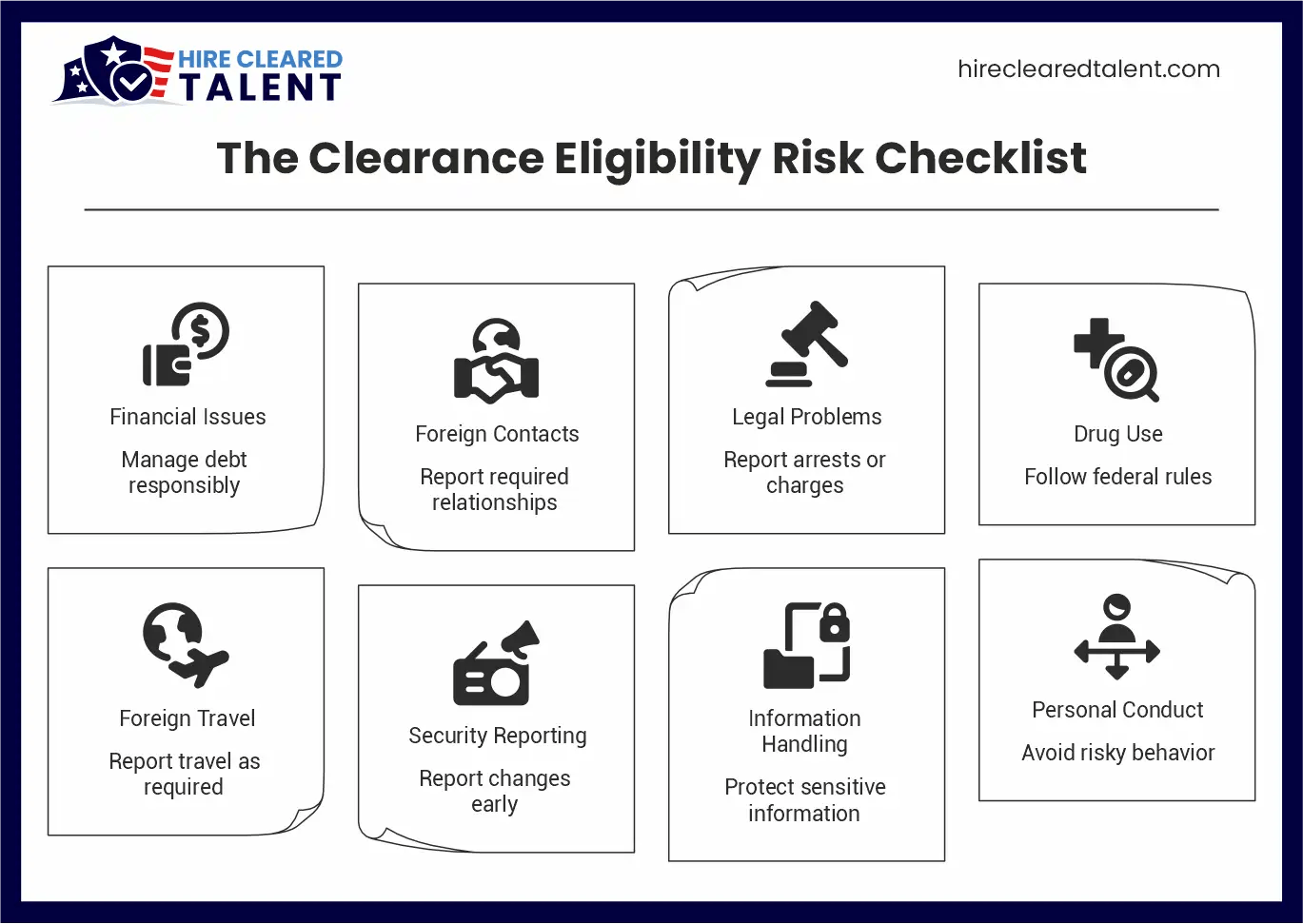
Manage Personal Finances Responsibly
Finances have their own SEAD 4 guideline because debt can create pressure or motive. Bankruptcy and any debt more than 120 days past due are reportable under SEAD 3.
Stay current on your accounts. If a debt is heading toward the 120-day mark, call the creditor, set up a payment plan, and tell your FSO before it turns into a finding. A documented plan counts heavily in your favor.
Continuous vetting runs automated financial checks constantly, so money problems don't stay hidden for long.
Report Changes in Personal Circumstances
Life changes, and some of those changes have to be reported. For contractors under DoD security oversight, DCSA's SEAD 3 guidance, ISL 2021-02, lists reportable items that include:
· Applying for or receiving foreign citizenship.
· Applying for, holding, or using a foreign passport or ID card for travel.
· Arrests.
· Alcohol- or drug-related treatment.
· Bankruptcy, or any debt more than 120 days past due.
· Personal foreign travel, which needs approval before you go, with limited exceptions.
Other reportable items include ongoing association with foreign nationals and media contacts looking for classified information. Some requirements vary by clearance level, so ask your FSO for the list that applies to you.
Report early. An arrest or a collections notice you report yourself, with context, looks responsible. The same thing found through a records check looks like you were hiding it. And don't count on continuous vetting to report for you: a conversation with a foreign intelligence officer at a conference won't show up in a database.
Follow Federal Drug Law, Including on Marijuana
In April 2026, a Justice Department final order moved two categories of marijuana to Schedule III, effective April 28: marijuana in FDA-approved drug products and marijuana regulated under a state medical marijuana license. The DEA held a hearing on broader rescheduling in July, and a recommendation is still pending. Recreational marijuana is still Schedule I.
For clearance holders, nothing changed in practice. Legal analysis from Arnold & Porter says clearance holders remain prohibited from using medical marijuana, even where state law allows it, and no change to SEAD 4 or ODNI's 2021 marijuana guidance had been announced as of this writing. The practical rule is simple: don't use marijuana in any form, and be careful with CBD products, which can contain THC.
Protect Your Security Clearance Every Day
Keeping a clearance is easiest when good habits become routine. Follow the procedures, report early, keep your own records, stay within your need-to-know, and treat every form as something that will be checked against the next one.
When you're ready for your next cleared role, create profile on HireClearedTalent and connect with employers actively hiring cleared professionals in high-demand sectors. Need more clarity?
Schedule a Call with Our Experts
FAQ
Q1- What should I do if I have contact with a foreign national?
A- Report foreign contacts when required by your agency or security program. If you are unsure, check with your FSO or security manager.
Q2- Do cleared employees need to report foreign travel?
A- Yes, many cleared employees must report foreign travel based on agency or program rules. Confirm the requirement before traveling.
Q3- What financial issues should a cleared employee report?
A- Report serious issues such as delinquent debt, tax problems, bankruptcy, or other required financial events.
Q4- Can a cleared employee use personal email for classified or sensitive work?
A- No. Classified information must stay on approved systems and within authorized environments.
Q5- What should I do if I accidentally receive classified information on an unapproved system?
A- Stop handling or forwarding it and contact your security office immediately.
Q6- Do arrests or legal issues need to be reported if there is no conviction?
A- Often, yes. Reporting rules can apply to arrests, charges, citations, or other legal issues.
Q7- Should I report a security concern if I am unsure whether it matters?
A- Yes. Ask your FSO or security manager rather than deciding on your own.
Q8- Can I list my security clearance on LinkedIn or my resume?
A- You may list your clearance status when appropriate, but avoid sharing classified program details or sensitive access information.
Q9- How should I describe my clearance after leaving a cleared job?
A- Use accurate wording about your eligibility and last date in access. Do not call it active if you are no longer in access.
Q10- Can social media activity affect a security clearance?
A- Yes. Public conduct, foreign relationships, illegal activity, or other security-relevant behavior may raise concerns.
Weekly newsletter
Get the latest blog updates, practical hiring insights, and featured reads delivered straight to your inbox.
Read about our Privacy Policy.