


If you've been scheduled for a polygraph as part of your security clearance process, you're probably nervous. That's normal. Cleared professionals at every level get anxious about the box. What separates the people who handle it well from the ones who don't is preparation, and not the kind that involves trying to outsmart the examiner.
The polygraph is now standard for a growing slice of the cleared workforce. DCSA processes over 700,000 background investigations annually, and the agency has enrolled approximately 3.6 million Department of Defense personnel, civilians, and contractors in its continuous vetting program, per a 2025 polygraph and clearance guide on Lie Detector Test.
The investigation backlog peaked at 291,200 pending cases in September 2024 before a dedicated tiger team reduced it to roughly 222,700 cases by April 2025, a 24% reduction, according to CCS Global Tech's 2026 analysis of clearance denial rates. If your polygraph is coming up, you're going through a system processing more candidates than at any point in recent memory.
After 20 years inside this space, the patterns are clear. Most polygraph problems aren't caused by bad people lying. They're caused by good people walking in unprepared, getting rattled, and making the situation harder than it needed to be.
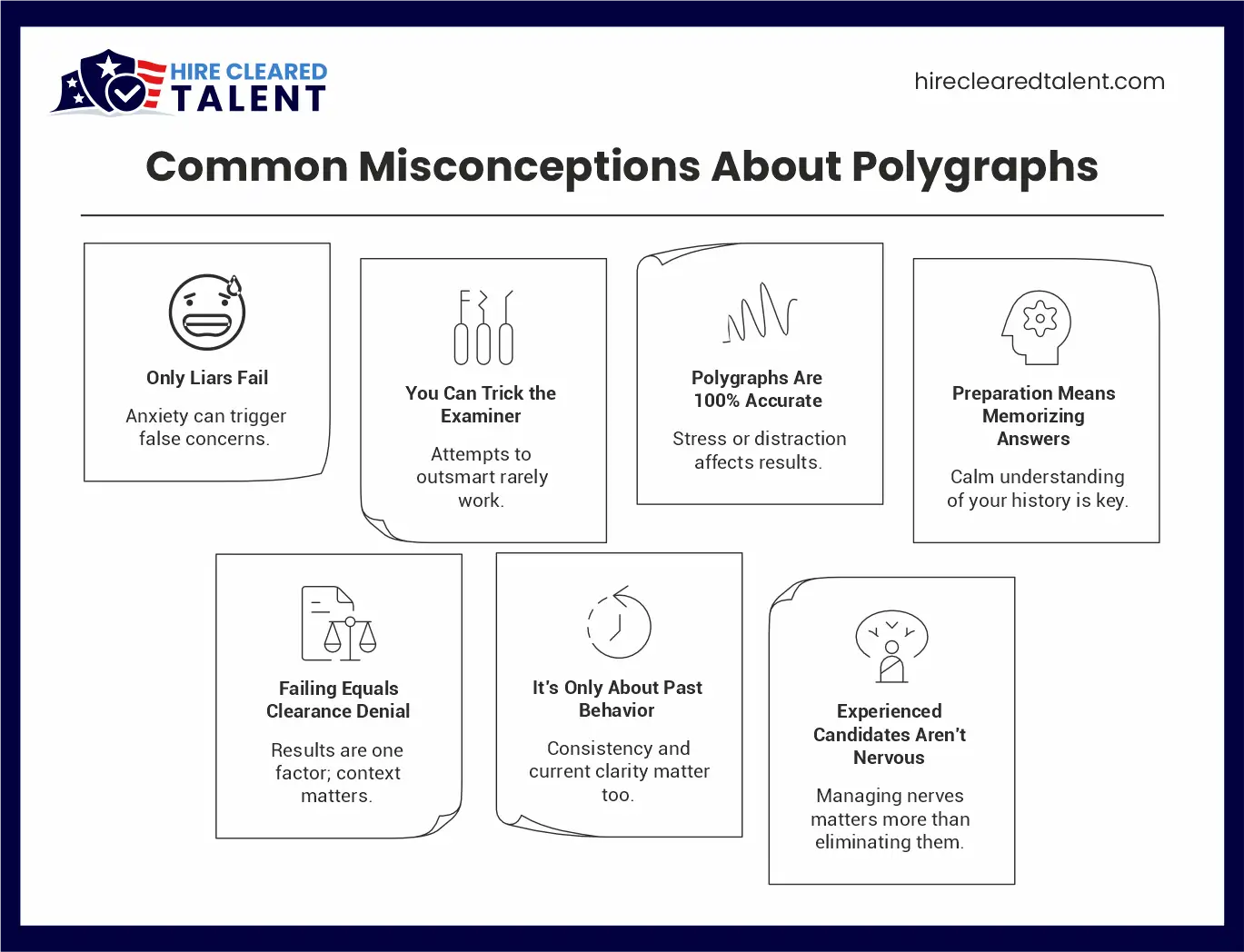
Rules to follow during Security Clearance Polygraph
Here are the five rules cleared professionals should follow when they sit down in that room.
Rule 1: Tell the Truth, Every Time
This sounds obvious. Most candidates think they understand it. They don't. Honesty covers more than answering the test questions truthfully. It applies to everything you say during the pre-test interview, the test itself, and the post-test discussion.
A polygraph examination at the NSA, CIA, FBI, or any other federal agency typically runs 2 to 6 hours, and most of that time gets spent talking rather than hooked up to the equipment, per a 2025 NSA polygraph candidate guide. Examiners gather more usable information from candid pre-test conversation than from the charts themselves.
Deception or omission is the most common reason candidates fail. And here's the part most people miss: disclosed issues are often adjudicated more favorably than concealed ones, per the same NSA guide. If you used marijuana three years ago, tell them.
If you had a foreign contact that made you uncomfortable, tell them. The adjudicators have seen everything. What stops a clearance is rarely the act itself. It's the cover-up.
One former federal examiner stated in a 2025 NPR interview that polygraphs are most effective at triggering confession or disclosure, not at detecting lies in real time. He noted he's had candidates confess before the equipment was even attached, per a polygraph preparation guide on Lie Detector Test. The pressure is real. The way through it is honesty, not technique.
Rule 2: Read Your SF-86 Before You Sit Down
Treat the polygraph as a verification of your security paperwork, because that's exactly how examiners use it. Your SF-86 forms the foundation for the entire interview. If your story shifts even slightly between what you wrote on the form and what you say in the room, the examiner notices, and that's where the conversation gets long.
Pull your most recent SF-86. Re-read every section. Pay attention to dates, names, addresses, employment history, foreign contacts, and any disclosed issues. If you submitted that form three months ago, you may have forgotten the specifics you put in writing. The examiner has them in front of them.
A practical example- A cleared engineer was scheduled for a counterintelligence polygraph at a defense contractor. She had listed a casual acquaintance from a foreign country on her SF-86 two years earlier and forgotten the person's name by the time she sat for the exam.
The examiner asked. She paused. She tried to remember. The pause and the uncertainty triggered a 90-minute follow-up discussion that could've been a 5-minute exchange if she'd reviewed the form the night before.
Read your paperwork. Take notes if you need to. Show up knowing what you already told them.
Read more- Using AI in Security-Cleared Job Search: Tools, Risks, and What Employers Expect
Rule 3: Sleep, Eat, and Show Up Regulated
Skip this one and you're handing your examiner a harder chart to read. Sleep and food matter for operational reasons, not wellness reasons.
Polygraph hardware is built to track physiological responses like heart rate, breathing pattern, skin conductance, blood pressure, and a few other signals that are a bit more subtle.
If you show up dehydrated, sleep deprived, hungover, or basically running on three cups of coffee, those baseline readings can turn out kind of erratic, in a way that’s annoying.
And when the baselines get erratic, the examiner has a harder time interpreting the results, while your charts look more ambiguous than they honestly should. Ambiguous charts usually lead to longer sessions, more retests, and more follow up questions, like you’re not just being checked, you’re being re-checked.
For the night before: aim for 7 to 8 hours of sleep, eat a normal dinner, skip alcohol, and don’t take anything that isn’t part of your usual routine. For the morning of: go with a balanced breakfast, drink water, and keep caffeine to your normal amount, not more, not less.
Also try to avoid any over-the-counter medications you don’t normally use. If you are taking prescription medication, say so during the pre-test interview. Examiners are trained to factor in medication effects, so that detail matters.
Show up about 30 minutes early, use the restroom then. Sit in the waiting area, breathe normally. The point is to be the same person you are on any regular Tuesday morning not something overly curated or stuck on calm mode. Just you.
Rule 4: Focus On the Question Asked
This is where most candidates end up making a mess for themselves. The examiner gives a clear, tight question. Then the candidate, because they’re tense, starts spiraling into every related thing they’re worried about, and they start talking like they’re answering that instead.
A counterintelligence polygraph circles foreign contacts, spying, and unauthorized sharing of classified info. A lifestyle polygraph goes into drug use, criminal activity, money stress, and general personal conduct, per the 2025 NSA candidate guide. So, when the examiner asks something specific, answer that specific thing. Yes or no. Short. Straight.
If the examiner asks whether you've had unauthorized contact with a foreign intelligence service, the answer is yes or no. Not a story about the time you sat next to someone on a plane who you weren't sure about.
Not a preemptive explanation of your study abroad semester ten years ago. If the examiner wants more, they'll ask for more. Volunteering information out of anxiety creates threads the examiner will then pull on, and those threads can extend a 2-hour exam into a 5-hour one.
Listen to the question. Answer the question. Stop talking.
Read more- How to Qualify for Federal Security Clearance Jobs?
Rule 5: Disclose Issues During Pre-Test Interview
The pre-test interview is your window. Not the test itself. If you have something on your mind, anything you're worried might come up, you bring it up before the equipment goes on.
This applies to a wide range of situations. Past drug use you've put behind you. Foreign travel that didn't make it cleanly onto the form. A relationship you weren't sure how to characterize. A financial issue that resolved. Anything that's been sitting in the back of your mind for the last six weeks.
Disclosing during the pre-test interview gives the examiner context to write into your file and adjudicate fairly. Holding it back and having the issue surface during the test, or worse, never surface at all because you bypassed the question, creates the kind of inconsistency that gets clearances denied.
In 2023, security clearance denials based on drug use increased by 36%, the largest single-year jump across any adjudicative guideline, according to the Secret Service polygraph guide.
That number includes both candidates whose drug history was disqualifying on its own and candidates who tried to conceal it. The disclosed ones often had a better outcome than the concealed ones, even when the underlying conduct was similar.
The broader picture matters too. Financial considerations, personal conduct, and foreign influence together account for approximately 75% of all security clearance denials, per Department of Defense adjudicative data summarized by DC Security Clearance Consultants.
DCSA denied or revoked 2,716 security clearances in a recent reporting period, per JOBSwithDOD's 2025 defense industry clearance guide. What ties most of those denials together has less to do with the underlying issue and more to do with how the candidate handled disclosure.
Personal conduct denials are largely driven by failure to disclose information on the SF-86 or during the investigation, according to CCS Global Tech's 2026 denial rate analysis.
The pre-test interview is your chance to lead with the story. Take it.
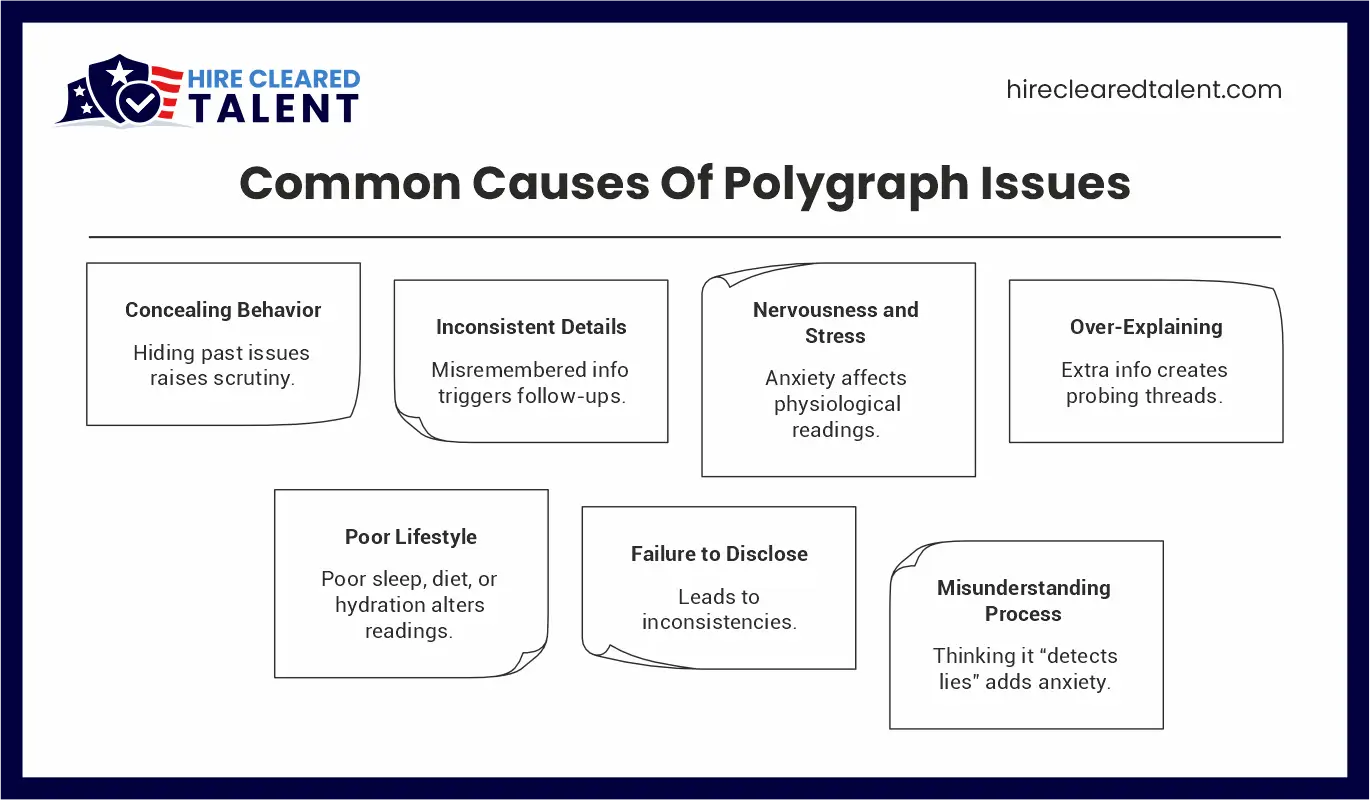
Common Mistakes to Avoid During a Polygraph
Inconclusive or failed polygraph results don't automatically end your career. Many candidates retake the exam after a cooling-off period, especially when the initial result was inconclusive rather than a clear deception finding. Some agencies offer multiple sessions on different days, since fatigue and stress can affect first-day results.
There's also a legal protection worth knowing. Under Security Executive Agent Directive 4 (SEAD 4), adverse security clearance determinations cannot be made on the basis of polygraph results alone, per a 2025 TS/SCI clearance and polygraph guide on Lie Detector Test.
Adjudicators must consider the whole person and the totality of information in your file. A bad polygraph chart on its own isn't grounds for denial. Combined with concealment, deception, or pattern evidence, it can be.
The honest reality is that a failed full-scope polygraph at one Intelligence Community agency can affect your standing at others, but it isn't always disqualifying. Document everything you remember about your session.
Get any feedback the examiner is willing to provide. Talk to a qualified clearance attorney if the result feels off. Many cleared professionals who failed an initial polygraph have gone on to successful careers in cleared roles that don't require full-scope testing.
The Role of HireClearedTalent
Whether you're preparing for your first polygraph, recovering from a tough session, or already through the process and ready to move into your next cleared role, you need a marketplace built for how cleared hiring actually works.
HireClearedTalent connects active and passive cleared professionals like you with federal agencies and defense contractors across the United States. We work with Secret, Top Secret, TS/SCI, TS/SCI with polygraph, and DOE Q/L candidates every week.
Our marketplace strips out the friction generic job boards leave in place. You list your clearance level, polygraph status, last investigation date, and contract availability once, and qualified employers see you.
If you're ready to put your clearance to work, create your profile on HireClearedTalent and start exploring active roles at your clearance level today. The polygraph is one step in a much longer career. Make the rest of the steps count.
The five rules above are simple to state and harder to follow under pressure. Practice them now. The day of the exam isn't the day to start. If you still have any doubts or facing any difficulty?
FAQ-
Q1- How should I prepare mentally for a security clearance polygraph?
A- Stay calm, review your personal and professional history, and be ready to answer questions truthfully without overthinking.
Q2- Can I withhold information or avoid answering certain questions during a polygraph?
A- No. Always answer fully and honestly; attempting to hide information can create more issues than the question itself.
Q3- What should I do if I don’t remember a detail during the polygraph?
A- Admit you don’t recall rather than guessing. Polygraph examiners expect some gaps and value honesty over fabricated answers.
Q4- Is it okay to practice or memorize answers before the polygraph?
A- Avoid scripted responses. Be familiar with your history but answer naturally, as memorized responses can appear deceptive.
Q5- How should I handle unexpected questions during the polygraph?
A- Pause, think clearly, and respond truthfully. If unsure, ask for clarification rather than giving an incomplete or misleading answer.
Q6- Can stress or nervousness affect polygraph results?
A- Minor anxiety is normal. Focus on steady breathing, clear thinking, and honest responses to minimize the impact of nerves.
Q7- Should I disclose potential issues before the polygraph?
A- Yes. Disclosing concerns during pre-test discussions demonstrates transparency and reduces misunderstandings during the exam.
Q8- How important is consistency during the polygraph interview?
A- Very important. Inconsistent or contradictory answers may trigger further questioning, so stay clear, honest, and consistent throughout.
Q9- Can lifestyle or personal habits affect my polygraph outcome?
A- Certain habits (like insufficient sleep or stimulants) can affect stress responses. Arrive well-rested, calm, and focused.
Q10- How can I ensure my answers are credible under polygraph scrutiny?
A- Be truthful, clear, and concise. Avoid over-explaining or volunteering unnecessary information.
Weekly newsletter
Get the latest blog updates, practical hiring insights, and featured reads delivered straight to your inbox.
Read about our Privacy Policy.