


Security clearance decisions are governed by 13 adjudicative guidelines established in Security Executive Agent Directive 4 (SEAD 4). When DCSA or a cognizant agency cannot affirmatively determine that granting or continuing access is clearly consistent with the interests of national security, the case proceeds to denial or revocation. The standard does not require proof of wrongdoing - it requires that the government cannot make the affirmative finding.
According to ClearanceJobs (January 2025), DOHA published 624 appeal case summaries in 2024 - a one-third drop from 2023. Financial issues outnumbered all other adjudicative categories combined for the eighth consecutive year.
Drug involvement cases have risen steadily since 2022, largely driven by state-level marijuana legalization creating confusion about federal standards. Personal conduct violations - primarily omissions or inconsistencies on the SF-86, convert otherwise mitigable financial concerns into near-disqualifying cases.
SEAD 4 Guideline | Category | Trend (2024) | Mitigation Difficulty |
Guideline F | Financial Considerations | Consistent - most common | Moderate (if documented) |
Guideline E | Personal Conduct / SF-86 Omissions | Stable - high severity | High - dishonesty compounds other issues |
Guideline H | Drug Involvement | Rising since 2022 | Moderate (time + cessation required) |
Guideline J | Criminal Conduct | Stable | Variable (depends on severity) |
Guideline B | Foreign Influence | Increasing (geopolitical) | High — context-dependent |
Guideline G | Alcohol Consumption | Stable | Moderate (treatment evidence helps) |
2026 Procedural Landscape - Key Changes Effective December 2024
As reported by ClearanceJobs (January 2025), DCSA implemented revised due process and appeal procedures effective December 8, 2024. The changes affect DoD civilians, military servicemembers, and SCI contractor personnel administered by DCSA.
Contractors adjudicated for collateral (non-SCI) access under DoD Directive 5220.6 are not affected, they continue to be referred to DOHA, where hearing rights have long been established.
WHAT CHANGED | WHO IT AFFECTS |
DoD civilians, military servicemembers, and SCI contractor personnel now have the option for a Personal Appearance (PA) - a virtual hearing before a DCSA Senior Adjudicator before a final revocation decision is issued. Previously, this hearing option was only available post-decision. | DoD civilians (GS/SES), active duty and reserve military servicemembers, and contractors whose SCI access is administered directly by DCSA. Does not apply to contractors adjudicated for collateral (non-SCI) access - those cases remain under DOHA / DoD Directive 5220.6. |
Step-by-Step: The DOHA Appeal Process for DoD Contractors
The following steps apply to DoD contractors whose cases are adjudicated under DoD Directive 5220.6 and referred to the Defense Office of Hearings and Appeals (DOHA). Deadlines are calendar days and are strictly enforced. Missed deadlines generally result in waiver of that right.
1- Receive the Statement of Reasons (SOR)
• The SOR is the government's written statement of every adjudicative concern. It is organized by SEAD 4 guideline, with specific sub-paragraphs for each allegation.
• Each sub-paragraph is a discrete allegation requiring a separate, specific response. A single undisclosed debt on the SF-86 will appear under both Guideline F (financial) and Guideline E (personal conduct) - two separate sub-paragraphs requiring two separate responses.
• Read the SOR as a legal document. Note every guideline cited and every sub-paragraph number. Your written response must address each individually or it is treated as uncontested. Deadline: Response window opens upon receipt.
2- Respond in writing within 20 days
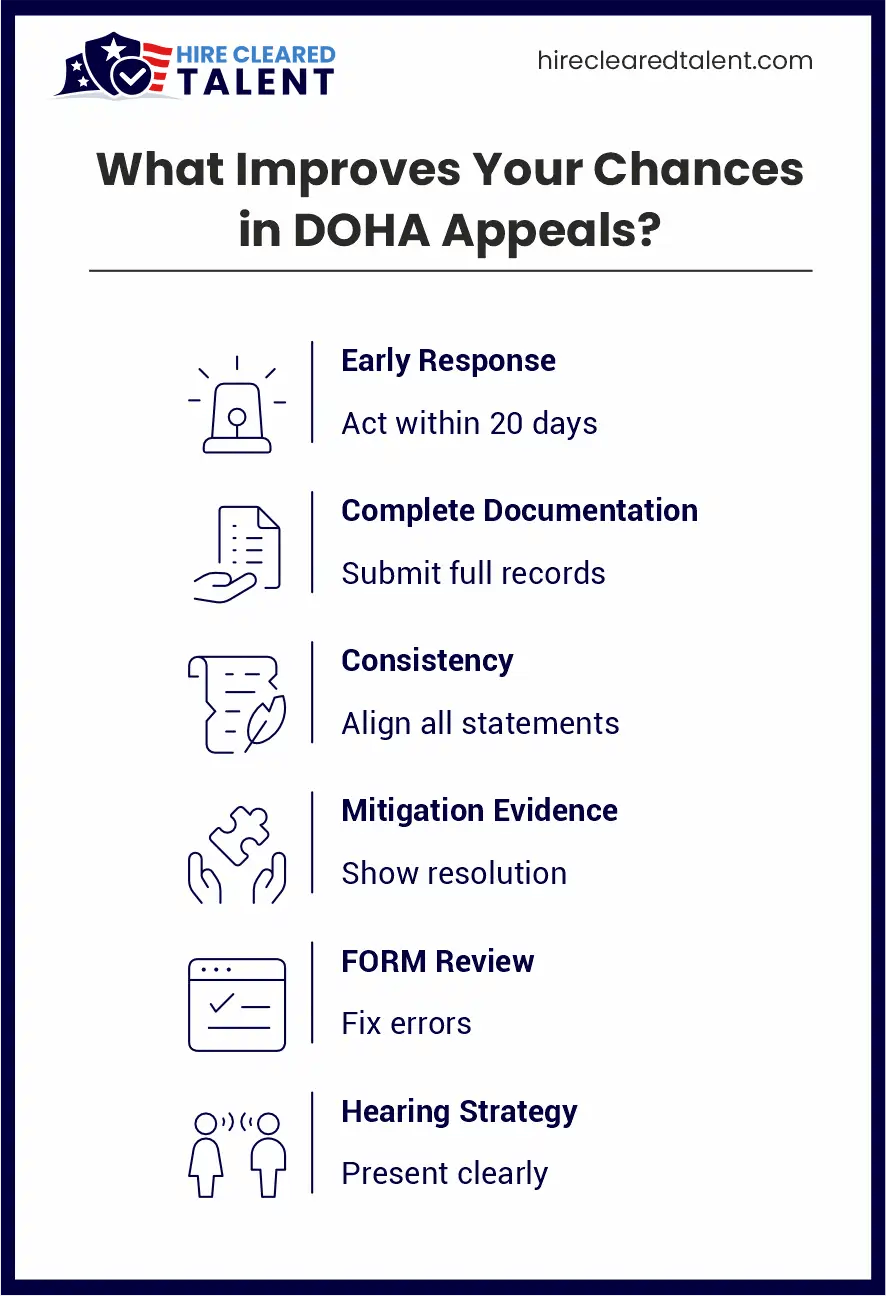
• You have 20 calendar days from receipt to submit a notarized written response to the SOR. Per established DOHA procedure, extensions can be requested and are commonly grantee, but the request must be made before the deadline expires.
• In your written response, you will also elect whether to proceed on the written record or request a hearing before a DOHA Administrative Judge. This election is one of the most consequential decisions in the entire process - see Step 3.
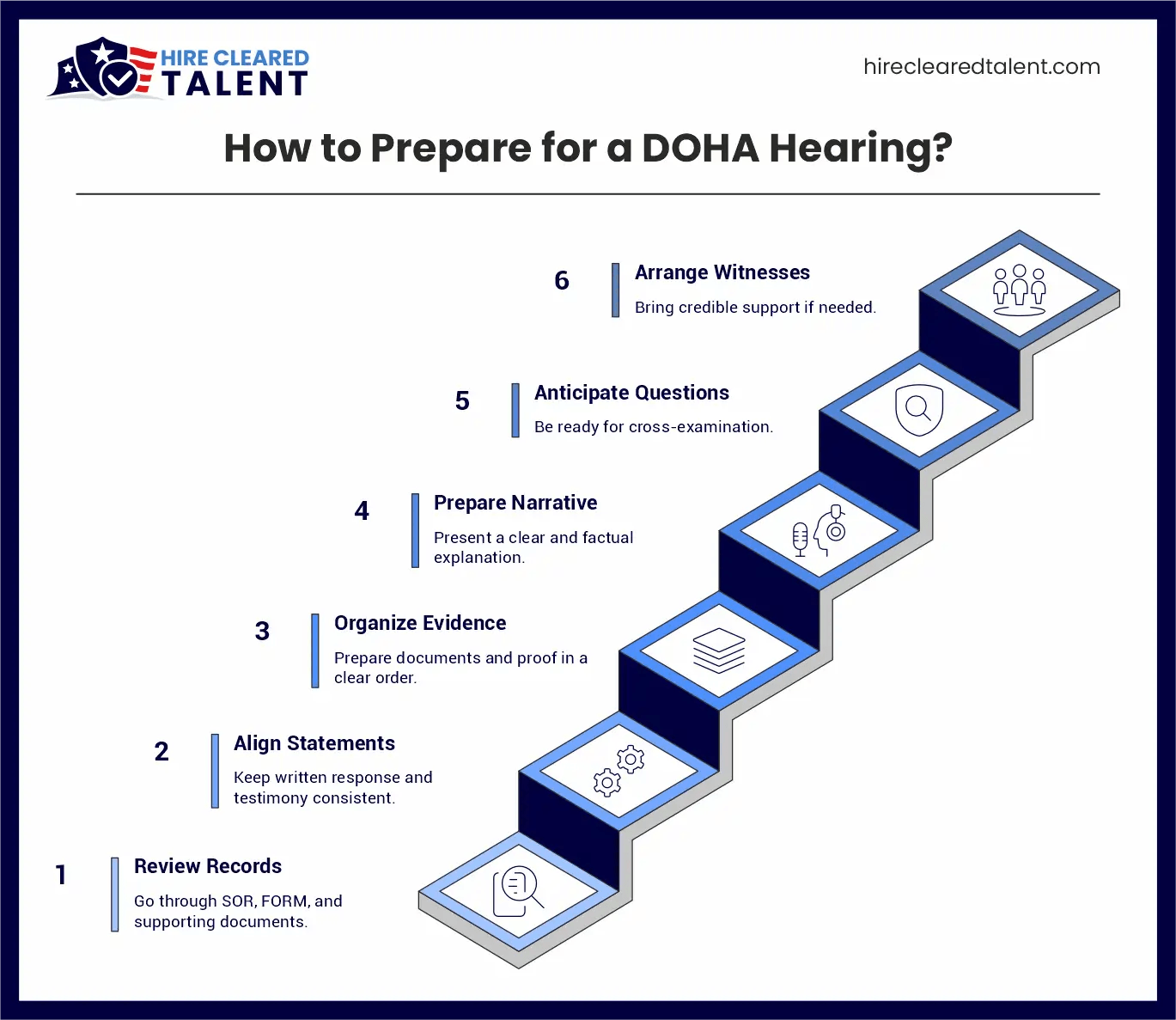
• The written response is not a formality. It becomes part of the permanent case record and will be compared against anything said at a subsequent hearing. Internal consistency between the written response and hearing testimony is critical. Deadline: 20 calendar days from SOR receipt.
3- Elect a hearing or written decision - understand the data
• Applicants who present their cases at a DOHA hearing perform approximately 33% better than those whose cases are decided solely on the written record, per ClearanceJobs (2025).
• Analysis by the National Security Law Firm found that full DOHA hearings result in favorable outcomes roughly 40% of the time, compared to approximately 12% for written-record-only submissions.
• A hearing allows presentation of live evidence, witness testimony, and cross-examination. The Administrative Judge can make a direct credibility assessment.
However: cases involving personal conduct concerns or documented inconsistencies carry additional risk at a hearing, where discrepancies are more easily exposed by Department Counsel.
Decision: Request hearing (generally recommended) or elect written decision.
4- Review the File of Relevant Material (FORM)
• Before your hearing or written decision, you are entitled to review the government's FORM - the complete file of documents the adjudicator reviewed, including investigation results, financial records, interview transcripts, and all supporting material.
• Review the FORM for factual inaccuracies, missing context, and omitted documentation. A debt appearing in the file without any record of repayment activity creates a materially incomplete picture. Identifying and correcting those gaps is the foundation of effective mitigation.
• Any inaccuracy you identify should be specifically addressed in your hearing presentation or supplemental written submission. Action: Request, review, and document all inaccuracies in the FORM.
5- Build your mitigation - what adjudicators require
• Mitigation is not an explanation of circumstances. It is documented evidence that the condition causing concern has materially changed and the change is durable. Adjudicators apply a whole-person analysis - context matters, but documentation is what moves the needle.
• For Guideline F (financial): Payment history documentation, written repayment agreements, credit counseling enrollment confirmation, bank statements showing consistent on-time payments, and a clear timeline of when debts arose, why, and what remediation has occurred.
• For Guideline H (drug involvement): Time since last use, verifiable drug tests, a credible and specific statement of current intent regarding continued non-use, and where applicable treatment completion records.
• Character letters from supervisors with direct knowledge of your work in classified environments carry measurable weight. They are not the deciding factor, but they provide context the documentary record alone cannot supply. Action: Compile financial records, repayment evidence, drug test results, character letters.
6- Attend the DOHA hearing
• The hearing is conducted before a DOHA Administrative Judge who functions as an Administrative Hearing Officer. It is not a criminal or civil proceeding. The standard of proof is 'clearly consistent with the interests of national security,' not beyond reasonable doubt.
• Department Counsel presents the government's case and enters exhibits. You then present your evidence, call witnesses, and may cross-examine government witnesses. An opening statement is permitted.
• Per Tully Rinckey PLLC, the judge's written decision includes findings of fact, conclusions based on the Adjudicative Guidelines, and application of the national security standard. The decision is issued approximately 10–14 days after the hearing.
• The hearing is not an opportunity to revise what was said in the written response. The two must be consistent. Venue: In-person at DOHA (Arlington, VA) or virtual confirm current procedure.
7- If denied: appeal to the DOHA Appeal Board within 15 days
• Either party may appeal an Administrative Judge's decision to the DOHA Appeal Board. Per Tully Rinckey PLLC, the notice of appeal must be received within 15 calendar days of the judge's decision date.
• The appeal brief- due within 45 days of the notice must specifically identify what the judge did wrong and why that error changes the outcome. The Appeal Board reviews for legal error only: misapplication of adjudicative guidelines, procedural irregularity, or evidentiary error.
• The Appeal Board cannot receive new evidence or re-weigh the facts. It cannot reverse a finding of fact unless that finding was unsupported by the record. The hearing stage is where cases are won or loss not the appeal board.
• If the final appeal fails, a one-year reapplication bar applies from the date of the Administrative Judge's initial decision, per DoD Directive 5220.6. Deadline: Notice of appeal within 15 calendar days of AJ decision.
Appeal Outcomes: What the Data Shows
Appeal Stage | Favorable Rate | Key Factor | Source |
Written record only (no hearing) | ~12% | Documentation quality; no credibility assessment | National Security Law Firm |
Full DOHA hearing | ~40% | Live evidence, witness testimony, credibility | National Security Law Firm |
Hearing with attorney representation | ~51% | Structured presentation, mitigation sequencing | National Security Law Firm |
Hearing without representation (pro se) | ~32% | Preparation gap; process unfamiliarity | National Security Law Firm |
DOHA Appeal Board (post-hearing) | <5% | Legal error review only; no new evidence | ClearanceJobs analysis |
Legal Representation: What It Changes and When It Matters
According to analysis by the National Security Law Firm, applicants with legal representation at the hearing stage achieved favorable outcomes 51% of the time, compared to 32% for those without representation.
The difference reflects the structural complexity of the process: SOR response construction, FORM review, evidence sequencing, mitigation framing, and cross-examination handling are not intuitive skills for first-time participants.
For those proceeding without counsel, the highest-leverage actions are:
(1) Address every SOR sub-paragraph individually in the written response.
(2) Elect a hearing unless your case has significant personal conduct or consistency risks.
(3) Review the FORM before submitting anything.
(4) Ensure your written response and any hearing testimony are fully consistent - any deviation will be noted and used.
WITH LEGAL REPRESENTATION | WITHOUT REPRESENTATION (PRO SE) |
• ~51% favorable outcome rate at DOHA hearing stage. • SOR response structured for mitigation, not just rebuttal. • FORM reviewed for evidentiary inaccuracies before submission. • Evidence sequenced against specific SOR sub-paragraphs. • Cross-examination of government witnesses. • Consistent framing across written response and testimony | • ~32% favorable outcome rate at DOHA hearing stage. • Common error: treating written response as informal explanation. • Common error: introducing new details at hearing not in written response. • Common error: failing to address every SOR sub-paragraph individually. • Common error: not requesting the FORM before preparing mitigation. • Hearing still significantly outperforms written record (~12%). |
Reapplication Rules and Career Implications
Per KCNF's analysis of DoD Directive 5220.6, an applicant whose security clearance is finally denied or revoked through DOHA is barred from reapplication for one year from the date of the Administrative Judge's initial decision, not the appeal board decision.
Reapplication requires employer sponsorship: a cleared contractor or federal agency must initiate a new investigation. There is no self-sponsorship mechanism.
Phase | Status | Employment Impact | Key Action |
SOR received / pending | Access typically | May be retained in uncleared | Respond within 20 days; do not |
response | suspended | capacity | resign |
Hearing pending / in process | Access suspended; case active | Employment relationship critical to maintain | Prepare mitigation; maintain employer relationship |
Final revocation- appeal period | Clearance revoked | Many contractors have limited uncleared work | File appeal if grounds exist; maintain employment |
1-year reapplication bar | Barred from reapplication | No cleared roles; sponsor required for new application | Build documented mitigation for reapplication |
Reapplication eligible | New investigation possible | Requires active cleared employer sponsor | Work with cleared employer to initiate new application |
CAREER WARNING
Maintaining the employment relationship during revocation proceedings - even in an uncleared, administrative, or support capacity is materially important. A cleared employer sponsor is required to initiate any new clearance application.
If the employment relationship ends before reapplication is possible, obtaining a new sponsor who is willing to initiate an application with a revocation on record adds a significant and often underestimated barrier to reentry into the cleared workforce.
Quick Reference: Deadlines and Key Facts
Deadline | Timeframe | Notes |
SOR written response | 20 calendar days from receipt | Extensions available on request before expiry |
Notice of appeal to DOHA Appeal Board | 15 calendar days from AJ decision | Strictly enforced; late notices require good cause |
Appeal brief | 45 days from notice of appeal date | Must specify legal error in AJ decision |
Reply brief (prevailing party) | 20 days from receipt of appeal brief | Optional but advisable in contested cases |
Reapplication after final revocation | 1 year from AJ initial decision date | Requires cleared employer sponsor; bar is per Directive 5220.6 |
Ready to return to the cleared workforce?
HireClearedTalent connects security-cleared professionals with federal agencies and defense contractors actively seeking cleared talent including roles available during reinvestigation and positions that support reentry after the reapplication window opens. Still have any concerns?
Schedule consultation with our experts!
FAQ-
Q1- What should you do immediately after losing a security clearance?
A- Review the Statement of Reasons carefully and identify the exact concerns. Start gathering documents and evidence to address each issue.
Q2- What is a Statement of Reasons in the clearance appeal process?
A- It is an official document outlining why your clearance was denied or revoked. It forms the basis of your response and appeal strategy.
Q3- How much time do you have to respond to a clearance denial?
A- Timelines are strict and typically range from 15 to 30 days. Missing deadlines can forfeit your right to appeal.
Q4- What are the most common reasons for clearance denial?
A- Financial issues, drug use, criminal conduct, and personal conduct concerns are the most frequent factors.
Q5- How can you improve your chances of winning a clearance appeal?
A- Provide clear documentation, show corrective actions, and demonstrate accountability. Consistency and honesty are critical.
Q6- Does hiring a clearance attorney improve appeal outcomes?
A- Legal support can help structure your response and avoid mistakes. It is especially useful in complex or high-risk cases.
Q7- What evidence should you include in your appeal?
A- Include financial records, repayment plans, character references, and proof of corrective actions. Evidence should directly address concerns.
Q8- How important is honesty during the appeal process?
A- Honesty is critical because omissions or inconsistencies can worsen your case. Transparency helps rebuild trust with adjudicators.
Q9- Can you reapply if your appeal is denied?
A- Yes, but you may need to wait before reapplying. You must show meaningful changes since the initial denial.
Q10- How long does the clearance appeal process take?
A- It can take several months depending on complexity and case backlog. Timelines vary based on the stage of appeal.
Weekly newsletter
Get the latest blog updates, practical hiring insights, and featured reads delivered straight to your inbox.
Read about our Privacy Policy.