


Cleared professionals' average compensation rose to $126,125 in 2025, marking an almost 6% increase in a year, as revealed by ClearanceJobs' 2026 Security Clearance Compensation Report. 70% of cleared professionals have had a base salary increase this year. 12% have had an increase of more than 10%. 78% of cleared professionals will probably change jobs within one year.
Let that sink in for a minute. A majority of cleared professionals are willing to move. If you are giving out offer letters that look like you have stolen them from some generic HR web five years ago, then you are not offering these people the best deal. Your competitor down the street is.
This post breaks down what a competitive cleared talent offer letter actually needs to say, why the standard corporate template falls short in this market, and gives you a structure you can adapt today.
Why Standard Offer Letters Fall Short for Security-Cleared Roles
The generic offer letter expects a straightforward exchange where the terms of employment and salary are laid out. There are some factors that a standard offer letter doesn’t have to consider when it comes to clearance.
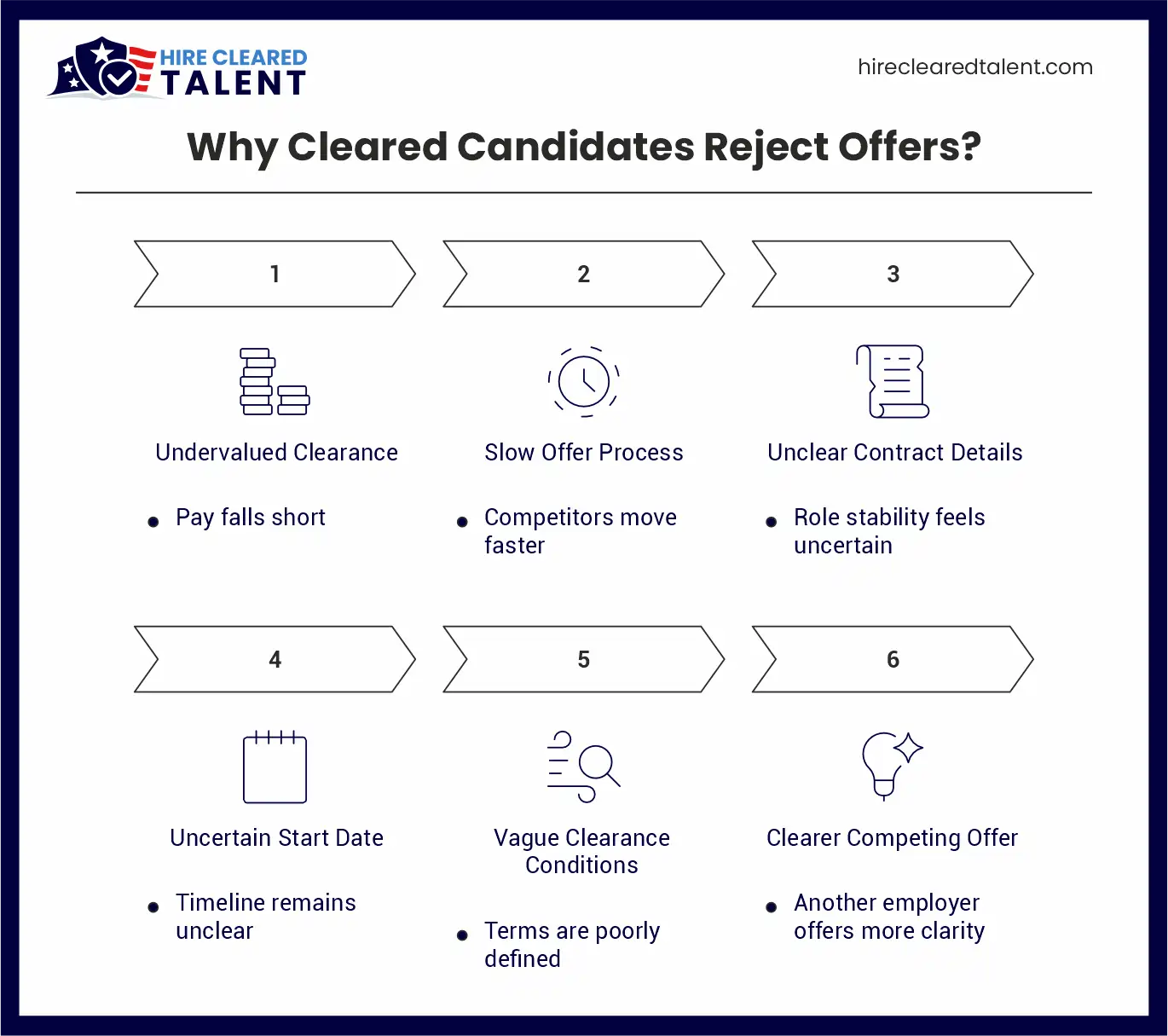
The clearance level affects the salary equation. While a Confidential clearance will increase your salary by $5,000-$10,000 compared to a similar uncleared position, a Secret clearance is usually worth $10,000-$15,000 more. According to ClearanceJobs, the full-scope polygraph in the Intelligence Community can put your total salary above $165,000. If your offer letter treats a TS/SCI candidate and a Secret-cleared candidate as interchangeable line items on the same pay band, you're already underpricing your best candidates.
Contract vehicles change what you can promise. In case the position is under a certain IDIQ, GSA Schedule, or task order, the comp structure might be limited by the labor rate contained in such a contract. A candidate who's negotiated cleared offers before will ask about this. If your letter is vague on it, that's a signal you don't know your own contract, and that reads as risk to someone weighing multiple offers.
Timing changes everything. Cleared candidates with an active, transferable clearance are getting multiple offers in the same window, often with 48 to 72 hour decision clocks from competitors. A polished but slow offer letter loses to a rougher one that lands first with clear terms.
Verification language matters. Terms in your letter have to be contingent on clearance and legal, not ambiguous "subject to clearance" language that will make the candidate ask what will happen if adjudication takes 90 days instead of 15.
What Determines Security-Cleared Compensation in 2026?
Before you write the number, know the market you're writing it into.
IT roles lead early-career cleared compensation, averaging $82,753 in the first two years, ahead of intelligence roles ($77,848) and engineering ($75,916), per ClearanceJobs' 2026 data. Cybersecurity is where the clearance premium hits hardest.
TS/SCI cleared jobs in cybersecurity can be paid between $120,000-$170,000 per year, while the same job but without a clearance pays $85,000-$120,000 annually; the difference is $35,000-$50,000 based on BestMilitaryResume's 2026 clearance salary survey. The median pay for an information security analyst with TS clearance is $120,370, and more than $140,000 with SCI clearance in the Washington, DC area.
Location still moves the number more than most hiring managers give it credit for. A $130,000 salary in Huntsville and a $130,000 salary in Northern Virginia are not the same offer, and candidates comparing multiple opportunities know it.
If you're hiring outside the DMV, don't just apply a flat national average. Make sure to check the locality pay tables on OPM’s website and the compensation survey on ClearanceJobs.com for the particular metro area first.
The Intelligence Community ranks among the highest in terms of salaries with organizations such as the CIA earning in excess of $170,000 per annum. If you're competing against IC-adjacent contractors for the same TS/SCI poly talent, your commercial-style pay band probably isn't in the conversation, and you need to know that before the candidate tells you.
Read more- Lost Your Security Clearance? Step-by-Step Guide to the Appeal Process
What Should a Competitive Cleared Talent Offer Letter Include?
A cleared offer letter earns trust by being specific about the things a normal offer letter glosses over. Here's what belongs in it.
Base salary, stated as a number, not a range. Ranges are fine in a job posting. In an offer letter, a range signals the negotiation isn't over, and a candidate weighing a competing firm offer will read it that way.
Clearance differential, itemized. If your comp structure pays a premium for the clearance level itself, separate from base, say so and show the number.
This does two things: it proves you understand the market rate for their specific clearance, and it gives them something concrete to compare against a competing offer that might bundle everything into one number.
Polygraph premium, if applicable. Full-scope and CI poly work commands a real premium. If your role requires it, price it explicitly. Candidates who've been through a poly know what it's worth and will notice if you don't.
Signing bonus and vesting terms. With 78% of the cleared workforce open to moving, a signing bonus is often the deciding factor in a close race. Specify the amount to be paid, the payment schedule, and clawback terms using simple language, not addendum language.
Retention or completion bonus tied to contract milestones. Common on task order work. If eligibility depends on staying through a specific contract period or option year, spell out the date and the condition. Vague retention language creates disputes later and distrust now.
Site or location premium. Where positions call for relocation to expensive or desirable locations, specify the premium separately from the base salary and indicate whether it is a one-time relocation bonus or a regular location allowance.
Travel allowance in case of temporary duty work. Candidates evaluating multiple cleared offers will compare this line item directly.
PTO, holiday calendar, and other benefits specific to being a federal contractor such as SCA fringe compliance, which is necessary if the position qualifies under SCA. Mention this and explain what it is, as most people who are not familiar with government contracting will have no idea.
Clearance contingency language, with a timeline. Don't just use the wording "contingent upon clearance verification"; include details about how it works at each step, including the date at which the interim clearance starts if there is such a thing, the overall timeline for the full adjudication process, and what the offer would look like if the adjudication takes longer than expected. This is the #1 omission in cleared offers.
Contract vehicle and labor category, briefly. You don't need to disclose rate ceilings, but naming the vehicle and labor category shows the candidate this offer is grounded in a real, awarded contract, not a speculative req.
Security-Cleared Offer Letter Template for Employers
Adapt the bracketed sections to your role and contract. Keep the structure. The sequencing is just as important as the content, since it ensures that the number of interest to the candidate appears in the first paragraph, not on page 2.
[Company Letterhead]
[Date]
Dear [Candidate Name],
We would like to extend an exciting opportunity for you to be part of our team as [Job Title] supporting [Program/Contract Name], under [Contract Vehicle: GSA MAS, Labor Category: Senior Systems Engineer], reporting to [Manager Name/Title], based out of [Location], remote/hybrid/onsite.
Compensation
Base Salary: $[XXX,XXX] per year on a [bi-weekly/semi-monthly basis].
Clearance differential: $[X,XXX] based on your current [Secret/Top Secret/TS-SCI] clearance.
Polygraph differential (if applicable): $[X,XXX] based on your current [CI/Full-Scope] polygraph clearance.
Signing bonus: $[X,XXX] within [X days] of start date with a repayment clause of [X-months] should employment be terminated by you prior to [date].
Retention bonus (if applicable): $[X,XXX] when you complete [Option Year 1/milestone in your contract.
Location and Travel
Work location: [Site/facility name and address]
Relocation assistance: [$X,XXX lump sum / itemized package / not applicable]
Per diem/TDY: [rate and conditions, or "not applicable to this role"]
Clearance Status and Contingency
Your offer is conditioned upon [active clearance / interim clearance / clearance process initiation].
With active and transferable clearance, your expected start date is [date].
With clearance needing to be reinvestigated or upgraded, the projected timeline would be [X weeks/months], and our offer will stay valid until then, with status checks at [interval].
Benefits
Health, dental, and vision coverage effective [date/waiting period]
401(k) with [match structure]
PTO: [X days] annually, plus [X] federal holidays
[SCA fringe benefit language, if applicable]
Start Date Your anticipated start date is [date], contingent on the clearance terms above.
This offer is valid through [date, typically 5-7 business days]. Please contact [recruiter name and direct contact] with any questions.
We look forward to welcoming you to the team.
Sincerely, [Hiring Manager/HR Name] [Title, Company]
Read more- Using AI in Security-Cleared Job Search: Tools, Risks, and What Employers Expect
Common Offer Letter Mistakes That Cost Employers Cleared Candidates
Pricing to the non-cleared market rate and hoping no one notices- Cleared candidates check their clearance's market value before they negotiate. If your number doesn't reflect the premium, the gap is the first thing they'll raise, and it puts you in a defensive position before the conversation even starts.
Burying the clearance contingency in legal boilerplate- A one-line "subject to clearance" clause with no timeline reads as uncertainty. Candidates with competing offers will take the one that tells them exactly what happens next.
Sending a range instead of a number- It signals you haven't finished deciding, and it invites a counter that could've been avoided by leading with your best offer.
Slow turnaround- In a market where 78% of cleared professionals are open to moving, a strong verbal offer that takes five business days to become a written letter is a strong verbal offer that a competitor beats to the finish line.
Treating every clearance level the same- A pay band that doesn't differentiate Secret from TS/SCI from full-scope poly tells experienced cleared candidates that your comp structure wasn't built with real market data.

What to Do After Sending an Offer to a Cleared Candidate
Sending a strong offer isn't the end of the process. In a market where two-thirds of cleared professionals name higher pay as their top factor in job satisfaction, expect pushback on at least one line item, even from candidates who seem eager.
Build room for a counter into your process before you send anything. When the initial offer you make is already your ceiling, you will find yourself at a dead end when the candidate presents his/her own proposal and you will either lose the candidate or be forced to concede in a manner that appears to be unthoughtful.
You can always get around this by determining the ceiling within yourself, offering your candidate an offer slightly below that ceiling, and treating the first counter as just another part of the negotiation process. Sometimes it's money. Just as often it's the clearance contingency language, the start date, or a benefit they didn't see spelled out.
If a candidate does come back with a counter, respond with specifics, not a flat yes or no. If you can move on base, say by how much. If you can't move on base but can add to the signing bonus or relocation package, say that instead. Candidates comparing multiple cleared offers are used to line-item negotiation. A vague "let me see what I can do" reads as stalling in a market where the other offer on the table has a deadline.
How Security-Cleared Candidates Compare Job Offers
The majority of hiring managers send out an offer letter, considering that it would stand alone as an independent document. However, the reality is that a cleared candidate who has a TS/SCI or a full-scope poly is usually comparing it to another offer and even to more than one.
These four criteria are usually used when such comparisons are made: the base salary, clearance and poly differential, contingency timeline clarity and the speed of sending the letter after the verbal offer.
You control all four. The base number is a market data problem, solvable with the ClearanceJobs compensation survey and OPM locality tables. The differentials are a math problem, solvable by itemizing instead of bundling.
The contingency timeline is a writing problem, solvable by the template above. And speed is a process problem: if your HR or legal review adds three days to every offer letter, that delay is costing you candidates before you even know you're in a race.
How to Build a Competitive Offer for Security-Cleared Talent
It’s a great time to be cleared talent, and the statistics prove it. The numbers for salary are the best they’ve ever been; the level of mobility is high, and the top prospects you need are the ones getting several offers simultaneously.
An offer letter that spells out differences in clearance and talks about contingencies in time is simply smart business. It's the difference between closing your top candidate and watching them sign with the company that moved faster.
If you're building out cleared roles and want to benchmark your compensation structure against real market data before your next offer goes out, HireClearedTalent connects you directly with security-cleared professionals who already know what their clearance is worth. You can also create your profile on HireClearedTalent and search for opened cleared positions. Still need more clarity?
Connect with Cleared Veteran Talent Today!
FAQs-
Q1. What should a competitive offer letter for cleared talent include?
A. It should clearly state the salary, clearance requirement, employment status, work location, start-date conditions, benefits, bonuses, contract dependencies, and any clearance-related contingencies.
Q2. Should compensation vary by clearance level?
A. Yes. Secret, TS/SCI, and polygraph-required roles often have different talent availability, hiring difficulty, and market value. Using one pay band for every clearance level can weaken the offer.
Q3. How should employers calculate compensation for a cleared role?
A. Consider the role, clearance level, technical skills, experience, location, contract labor category, market demand, and total compensation package.
Q4. Should the offer letter show a salary range or a final number?
A. A firm number usually creates more confidence. A broad range can suggest that compensation has not been fully approved and may encourage additional negotiation.
Q5. How should clearance contingencies be written in the offer letter?
A. State the exact clearance level required, what must be verified, who manages the process, and how delays or unsuccessful verification may affect the start date or offer.
Q6. Is “subject to clearance” enough in an offer letter?
A. No. The phrase is too broad on its own. Candidates need to understand whether the offer depends on clearance verification, transfer, adjudication, program access, or another requirement.
Q7. How should the start date be handled when clearance verification is pending?
A. Provide an expected start date and explain what could change it. Where possible, also clarify whether temporary assignments or delayed onboarding options are available.
Q8. Should contract and funding details appear in the offer letter?
A. The letter should explain any material conditions tied to contract award, task-order funding, customer approval, or labor-category acceptance without exposing confidential information.
Q9. How do contract labor rates affect the compensation offer?
A. Contract rates may limit salary flexibility. Employers should confirm the approved labor category and compensation ceiling before discussing or issuing the offer.
Q10. Should employers include a signing bonus for cleared candidates?
A. A signing bonus can strengthen the offer when salary flexibility is limited, the role is difficult to fill, or the candidate is comparing several opportunities
Weekly newsletter
Get the latest blog updates, practical hiring insights, and featured reads delivered straight to your inbox.
Read about our Privacy Policy.