


AI has shifted from optional to standard in the job search. By 2025, 83% of companies use AI to screen resumes, up from 48% two years earlier. On the candidate side, 70% of job seekers use generative AI. for research, resumes, and interview prep. But this creates a clear tension. 88% of hiring managers say they can detect AI use, and 54% say they care when candidates rely on it.
This matters more in the cleared job market. Hiring here follows different rules. Employers assess candidates based on strict alignment, security awareness, and precise language. The talent pool is smaller, scrutiny is higher, and mistakes carry real consequences.
AI is also used on the employer side. Over 60% of cleared recruiters use AI tools to screen candidates before human review. This means your application is evaluated twice, first by AI, then by a recruiter. Used correctly, AI helps. Used poorly, it can reduce trust and delay hiring decisions.
The Honest Case For Using AI - And Where It Actually Moves the Needle
Start with what works, because some of it works well.
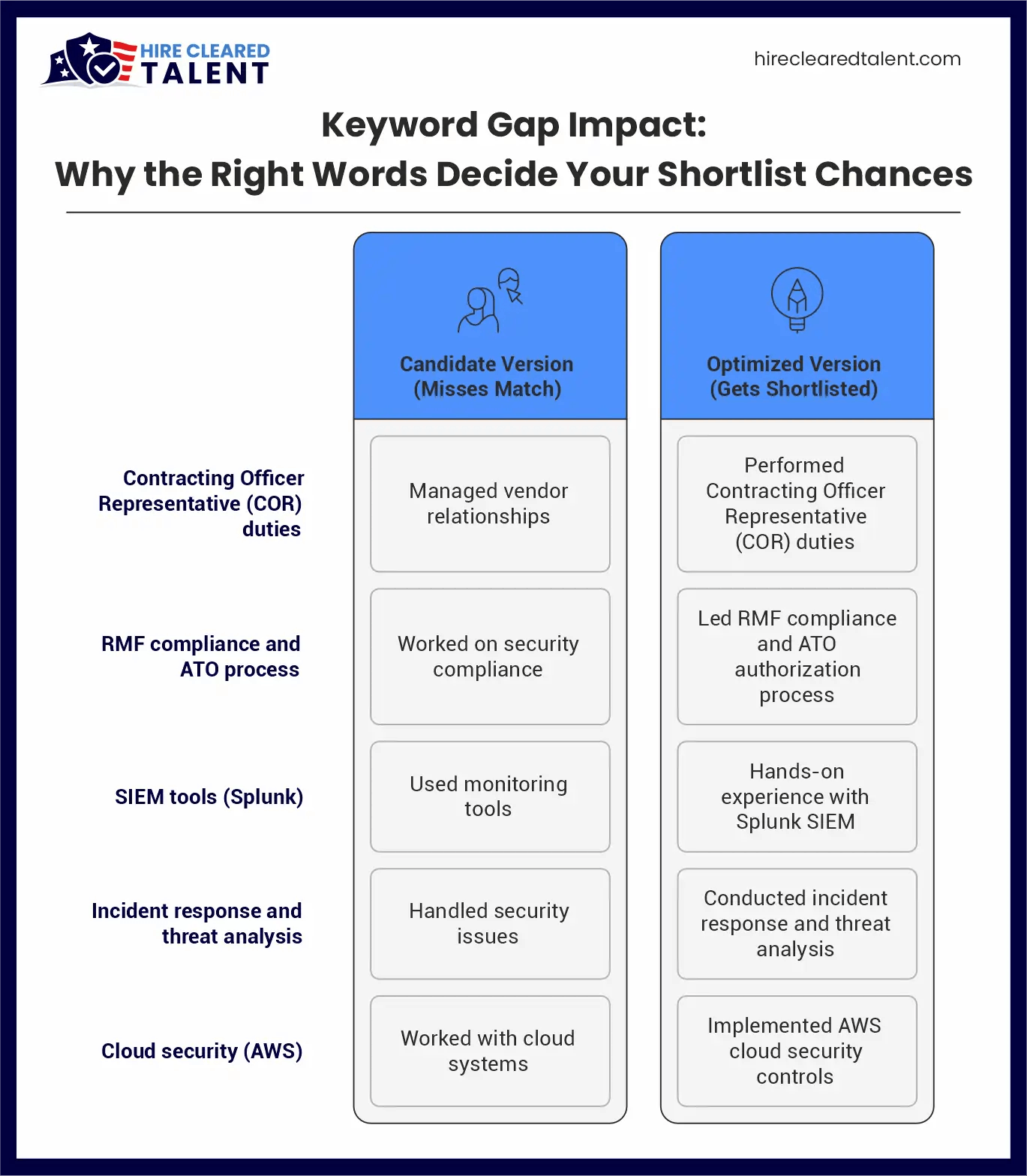
Keyword alignment is the highest-value use case for cleared job seekers right now. Federal and contractor ATS systems don't read resumes the way humans do. They parse text for specific language drawn from OPM competency frameworks, position classification standards, and the exact phrasing of each announcement.
A candidate who writes "managed vendor relationships" on a resume for a role requiring documented "contracting officer representative duties" will score lower than a candidate with identical experience who used the right terminology.
AI tools that compare your resume text to a job posting and surface language gaps can close that gap quickly and in this market, that gap is often the only thing standing between you and a human reviewer.
The numbers reflect how rapidly this has shifted. According to The Interview Guys' 2025 State of Job Search Report, 74% of hiring managers have already detected AI-generated content in applications, resumes and cover letters alike. That's how normalized AI use has become on the candidate side.
But the same research found that 58% of hiring managers are concerned about AI-generated applications, not because AI assistance is inherently wrong, but because the quality of AI-generated content varies dramatically, and volume has made differentiation harder for everyone. The lesson is not to avoid AI. The lesson is to use it precisely.
Interview preparation is the second area where AI genuinely earns its place. Cleared interviews routinely include behavioral questions tied to judgment, handling sensitive information, responses to foreign contact situations, and decision-making under ambiguity. These are categories where practice repetitions sharpen your ability to give structured, clear answers without hesitation.
AI platforms that let you practice specific questions, get feedback on pacing and specificity, and rehearse different response structures are useful tools. Composure reads as trustworthiness in cleared hiring and candidates who've spent time practicing hard questions don't just interview better, they signal something important about how they'll handle pressure in a classified environment.
Research and benchmarking is a third legitimate use. AI tools surface salary data, identify which roles are actively hiring at your clearance level, and help you map your background to different functional areas within the cleared space. Using AI as a research assistant not as the author of your application materials, is low-risk and genuinely useful.
The Risks That Only Exist in the Cleared World
Here is where most job search advice breaks down completely for this market-
General career platforms discuss the risk of AI-generated content sounding generic, which is real but manageable. What they never address, because they're not written for people with active security clearances, is a categorically different kind of risk.
Inputting work-related information into consumer AI tools is a security obligation issue, not a privacy preference. Inputting classified, proprietary, or sensitive data into an unsecured AI tool could violate Adjudicative Guideline K, Handling Protected Information, which governs the mishandling of sensitive data and is directly tied to clearance adjudication.
Consumer-grade AI tools, including widely used general-purpose chatbots are not certified to handle classified, ITAR-controlled, HIPAA-protected, or CJIS-sensitive information. These platforms often retain input data, process it through non-government-certified servers, and expose it in ways that can constitute unintended disclosure.
Your resume should never contain classified details regardless of how you're building it that's baseline. But the discipline extends further than most cleared professionals realize: it applies to how you describe your work in AI-assisted tools, how you draft cover letters through AI platforms, and how you frame operational context when using AI to prepare interview responses.
A person sitting in a SCIF describing their day-to-day work in a chatbot prompt even for job search purposes is exposing information that doesn't belong outside a cleared environment.
Nobody says this part out loud in most career content. But cleared recruiters see the downstream effects regularly. Candidates who describe program-sensitive details in AI-polished resumes often without realizing they've crossed a line create real problems for themselves and their potential sponsors.
As ClearedJobs.Net's experts note, your FSO is the right resource to consult when you're unsure where your specific limits fall. Consult before you use the tool, not after you've already pasted something sensitive into a prompt.
The counterintelligence dimension is also real and underappreciated. OpenAI's June 2025 threat report identified 10 distinct adversary campaigns, involving China, Russia, North Korea, and Iran using AI tools for coordinated espionage, cyberattacks, and identity subversion operations, including AI-generated fake resumes specifically designed to breach enterprise systems.
This isn't a future scenario. It's current tradecraft. And it means that cleared employers are reviewing AI-assisted applications with a counterintelligence lens that general employers don't apply. Vetting processes for cleared positions now increasingly assume that any professional profile could be AI-generated, which raises the scrutiny on every applicant, regardless of their actual background.
Read more- 7 Resume Tips for Security Cleared Talent Applying to Federal Jobs
What Cleared Employers Are Actually Seeing in 2026?
The volume problem is severe and getting worse. By 2025, 83% of companies use AI to screen resumes, up from roughly 48% just two years earlier, and that trend is accelerating. Recruiters are now managing 56% more open positions while processing 2.7 times more applications than three years ago. Defense contractors and federal employers processing cleared applications aren't immune to that flood, they're in the middle of it.
But the cleared market adds something no general hiring operation deals with. A 2025 survey by Insight Global found that 88% of hiring managers say they can tell when candidates are using AI to help with applications, cover letters, or resumes.
And 54% say they actively care whether a job seeker submits AI-written materials. For cleared employers specifically, where trust and judgment are the core professional currency that number carries more weight than it does in private-sector tech hiring.
Here's the compounding challenge. A 2024–2025 survey found that 64% of recruiters noticed a significant uptick in look-alike, AI-generated resumes, and this actually increased their screening workload because the flood of high-scoring but homogeneous applications created false positives.
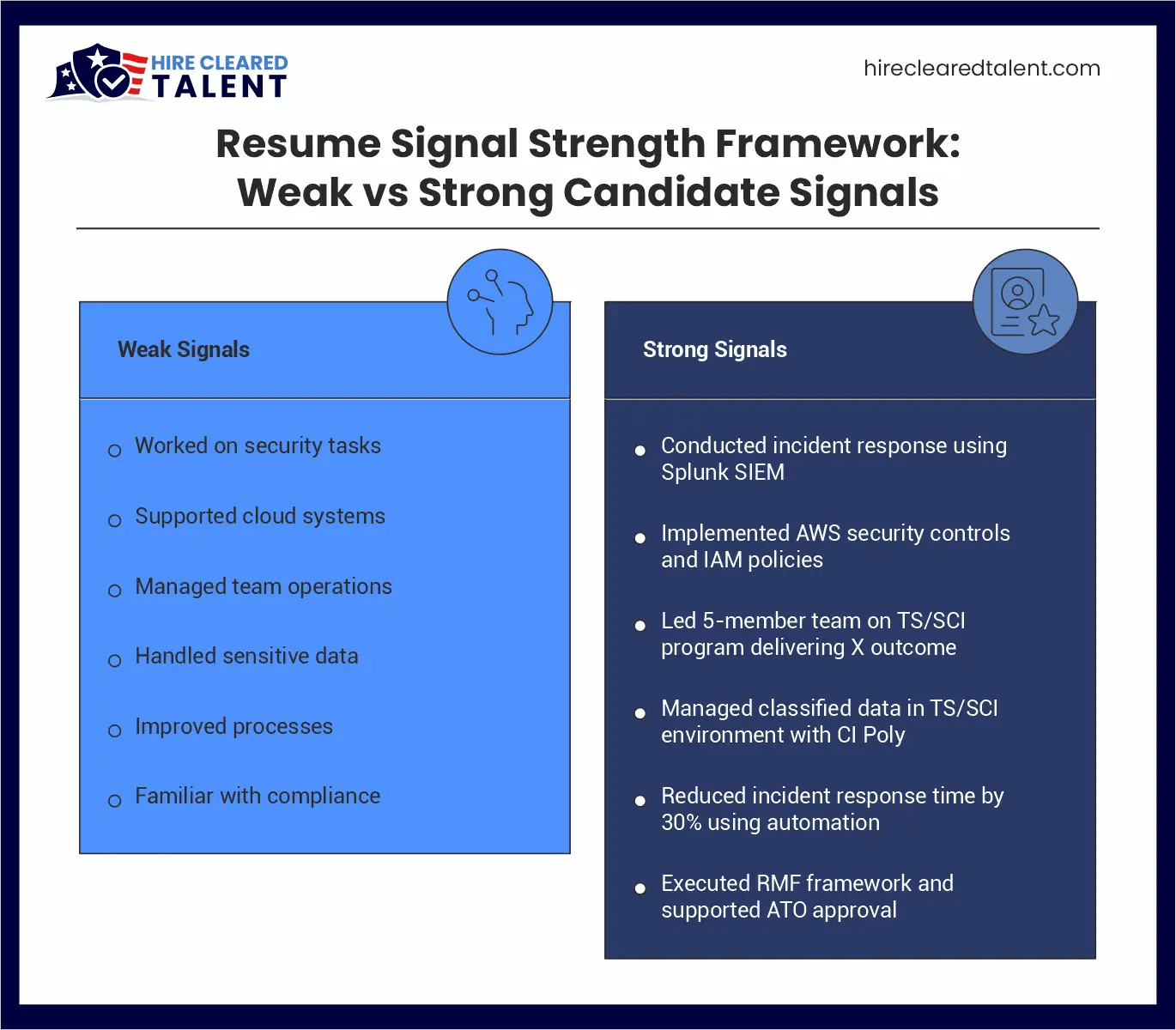
In the cleared space, the problem is sharper. Program managers and cleared recruiters read resumes looking for operational familiarity, signals that you've actually worked in classified environments, understand how mission-specific workflows function, and can be mission-effective from day one.
Generic AI-generated language doesn't produce those signals. It produces polished text that reads, to an experienced cleared recruiter, like someone describing their work from the outside.
The candidate who gets past both the ATS screen and the human review is the one who uses AI to surface the right language, then writes their own experience into those frames with enough specificity that the result could only have been written by them. That distinction is not subtle in this market. It's the whole game.
How Cleared Employers Are Using AI on Their Side of the Table?
AI now plays a central role in hiring decisions. Understanding this changes how you approach your job search.
By 2025, 99% of organizations use AI in hiring, with 98% reporting improved efficiency. AI goes beyond resume screening. It evaluates interview responses, ranks candidates against role requirements, and checks consistency across your application.
In the cleared market, over 60% of recruiters use AI tools to assess candidates. These systems flag mismatched dates, unclear career progression, and gaps between clearance level and experience.
This raises the stakes. Inconsistencies are not ignored. They can resurface during
background investigations. Trying to game the system with keywords or AI-generated content increases risk.
The approach is simple. Be accurate. Be consistent. Show clear alignment between your clearance, experience, and role. AI does not reward exaggeration. It rewards clarity and credibility.
The Practical Framework: How to Actually Use AI in a Cleared Job Search
Given everything above, here is how AI tools fit into a cleared job search without introducing unnecessary risk.
Use AI for language alignment - not content generation. Run your resume through a tool that compares your language to the job description and surfaces keyword gaps. Then close those gaps using your own words, written from your own experience. The output should sound like you, with the right vocabulary. Not like a template that any other cleared professional could have submitted with minor variation.
Use AI for research and benchmarking. Salary data, role analysis, clearance-level demand trends, industry mapping, this is useful information that AI tools surface efficiently. Use it to inform your strategy, not write it for you.
Use AI for interview rehearsal, not scripted talking points. The goal is repetitions, not polish. Cleared interviews test judgment and composure, not your ability to deliver a memorized answer fluently. AI interview prep tools are most useful when you're practicing varied questions repeatedly, building genuine fluency across different angles of the same core experience.
Keep sensitive information completely out of AI inputs. This is not optional and not a matter of degree. If you're unsure whether something crosses a line, default to leaving it out entirely and consult your FSO. The rule from the National Cybersecurity Alliance applies directly: don't input anything into an AI tool that you wouldn't share in a press release or post publicly and for cleared professionals, that standard is the minimum floor.
Proofread everything AI helps you produce. As cleared hiring practitioners have noted publicly, AI tools introduce specific errors that cleared professionals can't afford wrong job titles, inaccurate dates, exaggerated claims that can't be substantiated in a background investigation. Use AI as a refining tool, not a replacement for judgment. Review every line before it goes anywhere.
For cover letters, write your own. Cover letters for cleared roles should reflect specific knowledge of the program type, agency environment, or mission area you're targeting. That specificity can only come from you, and it's the part that actually gets read. A generic AI cover letter addressed to "the hiring team" for a cybersecurity role supporting an intelligence community program will not move you forward.
Read more- How to Qualify for Federal Security Clearance Jobs?
What the Numbers Say About AI Resumes in 2026- The Part Worth Paying Attention To
AI now plays a central role in hiring decisions. Understanding this changes how you approach your job search.
By 2025, 99% of organizations use AI in hiring, with 98% reporting improved efficiency. AI goes beyond resume screening. It evaluates interview responses, ranks candidates against role requirements, and checks consistency across your application.
In the cleared market, over 60% of recruiters use AI tools to assess candidates. These systems flag mismatched dates, unclear career progression, and gaps between clearance level and experience.
This raises the stakes. Inconsistencies are not ignored. They can resurface during background investigations. Trying to game the system with keywords or AI-generated content increases risk.
The approach is simple. Be accurate. Be consistent. Show clear alignment between your clearance, experience, and role. AI does not reward exaggeration. It rewards clarity and credibility.
Where HireClearedTalent Fits In?
Cleared hiring demands relationships, trust, and exact specificity. AI accelerates screening volume but doesn't deliver offers that still requires getting your TS/SCI/Poly and precise operational experience in front of the right recruiter at the perfect moment.
HireClearedTalent was built for exactly this reality, operating as a dedicated marketplace that connects security-cleared professionals directly to federal agencies and defense contractors across the United States, bypassing generic applicant queues filtered by meaningless keywords.
Our cleared hiring specialists understand the critical differences between ATS optimization for classified roles versus civilian positions. They track which employers need your clearance level right now, which programs prioritize your specific background, and how to position your experience so it reads as mission-credible rather than generically polished.
When you create a profile, you're not dropping into a void, your clearance status and functional expertise reach recruiters working exclusively in this space, people who know about roles before public posting and understand security constraints around describing classified work.
The cleared market punishes general workforce strategies but rewards clearance-aware execution. What are you waiting for? Your clearance is too valuable for generic job boards.
Create Your Profile
Schedule Call Today
FAQ-
Q1. Can I use AI tools for my security-cleared job search?
A1. Yes, but with limits. Use AI for general tasks like resume structure, research, and interview prep. Do not input sensitive or work-related details.
Q2. What are the risks of using AI in a cleared job search?
A2. The main risk is exposure of sensitive information. Entering program details or classified context into AI tools can create compliance issues and impact your clearance.
Q3. What do cleared employers expect when candidates use AI?
A3. Employers expect accuracy, consistency, and transparency. They want content that reflects your real experience, not AI-generated exaggeration.
Q4. Can recruiters detect AI-generated resumes or applications?
A4. Yes. Many hiring managers can identify AI-generated content based on generic language, inconsistencies, and lack of specificity.
Q5. How should I safely use AI for resume writing?
A5. Use AI to improve structure and clarity. Avoid sharing sensitive data. Always review and edit content to match your real experience.
Q6. Does using AI increase or decrease my chances of getting hired?
A6. It depends on usage. Proper use improves clarity and speed. Poor use creates inconsistencies and reduces trust.
Q7. What type of information should never be entered into AI tools?
A7. Do not include classified data, program names, client details, system architecture, or any sensitive operational information.
Q8. How are cleared employers using AI in hiring?
A8. Employers use AI to screen resumes, assess alignment, and detect inconsistencies before human review.
Q9. Can AI help with interview preparation for cleared roles?
A9. Yes. Use it to practice responses and structure answers, but avoid sharing real operational details during preparation.
Q10. What mistakes do cleared candidates make when using AI?
A10. Common mistakes include overusing generic content, adding inaccurate experience, and exposing sensitive information.
Weekly newsletter
Get the latest blog updates, practical hiring insights, and featured reads delivered straight to your inbox.
Read about our Privacy Policy.