


Leaving the military hands you two full-time projects at the same time. You have to find a civilian job, and you have to physically move your household, often to a state you have never lived in. Most service members underestimate how hard it is to run both at once.
You are not doing this alone. Approximately 200,000 servicemembers separate from active service each year, the U.S. Department of Labor reports. The market is on your side more often than not. In April 2026, the veteran unemployment rate sat at 3.7%, below the 4.2% rate for non-veterans, per DOL data.
The early months of 2026 were uneven, though. Veteran unemployment climbed to 4.5% in January before settling back down, according to the Institute for Veterans and Military Families. That swing is the real lesson. The people who handle transition well are the ones who plan the relocation and the job search together, months in advance.
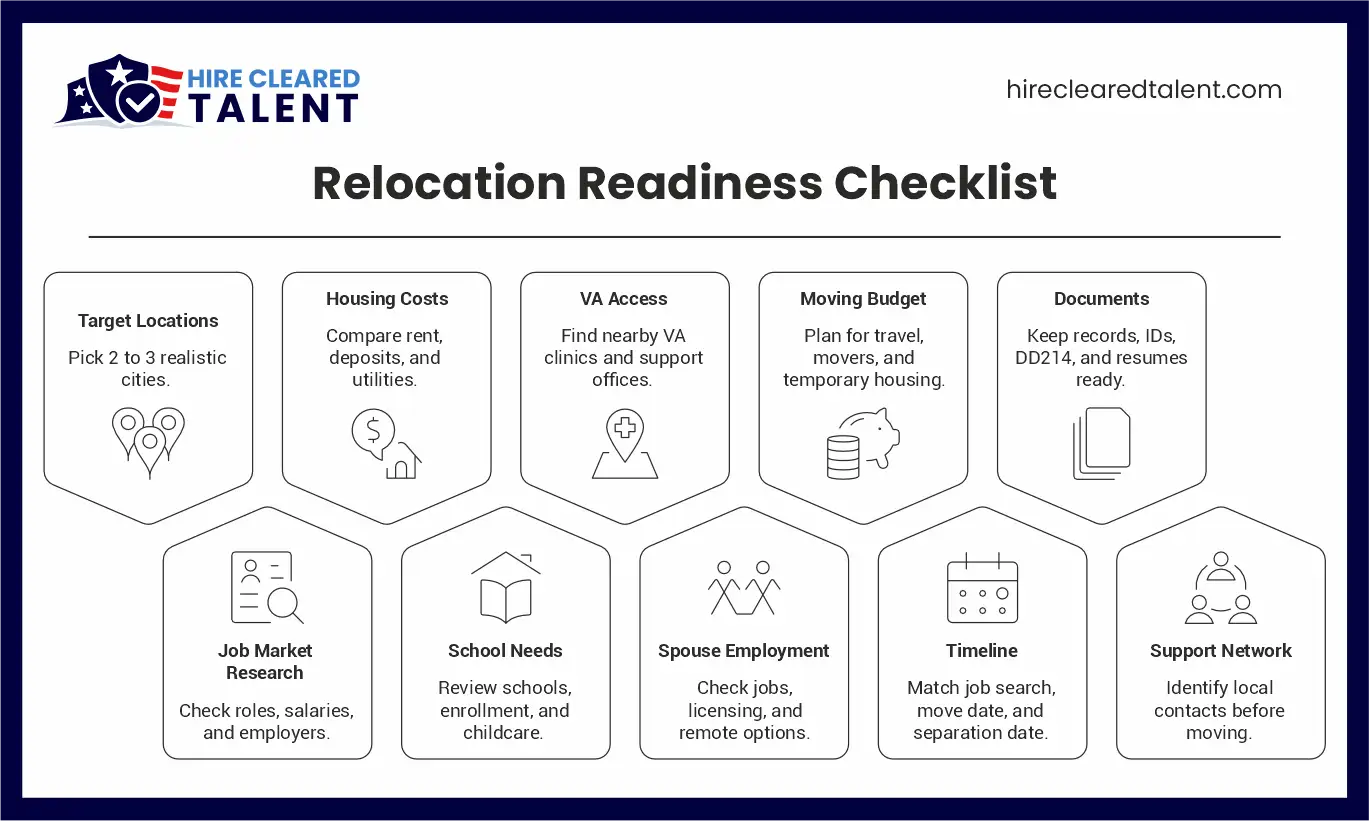
If you hold a security clearance, you are carrying a credential that pays. More on that below. First, the timeline.
Steps to Plan a Smooth Career Relocation After Leaving the Military
Start Early: Preparing for Transition
Set a timeline for your career relocation
Work backward from your separation date. That date is fixed, so build every other deadline around it.
If a service member begins the process of looking for a job six months prior to separation, he/she is much more likely to find a job before his/her separation. The DoD transition guide, which provides a review of the research on the issue, says that six months is the minimum, but not the goal. Give yourself twelve.
A workable timeline looks like this. At twelve months out, start your transition counseling and open your job search. At six months out, have a finished civilian resume and applications going out. At ninety days out, finalize your housing and moving plans and confirm start dates. Your final weeks fill up fast with medical appointments, out-processing, and clearing your unit. Do not leave the big decisions for that window.
Here is how that plays out. By the end of December 2011, a separating staff sergeant needs to have interviewed for a job by January and gotten an offer by March. This will give the individual sufficient time to arrange the relocation, get the children registered at a new school, and start work within a few weeks of separation, rather than arriving in a new place without money or plans.
Meet with a transition counselor
Your first real step is a one-on-one with a transition counselor. Federal law requires you to begin this no later than 365 days before you separate. You can start sooner. It is recommended to start the process of separation 18 months before and for retirees, 24 months.
Contact your career counselor as soon as you can, regardless of whether you know where you would be going. A counselor can develop an Individual Transition Plan, which outlines your objectives concerning employment, education, housing, and financial well-being. Beginning to develop this plan will not obligate you to leave the military.
Utilize Transition Resources
Transition Assistance Program (TAP)
TAP is the government-sponsored program that aims to prepare you for civilian life, and it is mandatory.
The program takes place within the minimum of twelve months and consists of pre-separation counseling, Department of Labor employment workshop, VA benefits seminar, and skills translation session known as Military Occupational Code Crosswalk according to Military.com. In addition, you have to choose one of the two-day tracks that focus either on employment, education, vocational training, or entrepreneurship.
Your Capstone will be signed off by your commander within 90 days prior to your separation. See the program as an opportunity rather than something you should just check off. You are free to go through it more than once, do it.
There are two more programs worth your attention. If you are separated in the last 180 days of your service, DoD SkillBridge will enable you to participate in an internship program within a civilian company while being paid by the army. Additionally, Military OneSource will stay with you and your family for one year after your separation.
Verification of Military Experiences and Training (VMET)
Bring out your VMET and DD Form 2586 as you go. This will detail your training and convert your experience in the military into something a civilian company can understand. You will use it to back up your resume and to claim civilian certifications tied to skills you already have. Do not wait until after separation to find it. Download it while you still have access to your military systems.
Read more- Veteran Job Placement Agencies: How to Find the Right Talent Faster in 2026
Translate Military Skills to Civilian Roles
Update your resume with civilian-friendly language
A hiring manager at a defense contractor may understand military jargon. A recruiter at a commercial tech firm will not. Strip the acronyms and the rank-heavy phrasing and write in plain results.
Numbers make your resume concrete. Instead of "responsible for logistics," write "managed $2.4 million in equipment and supplies with zero loss over 18 months." Instead of "led soldiers," write "supervised and trained 25 personnel." Employers read outcomes faster than they read duty descriptions.
Keep the resume to civilian norms. One or two pages. A short summary at the top. Skills and tools listed clearly. If you hold a clearance, state the level and status near the top, because for a lot of roles that single line gets your resume read first.
Identify transferable skills
You built more marketable skills than you probably give yourself credit for. Leadership under pressure, project management, supply chain and logistics, security operations, maintenance, and instruction all map directly to civilian roles.
A few concrete matches help. A motor transport operator moves into fleet or operations management. An intelligence analyst moves into cyber threat analysis or data work. A combat medic moves into healthcare, EMS, or clinical support. A signal or communications specialist moves into network and systems administration. Name the civilian title on your resume, then prove it with the work you already did.
Your clearance sits in its own category. It represents a completed federal background investigation that an employer would otherwise wait months to obtain. Protect it. If you let it go inactive, you lose negotiating room the moment you start applying.
Build Your Professional Network
Connect with mentors and veterans in your field
Jobs are primarily obtained through personal contacts, not through portals. Begin by contacting those who left the service one to three years ahead of you and have a job in the industry that you aspire to. They will know which companies are good for veterans, which recruiters respond to emails, and how much is a proper salary.
Contact them directly. An individual message works better than an open-ended request. Explain your credentials, separation date, and the two jobs you are seeking. Request for 20 minutes.
Attend networking events
Go to veteran-focused career fairs, both in person and virtual. Cleared job fairs are especially worth your time if you hold a clearance, because every employer in the room already understands what your clearance is worth.
Geography matters here, and it ties straight into your relocation decision. Clearance jobs are primarily located in and around Washington, D.C. According to the 2026 ClearanceJobs compensation survey, the most highly compensated states for cleared employees include Virginia, Maryland, and District of Columbia, with total average salary ranging from approximately $136,000 to $139,000. If your field is cleared work, that corridor may decide where you move.
Financial Planning for Career Relocation
Save and budget for the transition
A move costs more than people expect. A complete cross-state relocation job for a 2-4 bedroom house costs around $4,500 - $13,000 in 2026, according to Nelson Westerberg. Moving prices rose about 21% by mid-2026 as fuel costs climbed, per moveBuddha. Summer is the most expensive time to move, so if you can schedule between October and April, you will pay less.
Build a cash buffer before you separate. Three to six months of living expenses is a reasonable target. Your final military paycheck, your terminal leave payout, and your first civilian paycheck rarely line up neatly, and a gap of a few weeks is common. Sell or donate what you do not need, since long-distance movers charge by weight.
But it’s not just the truck. It could cost up to $9,000 to move across country with a full-service moving company, plus $1,500 for travel and lodging for the trip, plus $1,200 for deposits and utility hook-ups, plus rent overlap for a month. That’s almost $12,000 before you ever get paid your first civilian salary. Plan for it now, not in your final month.
Explore military retirement and benefits options
Know what you have earned. If you served 20 years or more, you have a pension. Under the Blended Retirement System, you also have a Thrift Savings Plan balance and any government match to manage. Do not cash out the TSP on impulse.
File for VA disability early. The Benefits Delivery at Discharge program lets you file a claim 90 to 180 days before separation, which can start your benefits sooner. Check your GI Bill balance if you plan to study and use your VA home loan benefit if you plan to buy at your new location.
These benefits carry real dollar value, yet about half of recently separated veterans do not connect with their earned resources for years, according to Performance.gov. Do not be in that half.
Read more- Resume Writing for Veterans: A Step-by-Step Guide to Landing Civilian Jobs
Job Search Strategies
Research industries suited to your skills
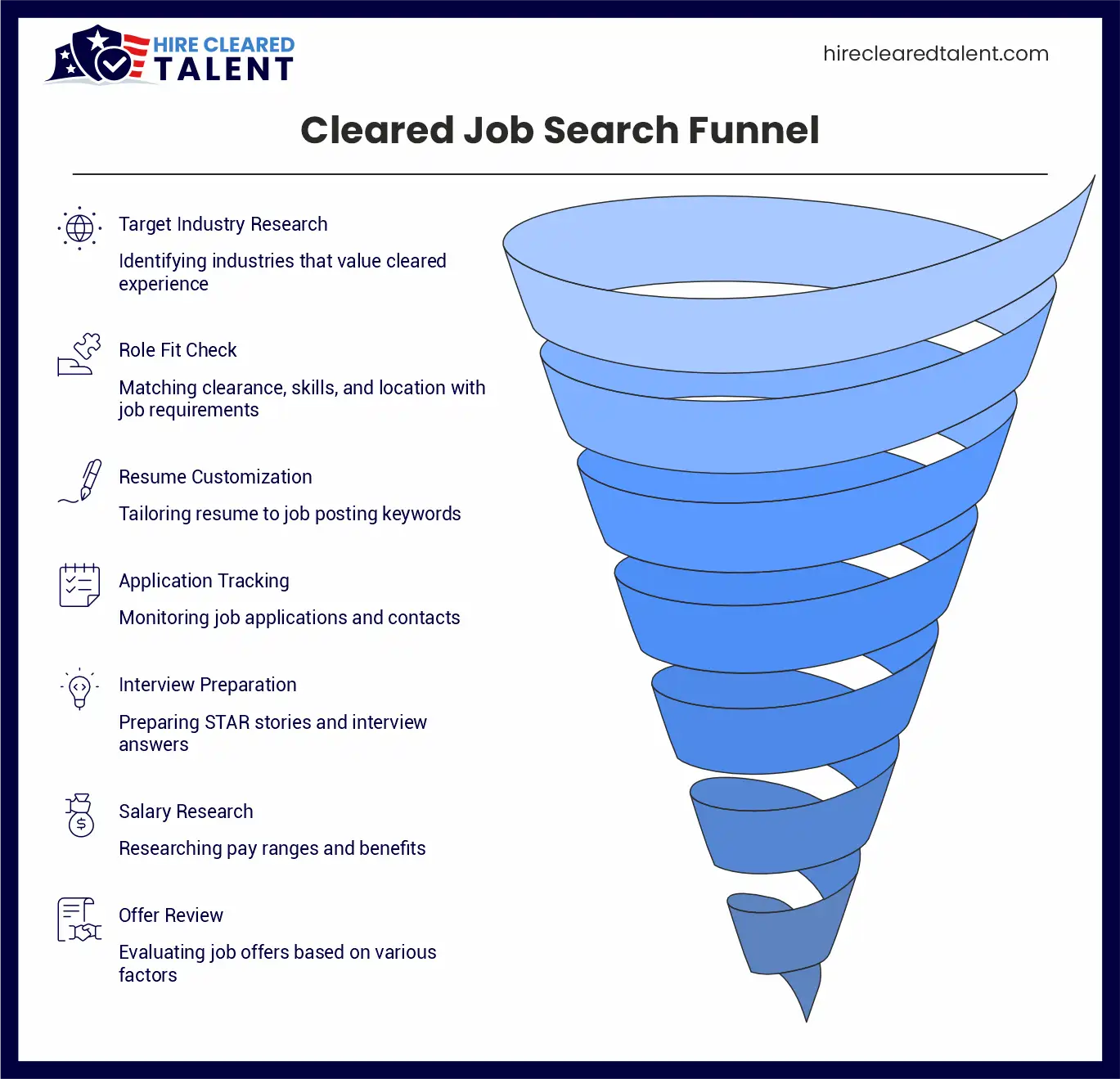
Point your search where your background pays the most. For cleared professionals, that means defense, intelligence, cybersecurity, IT, and government services. If you are unsure where you fit, look at the labor categories on active federal contracts, which spell out the exact experience and clearance levels employers are paying for right now.
The pay is strong and rising. Average total compensation for cleared professionals hit an all-time high of $126,125 in 2026, up nearly 6% year over year. Hold a full-scope or lifestyle polygraph and the average climbs to $149,875, close to $30,000 more than cleared professionals without one.
The market is active, too. About 78% of cleared professionals said they were at least somewhat likely to change jobs within the year, which tells you employers are competing hard for people like you.
Apply for jobs and prepare for interviews
Customize all applications. Ensure that the words on your resume align with the terms on the posting; most often for computer-screened jobs, it is important that the terms match in order to pass the screening process. Narrow your list to only those positions that you are really eligible for.
Organize your interviewing technique. Employ the STAR technique in answering behavioral interview questions; this entails situation, task, action, and result. Research salary ranges before you walk in, so you can negotiate from facts. And confirm the clearance requirement for every role, since a mismatch there wastes everyone's time.
Conclusion
A smooth relocation after the military comes down to sequencing. Start your transition counseling twelve months out. Use TAP, SkillBridge, and Military OneSource fully. Translate your experience into civilian results. Build your network before you need it. Budget for the move, and protect the benefits you earned. Run your job search where your skills and your clearance are worth the most.
One last point for cleared professionals. Your clearance is one of the most valuable things you own on the civilian market, and it can lapse if you stay out of cleared work too long after separation. Keep it active by lining up your next cleared role before you leave.
That is where HireClearedTalent helps. It is a marketplace built only for security-cleared professionals and the agencies and contractors that need them. You create a profile, list your clearance level and status, and let cleared employers find you. Your next role, and your next mission, can start before your separation date.
Ready to plan your transition around a cleared job? Create your profile on HireClearedTalent today. But if you still face any problem or want to discussed something else? Feel free to connect with us.
Book a call with Our Experts Today!
FAQ-
Q1. When should I start planning career relocation after leaving the military?
A. Start 12 months before separation when possible. This gives you time to choose target locations, research employers, update your resume, compare housing costs, and prepare your family for the move.
Q2. Should I choose a job first or a location first after military separation?
A. It depends on your priorities. Choose the job first when career growth and income matter most. Choose the location first when family support, schools, healthcare, or spouse employment matter more.
Q3. How do I decide where to move after leaving the military?
A. Compare each location by job demand, salary range, housing cost, schools, VA access, commute time, spouse job options, and long-term career growth.
Q4. How do I match my military experience to civilian jobs in a new city?
A. Look for roles where your leadership, operations, technical, logistics, cybersecurity, intelligence, or project management experience solves real employer needs. Use civilian job titles, not military-only language.
Q5. What should I research before applying for jobs in another state?
A. Research salary ranges, cost of living, major employers, clearance requirements, commute patterns, licensing rules, and remote or hybrid work options.
Q6. How do I handle interviews while still on active duty?
A. Be clear about your availability, separation timeline, relocation plans, and start date. Keep your calendar organized so interviews do not conflict with duty obligations or transition appointments.
Q7. How should I prepare my resume for a relocation job search?
A. Use the job posting as your guide. Match your resume to the employer’s language, list relevant skills clearly, and explain your military experience in terms civilian hiring teams understand.
Q8. Should I mention relocation in my resume or cover letter?
A. Yes, when it helps the employer understand your plan. Add a short line such as Relocating to Dallas in August 2026 or Available to relocate after military separation in September 2026.
Q9. How do I manage housing while searching for a civilian job?
A. Avoid rushing into a long lease before you understand your job location and commute. Compare temporary housing, short-term rentals, family support, and employer relocation help.
Q10. What should military families consider before relocating?
A. Review school districts, childcare, spouse employment, healthcare access, family support, safety, commute times, and the cost of settling into the new area.
Weekly newsletter
Get the latest blog updates, practical hiring insights, and featured reads delivered straight to your inbox.
Read about our Privacy Policy.