


James had been out of the Army for eleven days when his phone went quiet. He'd spent eight years as a 35F - all-source intelligence analyst, two overseas deployments, active Secret clearance. His resume listed the right acronyms. His experience was real.
But the responses from job listings were either automated rejections or radio silence, and his separation date was already in the rearview mirror. He wasn't unqualified. He was invisible. And the reason though nobody told him this directly was that the hiring process he was trying to use wasn't built for someone like him.
That's the gap that veteran job placement agencies are supposed to fill. Whether they actually do it depends almost entirely on which one you're working with, and how deeply the agency in question actually understands the cleared hiring market.
The Difference Between "Veteran-Friendly" and Actually Useful
There's a phrase that gets thrown around constantly in federal and defense contracting circles: veteran-friendly. Defense contractors put it in their recruiting materials. Federal agencies list it in their employer branding. Staffing firms use it on their homepages like a badge.
But here's what that phrase usually means in practice, they'll consider your application without penalizing you for the gaps in your resume that come from being deployed. That's the floor. It's not a differentiator; it's just basic decency. And confusing "veteran-friendly" with a genuine capability to place cleared veterans quickly is where a lot of hiring managers go wrong.
A veteran job placement agency that's actually useful in 2026 does something specific: it maintains an active, vetted pipeline of candidates who already hold security clearances, has already verified their investigative close dates inside DISS, knows which candidates are currently in a SkillBridge window and deployable within 30 days, and understands which DoD 8140 labor categories their candidates satisfy.
That's a different capability set than posting jobs to a veteran-focused job board and calling it sourcing.
Why Speed Is the Only Currency That Matters Right Now?
Filling cleared roles takes 41 to 60 days under ideal conditions. When a security clearance investigation is still open or needs to transfer between agencies, that timeline balloons to anywhere from 6 to 18 months. And because most defense contractors can't bill uncleared labor against a contract meaning they're paying for a body that isn't yet legally authorized to do the work every day a key personnel slot sits empty is a direct hit to contract revenue.
Per an analysis of 2026 federal contracting pipeline projections from CCS Global Tech, staffing agencies that specialize in pre-cleared talent cut hiring time by approximately 40% compared to general market recruiting.
That number has real dollar consequences. A contract worth $4 million with a six-person key personnel requirement doesn't just stall operationally when those seats are empty, it risks the kind of contracting officer scrutiny that generates cure notices and past performance dings that follow a firm for years.
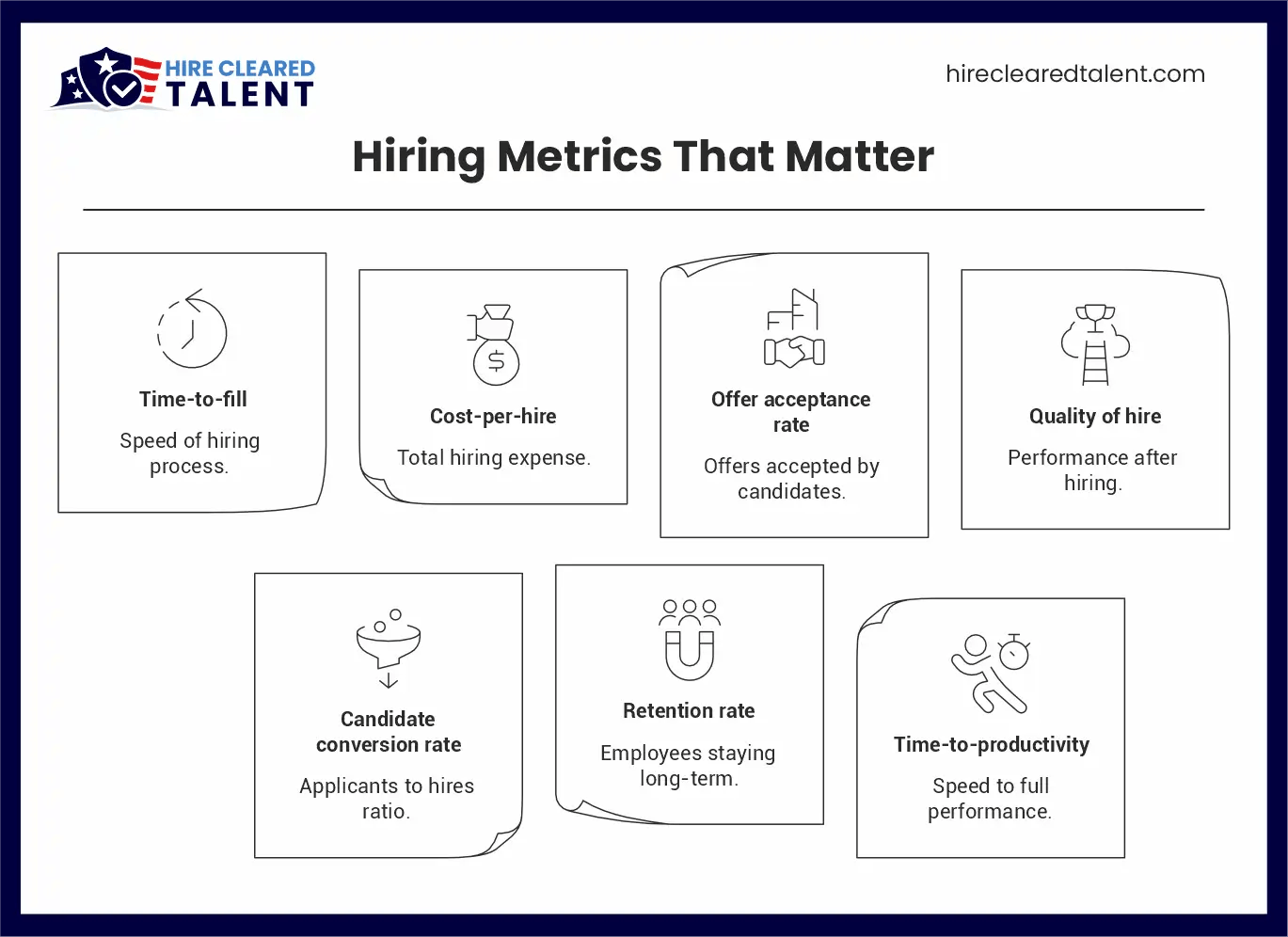
So, when a hiring manager asks which veteran placement agency they should work with, the answer has to start with a very simple question: how quickly can they put a cleared, role-qualified veteran in a seat that's actually billable? Everything else is secondary.
What to Look For And What to Look Past?
Here's what most people in this industry don't say out loud: a lot of veteran job placement agencies are essentially resume middlemen operating on the assumption that "veteran" is a search filter, not a qualification.
They pull profiles that mention military service, screen for basic keyword matches, and present candidates to clients without any real vetting of clearance status, scope, or currency. The contractor assumes the agency has done the work.
The agency assumes the contractor knows what questions to ask. And somehow, nobody asks whether the candidate's TS/SCI is still in scope or whether there's a suitability issue sitting in a pending adjudication queue.
The result and this plays out more than anyone publicly admits is that a hiring manager schedules six interviews, extends two offers, and then watches both candidates fall out of onboarding because their clearance status wasn't what it appeared on paper. The contract clock is still ticking. The account manager is apologizing. Nothing is moving.
Agencies worth working with do the following from day one: they verify investigative close dates, they maintain active relationships with transitioning service members through SkillBridge authorizations and TAP programs on actual military installations, and they can speak specifically to a candidate's DoD 8570/8140 certification status before they ever send a resume. Not after. Before.
The Veteran Hiring Numbers - What They Actually Mean for Contractors?
The annual average unemployment rate for veterans was 3.0% in 2024 - lower than the 3.9% rate for nonveterans, according to the U.S. Bureau of Labor Statistics. That sounds like good news for veterans. But the picture is more complicated.
By January 2026, the veteran unemployment rate had climbed to 4.5%, with post-9/11 veterans - the cleared, technically trained cohort that defense contractors most need seeing their jobless rate reach 5.8%, per Military Times.
What that shift actually signals is a federal labor market in contraction. Federal government employment has been declining for consecutive months, and the veterans most embedded in that workforce - the ones who transitioned from service into GS roles or contracting positions tied to government-funded programs are now re-entering a job market that's absorbing shock at exactly the wrong time.
For defense contractors, this creates a counterintuitive opportunity. Because when cleared veterans leave government positions - voluntarily or otherwise, their clearances remain active. Their skills are current. They're motivated.
And most of them are not going to spend six months being invisible on a general job board. They'll gravitate toward agencies that actually know this space.
Veterans hold substantial representation across the entire federal workforce - the Defense Department and VA alone employ more than 435,000 veterans, per the Partnership for Public Service.
Many of those professionals are now exploring contractor roles. The question is whether your hiring pipeline is positioned to reach them or whether you're waiting for them to find you.
The SkillBridge Window: The Single Most Underused Sourcing Opportunity in Defense Contracting
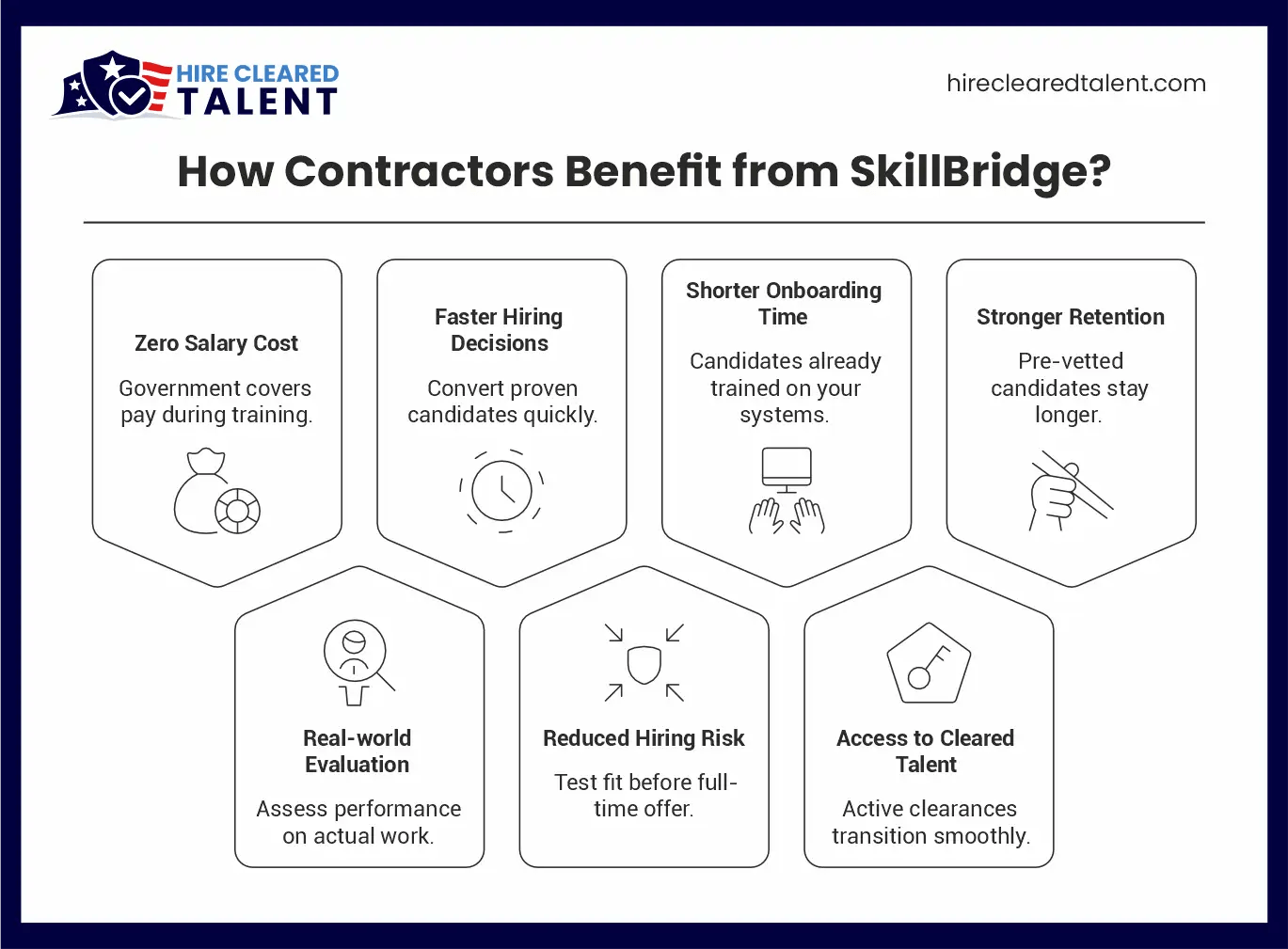
Think of SkillBridge like a pre-hire extended test drive that the Department of Defense pays for. Service members in their final 180 days of active duty can work full-time with a contractor gaining civilian experience, proving their capabilities, getting their clearance transferred while their military pay and benefits continue.
The government is funding the candidate's salary. The contractor gets risk-free evaluation time. The veteran gets a real job before they separate.
It sounds too clean to be true. But it works, and the hiring statistics for contractors who run disciplined SkillBridge programs are notably better than those who don't. And yet most mid-tier defense contractors either don't know it exists or don't have a formal process to accept participants.
A veteran placement agency that genuinely operates in this space will have active SkillBridge pipelines running meaning they're embedded with transition assistance program offices at military installations, they're pre-screening candidates months before separation, and they're presenting contractors with talent that has already been evaluated rather than talent that needs to start from scratch.
Two Scenarios That Illustrate the Divide
Scenario One- A program manager at a mid-tier IT services firm supporting a major intelligence community customer had a senior cybersecurity analyst vacancy that had been open for four months.
He'd been working with a generalist staffing agency that kept sending candidates who either lacked the right clearance scope or had investigative dates that were approaching the reinvestigation threshold.
He switched to a cleared-specialist agency with an active veteran pipeline. Within three weeks, he had a candidate in final interviews - a Navy veteran with an active TS/SCI, a CISSP, and a SkillBridge authorization that let him start full-time at the contractor before his official separation date. The seat was filled. The position was billable. The four-month clock stopped.
Scenario Two- A program director at a large federal IT services firm tried the opposite approach posting to a veteran-focused general job board, collecting applications, running them through HR screening. Three months in, she had 90 resumes, four candidates who made it through initial screening, and zero who cleared the clearance verification step without some kind of administrative issue.
The problem wasn't the candidates. It was that nobody in the process had actually checked clearance status before the offer was extended. One candidate's TS had lapsed due to a gap in employment. Another's SCI access had been deactivated when their previous contract ended. A properly structured veteran placement agency would have caught both of those before the first interview.
What the Right Agency Relationship Actually Looks Like?
Speed, clearance verification, and SkillBridge access are table stakes. But there's a fourth dimension that separates good cleared veteran placement agencies from great ones: their understanding of DoD 8140/8570 mapping.
Under the DoD 8140 framework which governs cyber workforce roles across all defense contracts - every labor category has specific certification requirements. A candidate for a CSSP Analyst role needs a different certification baseline than a candidate for an infrastructure support role.
An agency that can't tell you off the top of its head whether a given veteran's Security+, CEH, or CISSP satisfies the 8140 requirements for your specific contract labor categories is going to cost you time in onboarding. That's not a hypothetical inefficiency. It's a billable delay.
Under the current VEVRAA framework enforced by the Office of Federal Contract Compliance Programs, the national veteran hiring benchmark for federal contractors is 5.2%, effective March 31, 2024.
That benchmark matters both for compliance and for contracting competitiveness - winning contracts increasingly depends not just on technical capability but on demonstrating that you have cleared, mission-ready personnel on deck before the contract even starts.
Agencies that help you build a pipeline prior to award are contributing to your capture strategy, not just your hiring function.
The Honest Answer About What Most Agencies Get Wrong
The honest answer, after watching this play out across two decades of cleared hiring, is that most veteran placement agencies make a fundamental error in their operating model: they treat clearance as a checkbox rather than as a living credential that requires active verification and timeline management.
A clearance doesn't exist in a vacuum. It sits inside DISS with an investigative close date, a scope, a set of conditions, and potentially an open period of concern that only someone who knows how to read that record would catch.
When an agency presents a candidate as "cleared at TS/SCI" without verifying the actual status of that access not the eligibility, the actual in-access status, they're putting the contractor in a position where they might extend an offer, initiate onboarding, and wait three weeks before someone discovers the candidate's access was suspended at their previous assignment.
That's not a theoretical edge case. It happens routinely. And the agencies that don't let it happen are the ones worth building a relationship with.
Why HireClearedTalent Is Built for This Market?
At HireClearedTalent, we've spent years building exactly the kind of pipeline that makes the scenarios above go differently. Our veteran talent network isn't assembled through keyword searches.
It's cultivated through direct relationships with service members at the transition stage - people who have current investigative close dates, active clearances, and the DoD 8140 certifications that defense contract labor categories actually require.
We verify clearance status, not just clearance eligibility. We know the difference between an active SCI access and a lapsed one. We maintain SkillBridge partnerships at military installations so that our clients have access to candidates who are still on active duty, still getting paid by the government, and still available to evaluate before any offer is made.
And we know this market - the friction points, the timeline math, the compliance requirements under VEVRAA, the clearance transfer process under Trusted Workforce 2.0. Because this is all we do.
If your veteran hiring pipeline isn't producing cleared, role-qualified candidates within a timeline that your contracts can actually survive, we'd like to change that. Create your profile on hireclearedtalent and find the right talent.
Reach out to us and let's talk about what your specific staffing gap looks like and how to close it before it becomes a contract performance issue.
Connect with Our Experts Today!
FAQ-
Q1- How do veteran job placement agencies speed up hiring for employers?
A- They provide pre-screened candidates, reduce sourcing time, and present qualified talent ready for interviews. This shortens the hiring cycle and improves decision speed.
Q2- What should employers look for in a veteran placement agency?
A- Focus on agencies with strong military networks, proven screening processes, and experience in your industry. A structured pipeline is a strong indicator of quality.
Q3- How do placement agencies assess veteran candidates before submission?
A- They evaluate technical skills, clearance status, experience, and role fit. Many also conduct behavioral and cultural fit assessments.
Q4- Can veteran placement agencies help with cleared and non-cleared roles?
A- Yes, many agencies specialize in both. Some focus heavily on cleared roles for defense and federal contracts.
Q5- How do veteran hiring pipelines differ from traditional recruiting?
A- Veteran pipelines are often built in advance through transition programs and military networks. This gives access to candidates before they enter the open job market.
Q6- What role does SkillBridge play in faster hiring?
A- SkillBridge allows employers to evaluate candidates during active duty. This reduces hiring risk and speeds up full-time conversion.
Q7- How do agencies ensure candidate quality and job fit?
A- They match candidates based on skills, experience, and mission alignment. Pre-screening reduces mismatches and improves hiring outcomes.
Q8- Are veteran candidates easier to onboard?
A- Many veterans adapt quickly due to structured training and experience. Their background often supports faster integration into teams.
Q9- How can agencies reduce time-to-fill for critical roles?
A- They maintain active talent pools and deliver ready-to-interview candidates. This removes delays caused by sourcing and screening.
Q10- What industries benefit most from veteran hiring?
A- Defense, cybersecurity, IT, logistics, and operations roles see strong alignment with veteran experience.
Weekly newsletter
Get the latest blog updates, practical hiring insights, and featured reads delivered straight to your inbox.
Read about our Privacy Policy.