


Marcus had twenty-two years in. Two combat deployments, a Top Secret/SCI clearance, and a binder full of NCOERs that would make any senior leader proud. When he sat down to write his resume the week after terminal leave started, he stared at a blank Word document for two hours.
He knew exactly what he'd done - running intelligence operations, managing a team of twelve across three time zones, briefing general officers on threat assessments. But he had no idea how to say any of it in a way that would make sense to a defense contractor's HR department in Virginia.
That gap between what veterans have actually done and what civilian hiring managers can understand is where good candidates get lost. And in the cleared hiring space, it's particularly costly, because the people most likely to hold an active clearance are often the ones least practiced at marketing themselves on paper.
The Translation Problem Nobody Prepares You For
The military trains you to do extraordinary things. It does not train you to describe those things in civilian terms. That's not a criticism, it's just the reality of two very different professional cultures operating with entirely different vocabularies, hierarchies, and success metrics.
Think about what a security clearance actually represents in this market. There are currently an estimated 70,000 more open positions than there are candidates with security clearances to fill them. Your clearance is valuable genuinely, measurably valuable. But it doesn't automatically land on a civilian hiring manager's desk in a way they recognize if everything else on your resume reads like a DD-214 summary.
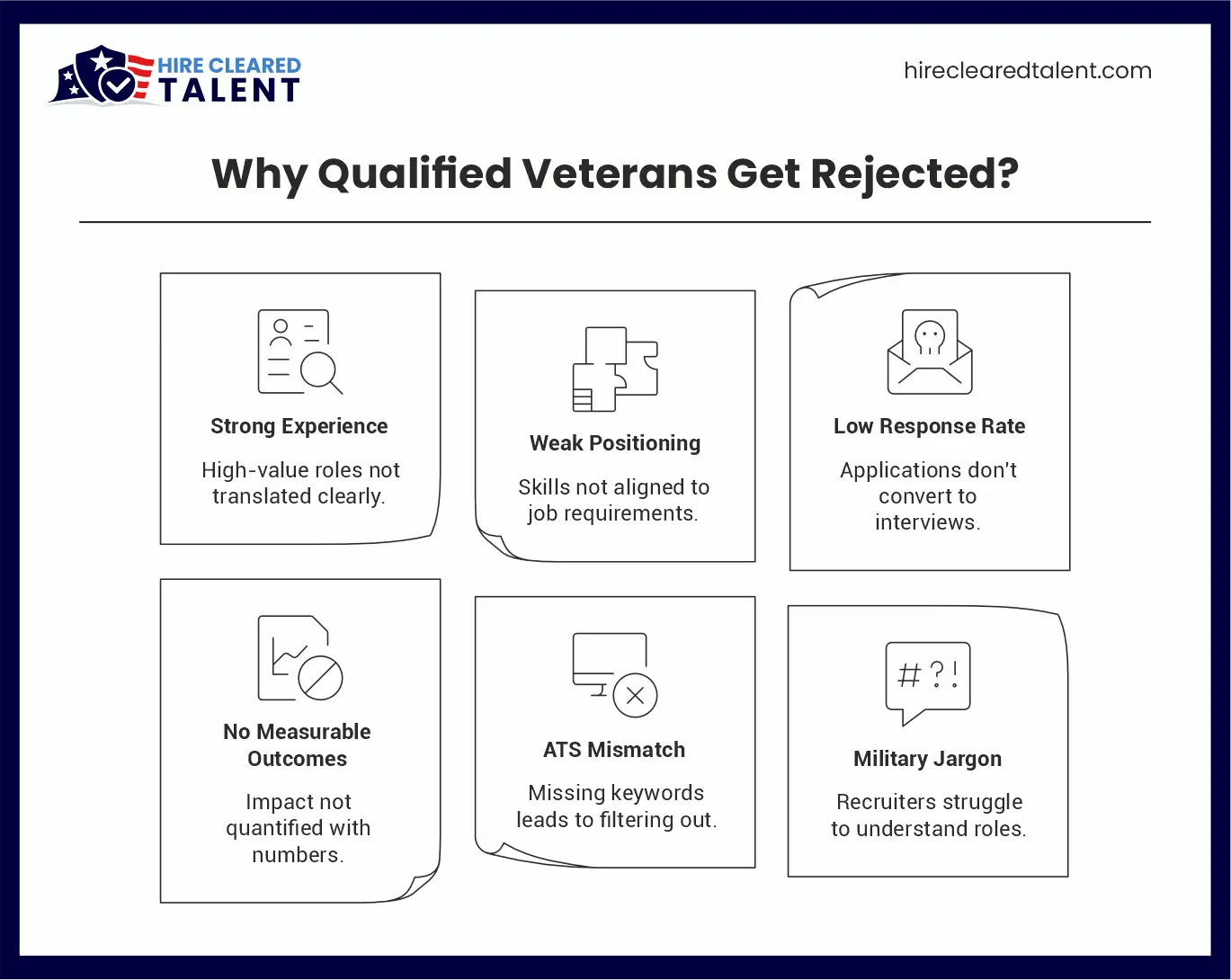
The friction shows up fast. When a veteran lists "NCOIC of a battalion-level S2 section," they've accurately described a serious leadership and intelligence management role. But to a civilian recruiter at a large federal IT services firm scanning fifty resumes in an afternoon, that phrase means almost nothing. It goes in the "unsure" pile, or worse- it doesn't get past the initial filter at all.
So, the first thing to accept is that translation is your responsibility. The hiring manager won't do it for you, and the automated filtering systems certainly won't.
The honest truth - after two decades in this industry
Here's what most people in this industry don't say out loud: a lot of veterans with genuinely elite backgrounds lose cleared civilian jobs not because they're underqualified, but because their resumes are written for a promotions board, not a hiring manager.
Military evaluation reports are structured to communicate up a chain of command that already understands the context - the MOS, the unit, the mission set. Strip that context away and you've got a document that signals competence to the wrong audience.
The resume that got you promoted to Master Sergeant is almost certainly not the resume that gets you hired as a senior intelligence analyst at a defense contractor. They're different documents for different purposes, and very few transition programs actually explain that distinction clearly enough to stick.
5 Resume Writing Steps for Veterans
Step 1 - Audit What You've Got, Then Set It Aside
Before you write a single new line, pull out your most recent performance evaluations, awards citations, and any duty descriptions you've accumulated. Read them carefully. These documents contain the raw material you need but you're not copying them. You're mining them for facts: scope of responsibility, personnel managed, budget overseen, outcomes achieved.
Write those facts down in plain language, as if you're explaining them to a smart friend who has never served. Not "maintained accountability of MTOE equipment valued in excess of $2.4M" but "tracked and managed $2.4 million in equipment with zero loss over a 36-month period." The underlying achievement is the same. The second version communicates it to someone without military context.
Do this extraction exercise before you touch a resume template. Once you've got a clean list of concrete accomplishments and responsibilities in plain English - you have something to work with.
Step 2 - Lead with the Clearance, But Don't Stop There
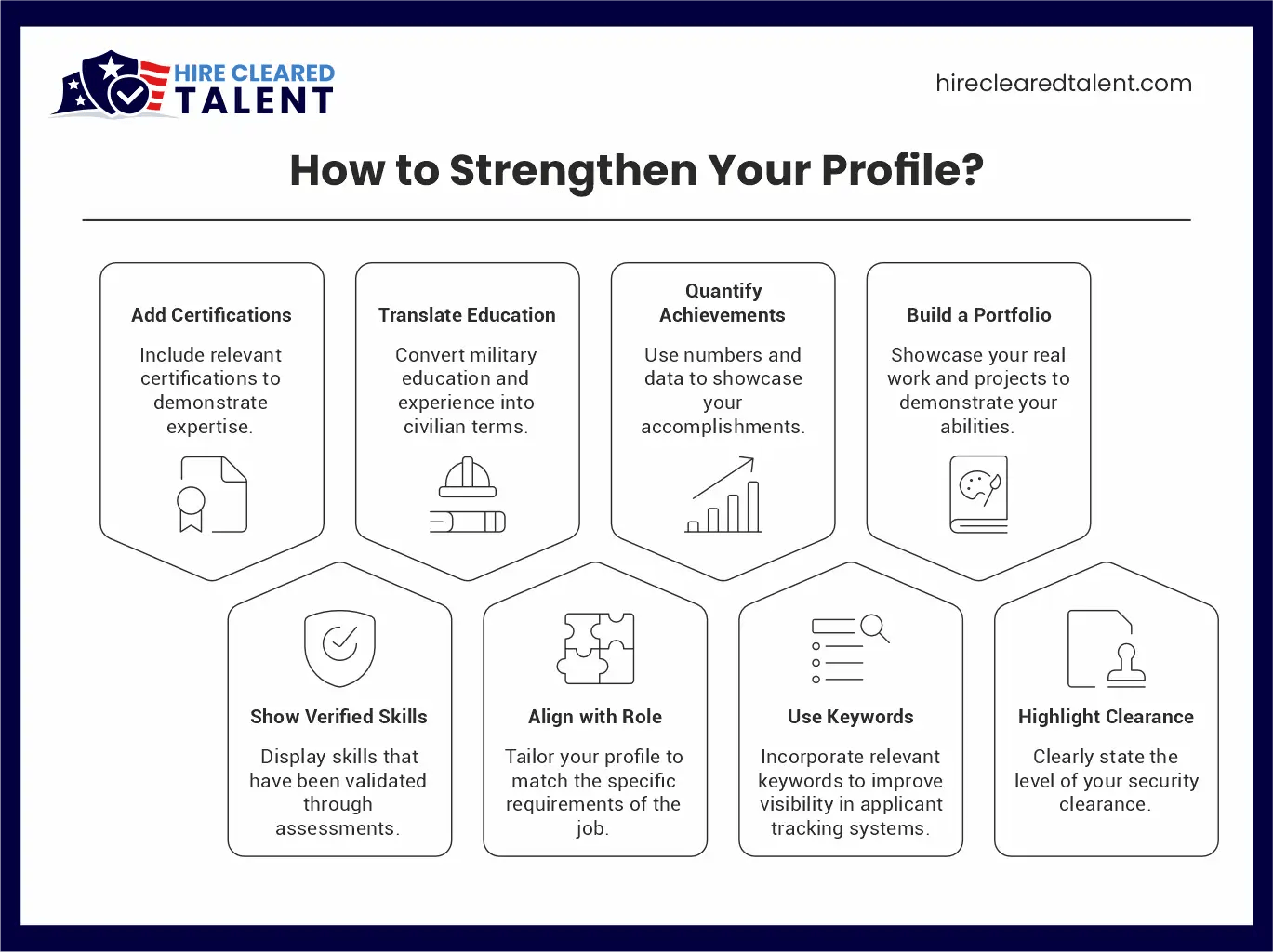
Your security clearance belongs near the top of your resume. Not buried in a skills section at the bottom - near the top, visible, and stated clearly. "Active Top Secret/SCI clearance with CI poly" is information a cleared employer needs to qualify you before they read anything else.
In a market where clearance processing times for Top Secret investigations now stretch to over 240 days according to ClearanceJobs hiring trend data, an active clearance isn't a credential, it's a competitive advantage that collapses the entire hiring timeline.
But here's where a lot of veterans stop, assuming the clearance will carry the resume. It won't carry it alone. The clearance gets you read. The rest of the document has to earn the interview.
"Your clearance gets you read. The rest of the document has to earn the interview."
Directly below your contact information and clearance status, write a two-to-three sentence professional summary. Not an objective statement. A summary. Something that tells a hiring manager, in the time it takes to read a tweet, who you are professionally and what you bring.
"Intelligence professional with 15 years supporting theater-level operations, specializing in HUMINT collection management and all-source analysis. Current TS/SCI. Experienced briefing senior DoD leadership on time-sensitive assessments." That's it. Specific, clean, no filler.
Step 3 - Translate Rank and Role Into Scope Language
Civilian hiring managers don't have a reference chart for military rank equivalencies. An O-5 lieutenant colonel running a 600-person battalion might translate to a senior director-level role at a mid-size company but the hiring manager won't make that connection unless you show them the scope explicitly.
Instead of leading with rank and title, lead with scope. How many people did you lead? What was the operational budget? What was the geographic or organizational scale? "Led a team of 45 intelligence analysts supporting five geographic combatant commands" communicates far more to a civilian than "Staff Officer, J2, USCENTCOM." Both describe the same job.
Only one of them lands because the cleared hiring market is active and the talent pool is tight, employers at major defense contractors are increasingly willing to take candidates who need some role-specific training as long as the person's clearance and leadership background are rock solid.
That means your scope language isn't just about getting past a filter. It's about positioning you accurately for the seniority level you're targeting.
1- Remove all military-only acronyms
MOS codes, military occupational titles, unit designations, and internal program names mean nothing to civilian recruiters. Write out every acronym on first use, or replace it with plain language entirely. "S6 shop" becomes "communications and IT unit." "MDMP" becomes "operational planning process."
2- Quantify everything you can
Numbers cut through translation problems faster than any other technique. Personnel managed, budget controlled, missions executed, training hours delivered, systems maintained. If you can attach a number to an accomplishment, attach one. Vague responsibility descriptions don't differentiate you. Numbers do.
3- Match keywords to the job posting
Defense contractor and federal job postings are written with specific language that their internal systems are calibrated to recognize. Read each posting carefully. If they say "program management," use that phrase - not "managed programs." Direct keyword alignment matters, especially in larger organizations where applications are filtered before a human reviews them.
4- Keep the format clean and machine-readable
Fancy resume templates with columns, graphics, and text boxes look professional but frequently break when passed through hiring management software. Use a single-column format, standard section headers, and no tables or embedded images. The resume that's easiest to parse is the one that gets read by the person who matters.
5- Separate classified from unclassified accomplishments carefully
This is a friction point unique to the cleared world. You may have done some of the most consequential work of your career in environments you can't describe in detail on an unclassified document.
The solution isn't to skip those roles - it's to describe the nature of the work, the clearance level required, and the scope without compromising classification. "Provided classified analytical support to national-level intelligence consumers" communicates the significance without violating any handling requirements.
Step 4 - The Classified Experience Problem (And How to Handle It)
This is the part most generic resume guides skip entirely, because they've never worked in the cleared space.
Consider someone like Jennifer - a 12-year cryptologic linguist with NSA-affiliated assignments who spent the better part of her career doing work she genuinely cannot describe on an unclassified piece of paper. Her first instinct was to leave those positions nearly blank on her resume, which made her career look thinner than it actually was.
The right approach is to describe what you can. The clearance level required. The broad mission category - signals intelligence, human intelligence, cyber operations, all-source analysis. The type of consumers you supported national leadership, combatant commands, tactical units.
The scale of the team or operation. You're not writing a classified document. You're writing enough to let a cleared hiring manager understand the nature and significance of the work, while giving them a reason to ask follow-up questions in a cleared conversation.
And here's something worth knowing: a hiring manager at a defense contractor who holds the same clearance level understands exactly what "supported Tier 1 special operations forces in a classified operational environment" means. You're not writing for the public, you're writing for someone who lives in this world too.
Step 5 - Education, Certifications, and the Clearance Is Not Enough Myth
The cleared job market is competitive in ways that didn't exist a decade ago. Average total compensation for cleared professionals reached a record $114,946 in 2023 according to ClearanceJobs compensation data, and that number has continued climbing. With compensation at those levels, employers are selective and they're looking at the full picture of a candidate's qualifications, not just their clearance status.
Certifications matter here in specific ways. If you're targeting cybersecurity roles, CompTIA Security+, CISSP, or CEH are expected on the resume - the clearance alone won't substitute.
If you're pursuing program management, a PMP certification signals you've made the translation to civilian professional standards. If your background is in signals or electronic warfare and you're targeting technical roles, relevant technical certifications should appear prominently.
Military training and education translates better than many veterans realize. Senior enlisted professional military education - Sergeant Major Academy, Senior Noncommissioned Officer Academy - demonstrates leadership development that civilian equivalents often don't get until much later in their careers. List it. Explain it briefly if necessary. Don't assume the hiring manager knows what it signifies.
What a Good Cleared Resume Actually Looks Like in Practice?
Take Marcus from the opening of this piece. After working through the translation process, his first bullet under his most recent assignment stopped reading like "Served as NCOIC of the S2 section, responsible for all intelligence functions." It read: "Led a 12-person intelligence team providing all-source threat analysis for a 4,500-person combined arms brigade; briefed brigade commander and key staff on time-sensitive assessments at an average of four times daily during deployed operations."
Same job. Completely different impact on a civilian reader. The scope is clear, the output is specific, and the tempo of the work communicates something real about the pressure and pace of the role.
Does that mean every bullet needs to be that detailed? No. But every bullet should answer one basic question: so what? What was the scope, what was the outcome, why does it matter? If a bullet on your resume doesn't answer that question, rewrite it or cut it.
And on length - two pages is generally the right ceiling for most veteran candidates with under 20 years of service. Three pages is occasionally justified for very senior candidates with significant technical depth. One page is almost never appropriate for someone with multiple overseas assignments and a decade-plus of career. The goal isn't brevity for its own sake. The goal is density: every line earning its space on the page.
The Part Nobody Tells You About the Cleared Hiring Process
There's a genuine irony at the center of veteran resume writing for cleared jobs, and it's worth naming directly: the cleared hiring market is one of the most candidate-favorable markets in the entire U.S. economy right now.
There are more open positions than cleared people to fill them. Employers are competing for candidates, paying record salaries, and in many cases willing to be flexible on specific qualifications.
But veterans who represent a disproportionate share of the cleared talent pool are still losing out on jobs or getting offers below their experience level, because their resumes don't accurately represent what they've done.
So ask yourself this: if the market is tilted in your favor, why would you show up with a document that undersells you?
The resume is not the hardest part of the transition. But it is the first part. And in a hiring process where a recruiter at a major defense contractor may be reviewing dozens of cleared candidates in a single afternoon, a resume that doesn't communicate your real value in the first thirty seconds doesn't get a second look - regardless of what's behind it.
But the cleared job market genuinely rewards the candidates who get this right. The clearance is a foundation. The resume is what builds on it.
Your next career move starts here!
HireClearedTalent connects security-cleared veterans with the federal agencies and defense contractors actively looking for candidates with your background. You can create your profile on HireClearedTalent and get yourself positioned where hiring happens. Are you ready to get expert guidance from people who know the cleared market?
Schedule Your Free Consultation Today
FAQ
Q1- How should veterans translate military experience into civilian roles?
A- Focus on outcomes, leadership, and skills instead of military titles. Use civilian terms, quantify impact, and show how your work improved efficiency or led teams.
Q2- What is the best way to convert military job titles for a resume?
A- Replace military titles with equivalent civilian roles and add a brief explanation. Use job-relevant keywords to improve clarity and ATS visibility.
Q3- How can veterans highlight transferable skills effectively?
A- Emphasize leadership, operations, and problem-solving with measurable results. Connect each skill to business outcomes relevant to the target role.
Q4- What resume format works best for veterans?
A- A hybrid or chronological format works best to show skills and progression. Keep it structured and easy to scan for recruiters.
Q5- How should veterans address security clearance on a resume?
A- Clearly mention active clearance with level and status near the top. Include relevant details to increase recruiter confidence.
Q6- How can veterans quantify their achievements on a resume?
A- Use numbers such as team size, budget handled, or mission impact. Focus on results like cost savings or performance improvements.
Q7- What are common mistakes veterans make in resumes?
A- Using military jargon, listing duties instead of achievements, and not translating roles. Focus on impact and relevance.
Q8- How long should a veteran resume be?
A- Keep it one to two pages with relevant experience only. Prioritize recent roles and remove outdated details.
Q9- How can veterans tailor resumes for different job roles?
A- Customize keywords, skills, and achievements based on job descriptions. Align your experience with employer expectations.
Q10- How important are keywords for ATS systems?
A- Keywords are essential for passing ATS filters. Use industry terms naturally and match the job description language
Weekly newsletter
Get the latest blog updates, practical hiring insights, and featured reads delivered straight to your inbox.
Read about our Privacy Policy.