


Your clearance is one of the most valuable credentials you own, and most cleared professionals still accept the first number they hear. That is an expensive habit.
According to the 2026 Security Clearance Compensation Report, average total compensation for cleared professionals reached a record $126,125 in 2025, up nearly 6% year over year.
The cleared talent market remains tight, and qualified candidates are in demand. Employers know active cleared professionals are hard to find, which gives you more room to negotiate than most candidates realize.
That gives you room to negotiate that workers in most other fields simply do not have.
This post covers how to use it. What to research, how cleared pay actually gets set, when to make your ask, and the specific mistakes that cost cleared professionals' money on every offer.
Salary Negotiation Tips for Security-Cleared Professionals
Let’s get started.
Know your salary number before the recruiter asks
Walking into a pay conversation without data is how you end up saying yes to a low offer. Do the homework first.
Start with the benchmarks for your clearance level. A Secret role typically runs $110,000 to $135,000. Top Secret and TS/SCI roles generally land between $130,000 and $170,000, averaging around $141,000 with bonus potential of up to 20 percent, according to CCS Global Tech's 2026 analysis.
A full-scope or lifestyle polygraph pushes you higher, with poly holders often clearing $150,000. Location matters too. Virginia, Maryland, and the District of Columbia pay the most for cleared work, so a number that sounds strong in another market can be low inside the Beltway.
Land on one specific figure, not a range. Give a range and the employer hears the bottom of it and treats that as your ceiling. Decide the number you want, gather the market data that backs it, and be ready to say it out loud without flinching.
Build your case from three points, not a hunch: the ClearanceJobs benchmark for your clearance and role, two or three current postings for the same labor category, and what a peer with your background recently accepted.
When the recruiter asks how you arrived at your number, have the answer ready. "Comparable TS/SCI analyst roles in this market are posting $150,000 to $165,000, and my active poly puts me at the top of that band" ends the question. A gut feeling does not.
Understand how cleared job salaries are set
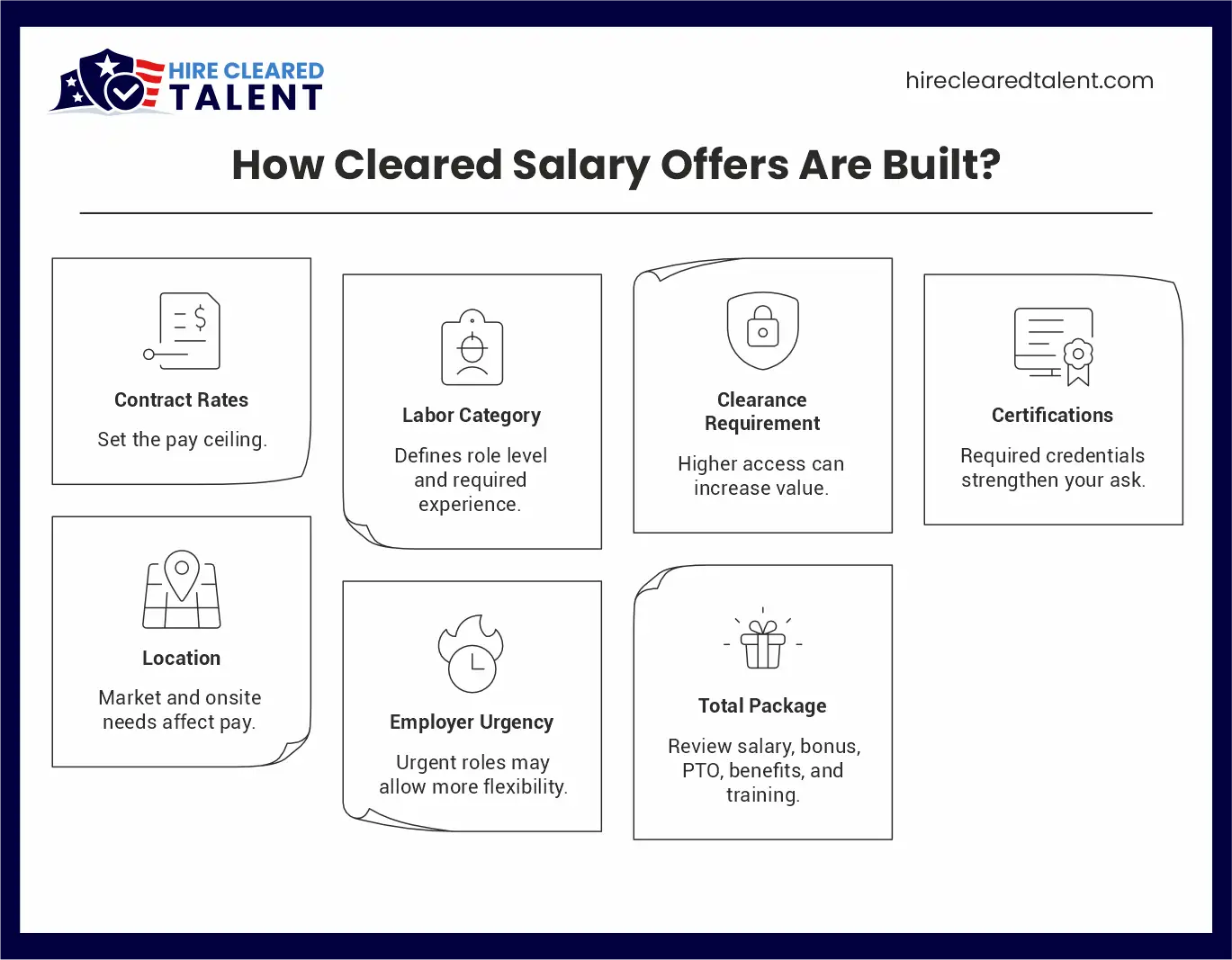
This is where cleared negotiation splits from regular hiring. On most federal work, your salary is tied to a labor category on a contract. The prime contractor bid a fully burdened rate for something like "Systems Engineer III" or "Intelligence Analyst II," and your pay comes out of that rate after overhead and fee.
That has two effects on your negotiation. First, there is often real room inside the band, because the company padded the range and expects candidates to push. Second, there is sometimes a hard ceiling, because the labor category rate caps what the contract can pay. Knowing which situation you are in changes your whole approach. Ask early where the role sits, prime or subcontract, and whether the rate is fixed or has movement in it.
Your clearance is a line item in that math. A cleared candidate saves the employer months of waiting and thousands in sponsorship costs. If you already hold an active TS/SCI with a current poly, you are pulling risk and delay out of their staffing plan, and that is worth money. Say it plainly. The CEO of DHI Group, the parent company of the largest cleared job board, put it directly in 2026: compensation is the cleared workforce's strongest bargaining chip.
Consider two candidates with the same TS/SCI and the same skills. One asks the recruiter whether the base is fixed, learns the band tops out above the offer, and counters to the top of it for $8,000 more.
The other accepts the first number because it already felt high. Same clearance, same value, $8,000 apart in year one, and every future raise builds on that higher base.
Read more- Using AI in Security-Cleared Job Search: Tools, Risks, and What Employers Expect
Time the salary conversation correctly
Get the offer in writing before you respond to anything. A verbal number is easy to walk back, and a written offer gives you time to think. A clean way to create that time: "Thank you, I am glad to hear it. Could you send the full offer in writing so I can review the details? I will get back to you within two business days."
Avoid naming a hard number first if you can. When a recruiter asks your salary expectations early, point to the market instead of your paycheck. "For a TS/SCI role at my level in this area, I am seeing $150,000 to $165,000, and I am looking in that range" keeps you anchored to data. Never volunteer what you earn now. It only hands the employer a lower place to start.
Read more- Lost Your Security Clearance? Step-by-Step Guide to the Appeal Process (2026 Update)
Negotiate the full offer, not just base salary
When the written offer arrives below your number, counter with a specific figure and one line of reasoning. "Based on the market for cleared analysts with an active poly, I would like to bring the base to $158,000." Then stop talking. Silence after your ask pressures the other side more than another sentence would.
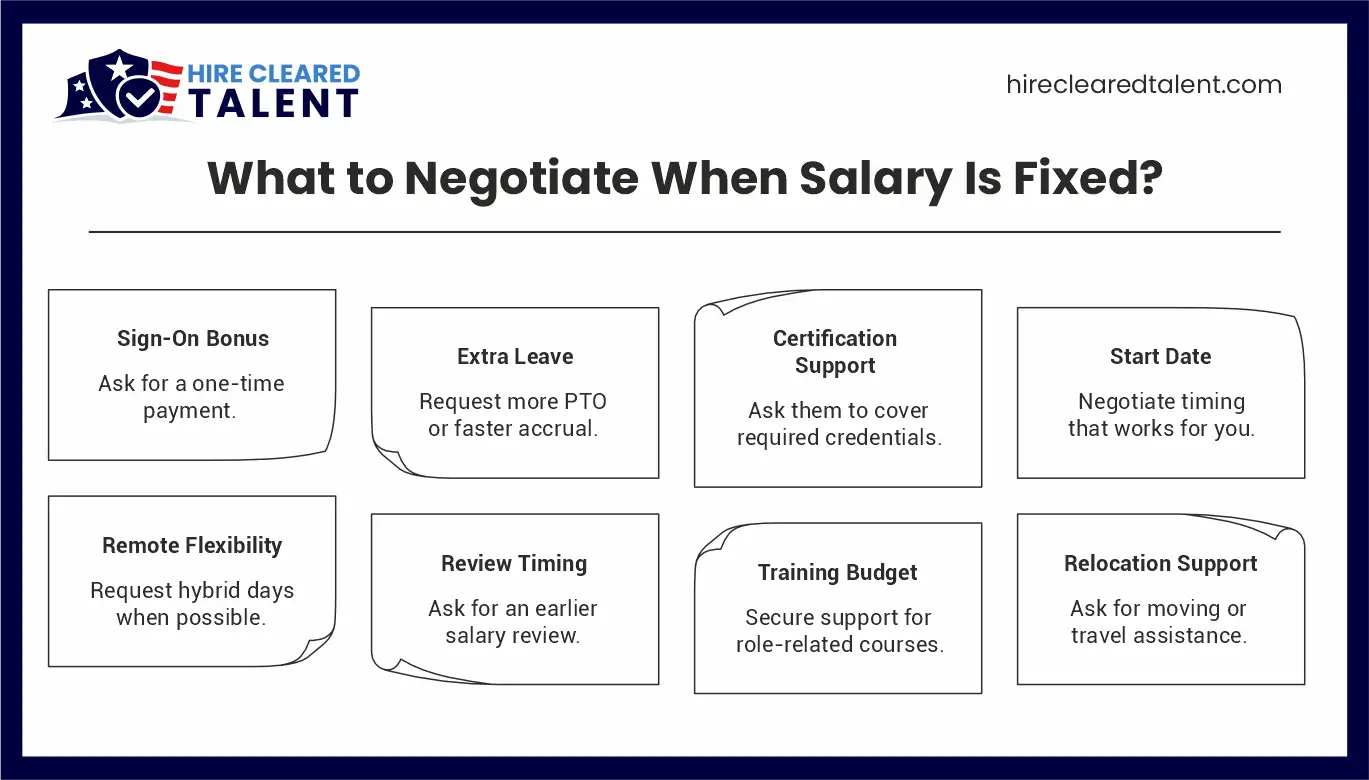
Base salary is not the only thing you can negotiate. Cleared roles carry several items worth real money, and some are easier for a manager to approve than base pay:
· A signing bonus, which does not touch the salary band.
· Certification reimbursement for Security+, CISSP, or the cloud certs the contract requires.
· Sponsorship for a clearance upgrade or an added polygraph, which raises your market value for the next role.
· Remote-eligible days for unclassified work, when the contract allows it.
· Extra paid time off or a faster vacation accrual rate.
If the base is capped by the labor category, move the conversation here. A recruiter who cannot touch the salary line can often approve a $10,000 sign-on or cover your next certification.
Handle salary pushback professionally
You will hear "that is the rate for this labor category." Sometimes that is true, and sometimes it is an opening position. Ask the direct question: "Is the base fixed by the contract, or is there room in the band?" If it is fixed, pivot to bonuses, certs, and paid time off. If it has room, hold your number and let them come up to it.
You have more standing than you think. Seventy-eight percent of cleared professionals said in 2026 that they were at least somewhat likely to change jobs within the year, and switching roles is where the largest raises happen.
People who change jobs can often negotiate meaningful pay increases, especially when they bring in-demand skills or competing offers. If you hold a competing offer, say so plainly and let it do the talking. If you do not, your active clearance and clean record are still real bargaining power in a market short on both.
Set your walkaway number before the call, the figure below which you will politely decline, and hold it. Knowing that line keeps you steady and stops you from talking yourself into a weak offer while you are on the phone.
The fear of losing the offer stops many people from negotiating, but it should not. Fidelity reported that 87% of Americans who countered on salary, benefits, or both received at least some of what they requested. You can read the full details in Fidelity's 2026 salary negotiation guide.
Avoid Salary Negotiation Mistakes That Cost Cleared Professionals Money
A few errors show up again and again.
Accepting the verbal offer. You give up your best window the moment you say yes out loud. Wait for the written version.
Negotiating against the GS scale. If the role is a federal position on the General Schedule, base pay is fixed, and your room is in step, locality, and start date, not the salary number. Know whether you are talking to a government employer or a contractor, because the rules are different.
Revealing your current salary. It anchors the employer low. Redirect to market data every time they ask.
Focusing only on base and ignoring the rest. A $5,000 sign-on, paid certifications, and an extra week of leave add up fast, and they are often the pieces a recruiter can actually move.
Find a Cleared Role Worth Negotiating For
Cleared hiring rewards the people who prepare and ask. Research your clearance-level market, land on one number, get the offer in writing, and negotiate the full package instead of the base alone. Your clearance already puts you in a strong position. Using it is a five-minute conversation that can be worth thousands in year one, and far more once it compounds into every raise after that.
If you are weighing cleared roles right now, HireClearedTalent is built for this exact moment. It is a marketplace only for security-cleared professionals and the agencies and contractors that need them.
You list your clearance level, poly status, and availability, and cleared employers come to you, which puts you in the strongest possible position to negotiate from.
Ready to find a cleared role worth negotiating for? Create your profile on HireClearedTalent today.
But still if you are facing any challenge or want to discuss something feel free to connect.
Schedule a call with our cleared career experts!
FAQ-
Q1. When should I bring up salary for a security-cleared job?
A. Ask about the approved range during the recruiter screen so you know whether the role is worth pursuing. Save detailed negotiation for after the employer confirms interest or sends an offer.
Q2. How do I know if a cleared job offer is fair?
A. Compare the offer against your clearance level, role type, location, polygraph status, certifications, contract urgency, and current market ranges. Do not judge the offer by title alone.
Q3. Should I share my current salary with a recruiter?
A. It is better to redirect the conversation to market value. You can say, “I’m focused on the approved range for this role and the market rate for cleared professionals with my background.”
Q4. How much does clearance level affect salary?
A. Clearance level can affect pay because higher access requirements usually narrow the candidate pool. TS/SCI, polygraph, and niche agency experience often give candidates more negotiating power.
Q5. Can I negotiate salary if the employer says the range is fixed?
A. Yes, but you may need to negotiate outside base salary. Ask about sign-on bonus, PTO, certification reimbursement, relocation support, remote flexibility, or an earlier compensation review.
Q6. What should I research before negotiating a cleared job offer?
A. Research similar cleared roles, salary ranges in that location, required clearance level, labor category, contract type, benefits, and whether the role is urgent or hard to fill.
Q7. How do I ask for more money without sounding difficult?
A. Keep it simple and factual. Say, “Based on the clearance requirement, role scope, and market range, I was expecting something closer to $150,000. Is there room to adjust?”
Q8. Why should I wait for the written offer before accepting?
A. A verbal offer is not the full package. Wait until you see base salary, benefits, PTO, bonus, start date, job title, location, and any conditions tied to clearance or contract approval.
Q9. What parts of a cleared job offer are usually negotiable?
A. Base salary may be negotiable, but so are sign-on bonus, PTO, start date, relocation support, certification support, training budget, hybrid schedule, and review timing.
Q10. How do labor categories affect salary negotiation?
A. Labor categories can limit salary because they define the role level, experience requirement, education requirement, and contract billing structure. Always ask how the role is mapped.
Weekly newsletter
Get the latest blog updates, practical hiring insights, and featured reads delivered straight to your inbox.
Read about our Privacy Policy.