
-1790193185493-926890776.png)

Many cleared candidates approach federal recruiters the wrong way. They apply everywhere, send the same resume repeatedly, and then wonder why no one responds. The truth of the matter is much easier and works in your favor. If you have an active or current clearance and your profile is easy to find, recruiters are more likely to reach out.
The numbers say so. As per the research, 56 percent of cleared recruiters named the small cleared talent pool as their single biggest headache, and almost 40 percent admitted that several of them were chasing the same people. Pay keeps climbing too. Average total compensation for cleared professionals hit a record $126,125 in 2025, up nearly 6 percent, per ClearanceJobs' 2026 Security Clearance Compensation Report.
So, stop chasing. Your job is to make yourself easy to find, easy to verify, and easy to submit. Get that right and the recruiters worth knowing come to you. Here is how the people who do this well actually do it.
Steps to Connect With Federal Recruiters
Fix your profile and resume before you reach out
It is the section everyone glosses over and it loses them an opportunity. The recruiter skims the first third of your resume and makes his decision in mere seconds as to whether you are qualified for whatever he is currently staffing.
So be sure to prominently display your clearance at the top of your resume: the level, status, polygraph and date. Use the exact language from the desired job postings.
Then cut the filler. Nobody hiring for a cleared role cares about a paragraph of summary adjectives. They want to know what systems you ran, which programs you supported in general terms, and what certifications you hold. If a recruiter has to dig through your resume to find your clearance and your specialty, they stop digging and open the next one.
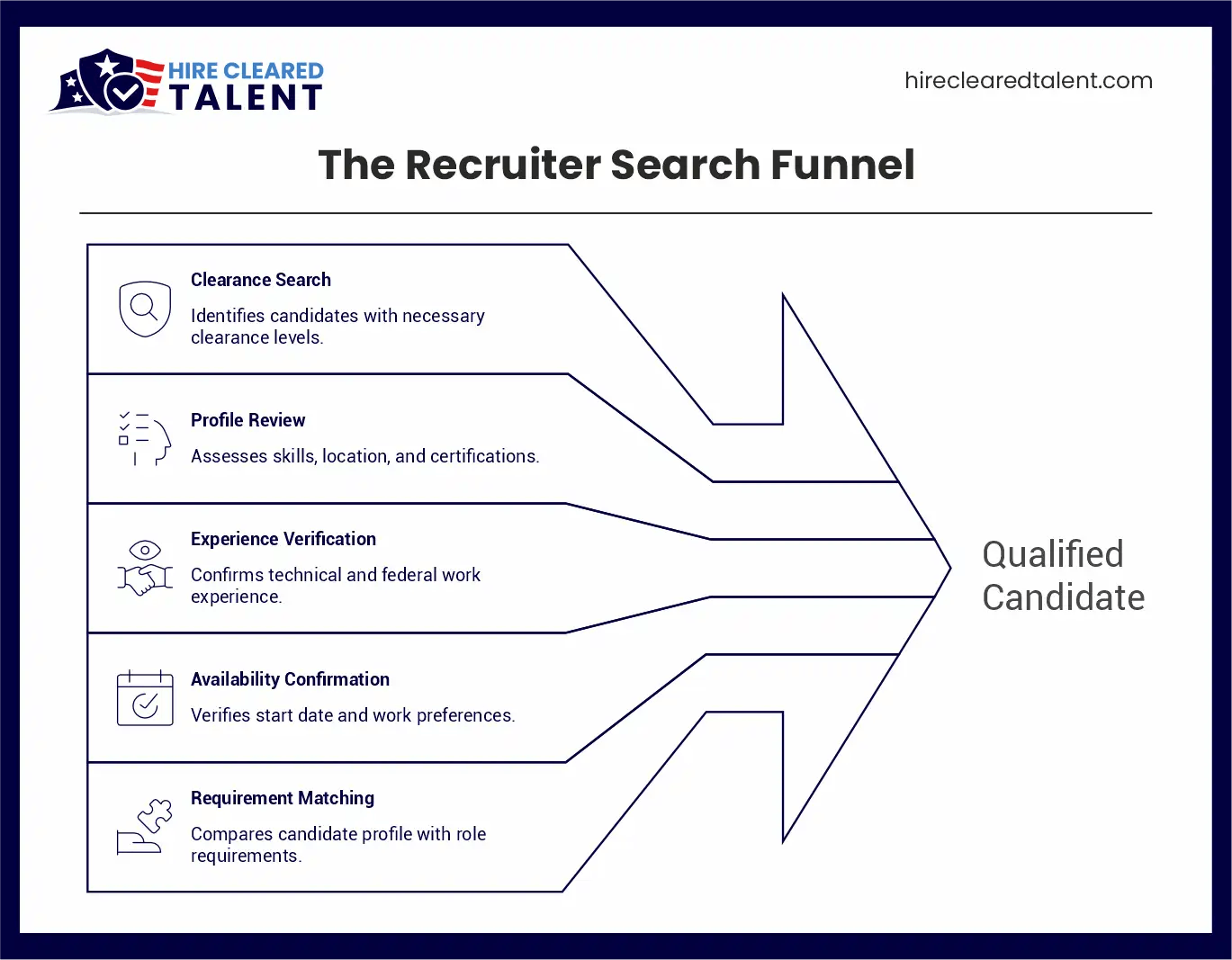
Always be specific about your clearance
Vagueness costs you more than anything else here. "I think it's still active" is useless to a recruiter, because they cannot submit a guess. Give them the level, whether you are currently in access or eligible but not in use, the type and date of your last investigation, and your polygraph if you have one, CI or full scope.
Why does this matter so much? Also, it's found that 30 percent of recruiters need 6 to 10 candidates in the funnel to land a single hire. When they are weighing that many people, the candidate whose clearance is clean and verifiable goes to the front.
The one whose status is murky waits while the recruiter works someone easier. Write your clearance summary once, keep it honest, and paste it into every conversation.
Show up where cleared recruiters search
General job boards are not where cleared roles get filled. Federal recruiting happens via cleared-specific platforms, professional networks, and referrals. It is important to keep a well-updated profile on the websites meant for this purpose – ClearanceJobs, HireClearedTalent, and LinkedIn update it according to changes in your clearance level or skill set. A profile that is two years old implies that you aren’t looking for work.
One caution. There is a smart way to show your clearance in public and a careless way. Say you hold one and give the level in broad terms. Do not post your investigation dates, your agency, program names, or polygraph details where anyone can read them.
Save that for a private conversation. Recruiters expect discretion, and a candidate who spills clearance specifics online looks like someone who does not take operational security seriously. In this field, that gets you passed over fast.
Make your first message worth answering
Recruiters scan quickly. If you are emailing someone unsolicited, provide something useful in ten seconds flat. It all starts with the type of position you are looking for, the fact that you are cleared in one line, your availability, and one question only.
Notice the contrast here. "Cleared network engineer, currently TS/SCI with CI poly, last polygraph conducted in 2023, available in 30 days, do you hire in that area?" gives a scout everything they need to know whether to respond to your email. "Hi, are you hiring?" gives them nothing and remains untouched beside 40 other emails like it.
Read more- Step-by-Step Guide to Landing Federal Background Investigator Jobs
Respond quickly and clearly
Speed gets you submitted. The recruiter is running several vacancies at a time, and the one who responds to the call within two hours has more chances to be recommended than one who needs three days to respond. It is ok to decline an offer, but not to ignore the call.
If the job opportunity is not up to your liking, inform the recruiters about it; why? Inform them of all the things which cross your mind: the location, the compensation, the working conditions, et al. It may be noted that such honesty is extremely uncommon. The cleared community is quite small.
Recruiters appreciate the truth more than silence. Ghost one and you have not just lost that opening, you have cost yourself a contact who fills these jobs again and again, year after year.
Share your real terms early
Tell the recruiter what you actually need at the start: your salary number, where you will and will not work, whether you will sit on-site full time, which clearance you are willing to use. Keeping that quiet to seem flexible does not help you. It burns two weeks and leaves everyone frustrated when the offer comes in wrong.
The data is blunt about where deals fall apart. In the 2025 guide, 43 percent of offer rejections came from people taking a competing offer, and another 30 percent came down to pay. Recruiters already know money is usually what ends it.
Give them your real number right from the start; either they will find you a position to clear that or they will simply tell you that they can’t. Either way is better than spending a whole month going through interviews just for the sake of that one number.
Build a few strong recruiter relationships
You do not need every recruiter in the defense sector in your contacts. Some of these people should be aware of your background, your clearance, and what kind of position you’re seeking. These individuals should recognize you when an appropriate opportunity comes through their door, even before you see it listed elsewhere.
Consider that these individuals are going to be the ones who stay on your list for the long run. Contact them once or twice a year to let them know where you are at and how things are going.
If you have someone to refer to them, send the referral along. Inform them of any change in your clearance status or personal circumstances. There are over five million people with clearance eligibility in the country, but there aren’t necessarily five million people in cleared positions.
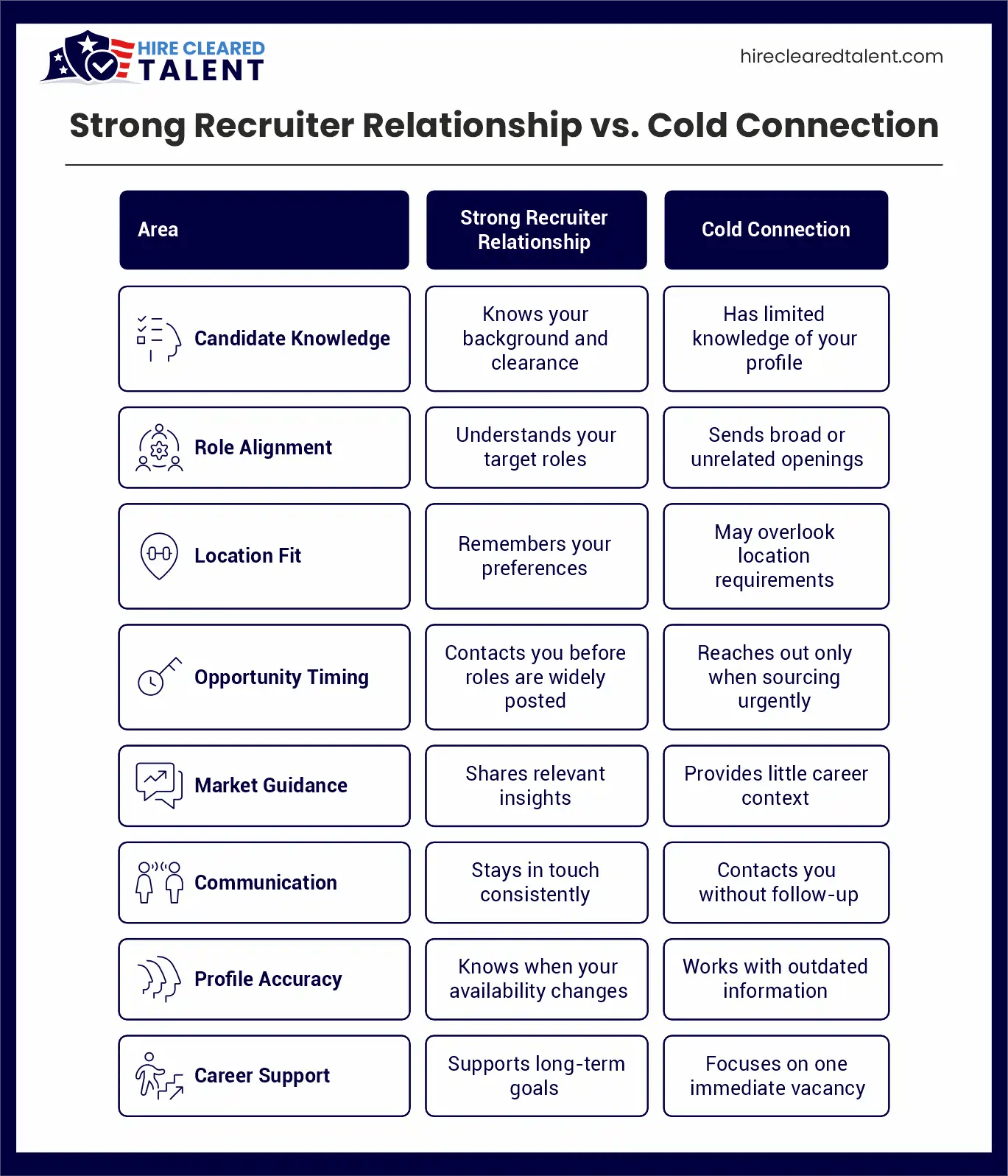
Reach out while your clearance is still current
Timing matters, and most people get it wrong. The moment to build these relationships is while your clearance is active, not after it lapses. A clearance tied to a job can go inactive about 24 months after you leave the role, and reactivating a current clearance through reciprocity is far easier than starting over.
If you are leaving a cleared position, talk to recruiters before that window closes, even if you are not looking yet. Tell them where you stand and when you could move. A live, verifiable clearance is what lets a recruiter act fast, and waiting until you need a paycheck is the most common timing mistake in this business.
Avoid duplicate recruiter submissions
This one quietly disqualifies good people. Nearly 40 percent of recruiters acknowledge that they contact the same applicants, it becomes easy to be submitted to the same role by two different recruiters, and that repeated nomination results in your rejection.
Keep an eye on it. Once someone has submitted you to something, find out exactly which firm and position and accept only this particular submission. Maintain a list of everyone who has sent you somewhere at a particular time.
If another recruiter sends you to this position again, inform him that it has been done already. You keep control, and you avoid looking like someone who cannot run their own search.
Never guess or exaggerate clearance details
This is the one that ends careers, not just applications. Do not overstate your clearance, your access, or your investigation dates. It is all verifiable, and a recruiter or a facility security officer will spot the gap between your story and the record.
An innocent mistake is taken for being careless at best and negligent at worst, and in both cases, you are ruled out from further consideration in cleared positions. If you honestly don't know if your clearance is still valid, just say so and allow the recruiter to help you figure it out.
Read more- Veteran Employment Opportunities: Where Demand Is Growing Fast
Make It Easy for Cleared Recruiters to Find You
All of this is really one idea. Be visible, be verifiable, be easy to reach. That is what HireClearedTalent is for. It is a cleared-only hiring marketplace connecting security-cleared professionals with federal agencies and defense contractors across the country, so the recruiters searching for it are the ones actually filling cleared roles.
A single profile does the work this article is asking of you. You list your clearance level, status, and specialty in a form recruiters can search and trust. You keep the sensitive details private until a real conversation starts.
You stay in front of the people hiring without scattering your resume across public boards. When a recruiter has a TS/SCI seat open and a funnel to fill, be the verified, ready candidate they reach first. By creating your profile on HireCleatredTalent, keep it updated and let the right roles find you.
So, make sure you stay visible where recruiters actually search, without oversharing. Reply fast and tell the truth, even when the truth is no. Name your terms on day one. Keep a few real relationships going. And never guess or pad your record. Do that, and the recruiters worth knowing will be the ones coming to you. Still have any queries?
FAQs
Q1. What should I say when I first contact a federal recruiter?
A. Keep the message focused. Share your current role, clearance level, core skills, preferred location, and the type of position you want. Give the recruiter enough information to understand where you fit.
Q2. Should I contact a federal recruiter before applying for a job?
A. Yes. A brief introduction can help the recruiter recognize your name and understand your background before reviewing your application.
Q3. How do I find recruiters who work with cleared candidates?
A. Search by clearance level, job function, location, agency, or federal contractor. Terms such as cleared cybersecurity recruiter or TS/SCI recruiter in Virginia will produce more relevant results than a broad search.
Q4. Should I mention my security clearance in the first message?
A. Yes. State the general clearance level and current status when it is relevant to the role. Do not share investigation records, clearance documents, classified details, or sensitive program information.
Q5. What information does a cleared recruiter need from me?
A. Recruiters usually need your target role, clearance status, experience, certifications, location, relocation preferences, availability, and compensation expectations.
Q6. Why do federal recruiters sometimes not respond?
A. They may not have a role matching your skills, location, or clearance. Your message may also be too broad. A clear message tied to a specific position or job type is easier to act on.
Q7. How long should I wait before following up with a recruiter?
A. Wait five to seven business days before sending one brief follow-up. Add useful context, such as a job ID, updated résumé, new certification, or change in availability.
Q8. Is it acceptable to contact more than one recruiter at the same company?
A. Yes, when they support different roles or locations. Avoid sending the same message to several recruiters who appear to manage the same hiring area.
Q9. Should I send my résumé in the first message?
A. Send it when the recruiter requests it or when you are contacting them about a specific opening. Make sure your résumé clearly shows your clearance, technical skills, location, and relevant experience.
Q10. How should I describe classified or sensitive work experience?
A. Focus on your responsibilities, tools, skills, and results at an appropriate level. Do not name restricted programs, disclose mission details, or include classified information.t
Weekly newsletter
Get the latest blog updates, practical hiring insights, and featured reads delivered straight to your inbox.
Read about our Privacy Policy.