


The cleared federal hiring market isn't suffering from a lack of opportunity. It's suffering from a gap between where demand actually concentrates and where veterans are looking for it. These are not the same problem, and conflating them has real consequences for how quickly veterans find roles that match what they're actually worth.
Understanding where demand is growing fast requires looking at the cleared market as a distinct environment - one with its own supply constraints, its own salary premiums, and its own timeline pressures that differ sharply from the general commercial job market.
Veterans who know which sectors are structurally under-supplied, and who position their cleared backgrounds in those sectors specifically, compress their job search timelines significantly compared to those applying broadly.
The sectors discussed below aren't ranked by prestige or by how frequently they appear in veteran transition material. They're ranked by the actual supply-demand gap in the cleared labor market right now which is the only metric that matters for a veteran trying to move efficiently from separation to employment.
Cybersecurity: The Structural Gap That Policy Hasn't Fixed
Start with the sector that has the most documented unmet demand in the cleared federal space. Federal agencies responsible for securing national networks and critical infrastructure have been reporting cybersecurity workforce shortages for years. The gap hasn't closed, it's widened.
Legislation has directed the Pentagon to examine recruitment and retention of cyber professionals.
Reports from oversight bodies have been issued. And the shortage persists because structural causes remain unresolved: federal salary competition with private sector packages is difficult, the investigation pipeline for new cleared candidates runs slower than the threat environment, and the skill profiles needed are highly specific.
What that looks like in concrete terms: workforce reporting has identified a gap of more than 20,000 cybersecurity professionals across the defense enterprise alone, covering network defense, cyber operations, intelligence analysis, and cyber battlefield capabilities. That figure covers the defense sector only. The federal cybersecurity shortage extends well beyond it.
500K+ Unfilled cybersecurity positions across the United States, according to ClearanceJobs. Federal agencies and defense contractors account for a significant portion of that unmet demand. The Bureau of Labor Statistics projects information security analysts will see 33% job growth through 2033, one of the highest of any tracked occupation.
Veterans from signals intelligence, information assurance, communications, and even logistics backgrounds have direct pathways into this demand. The missing piece is usually certification, not experience.
Credentials like CISSP, CEH, etc. take months to obtain, not years and they're obtainable through GI Bill benefits or DoD SkillBridge programs before separation.
A veteran who walks in with an active clearance and relevant certifications eliminates both the investigation timeline and the credentialing gap that slow civilian candidates down. That combination is why cleared veterans consistently command premium placement in this sector.
Artificial Intelligence and Data Analytics: Where Federal Investment Is Going
Federal AI adoption didn't just accelerate in 2025, it compounded. Federal agencies reported more than 3,600 AI use cases in 2025, more than doubling the prior year's total, according to the Office of Management and Budget's Federal Agency AI Use Case Inventory.
That represents a multi-year buildout, not a one-year blip, and it's creating sustained demand for professionals who can operate at the intersection of technical capability and national security judgment.
Veterans are positioned well here for a reason that's less obvious than technical background: operational judgment.
AI systems operating in national security contexts require oversight from people who understand what happens when a system fails under real-world pressure - not theoretical failure modes, but the operational consequences of bad data informing a targeting decision or a logistics chain breaking in a contested environment. That judgment is forged in service. It doesn't come from a data science certificate program.
The cleared market for AI-related roles now spans intelligence modeling, data science supporting defense contracts, and systems roles tied to the Pentagon's Joint All-Domain Command and Control initiative which links sensors and decision-makers across every operational domain simultaneously.
Veterans from intelligence, communications, and systems backgrounds already understand the operational stakes that shape how these systems need to work. That's not a soft credential. It's the reason cleared AI and data roles continue to produce strong placement outcomes for veterans willing to build the technical layer on top of their operational foundation.
7–10% Annual growth rate projected for the cleared talent market, driven by cybersecurity, AI, data analytics, and intelligence operations per ClearanceJobs.
Demand for TS/SCI positions rose 12% year over year in 2024. The cleared market is growing faster than the cleared pipeline can replenish it.
Intelligence Analysis and Program Management: The Overlooked Pipelines
Cybersecurity dominates most discussions of veteran opportunity in the cleared space. But intelligence analysis and program management are equally supply-constrained, and in many cases they're a more natural fit for the majority of veterans who don't come from a technical military occupational specialty.
A veteran with a decade of all-source analysis, counterintelligence, or human intelligence collection has spent years doing what federal intelligence agencies and cleared firms are actively paying top-of-market salaries for: synthesizing incomplete information under time pressure, making judgment calls in ambiguous environments, and producing output that decision-makers can act on.
That isn't a soft skill set, it's a technical discipline that civilian analysts without operational backgrounds typically take years to approximate. The cleared intelligence contractor market understands this distinction and compensates for it accordingly.
Program management in the defense contracting space is the other underappreciated pipeline. Every defense contract - cost-plus, fixed-price, IDIQ, GWAC needs a program manager who can navigate federal acquisition requirements, manage subcontractor relationships against a statement of work, and keep a government customer satisfied enough to exercise the next option year.
Veterans who managed large-scale operations, coordinated multinational logistics chains, or ran complex equipment maintenance programs have been doing equivalent cognitive work under different acronyms. The cleared federal market pays well for this profile. And it doesn't have nearly enough of it.
Four More Sectors With Real and Growing Cleared Demand
Rapidly expanding: Space & Satellite Operations
Space is a contested domain now, and the cleared workforce supporting it is expanding accordingly. Veterans from signals, navigation, or satellite operations backgrounds have direct pipelines into contractor and government roles that barely existed a decade ago.
Infrastructure priority: Critical Infrastructure Defense
Power grids, financial systems, and water infrastructure all require cleared professionals who understand the convergence of cyber and physical threats. Veterans with operations or security backgrounds particularly those who've worked in hardened or contested environments are increasingly sought in this space.
Persistent demand: Logistics & Supply Chain Security
DoD supply chain modernization has created cleared roles in logistics analysis, vendor risk management, and inventory security. Veterans from transportation, sustainment, or distribution MOSs fit these roles without requiring significant retooling, and the cleared premium applies here just as it does in technical fields.
Emerging market: Information Operations
Counter-disinformation and strategic communications are fast-growing mission areas in both government and cleared contractor environments. Veterans from psychological operations, public affairs, or information operations backgrounds are walking into roles that barely existed five years ago and that civilian candidates can't credibly fill.
These sectors don't get the media attention that cybersecurity does. But the cleared demand in each of them is documented and growing. Competition from other candidates is thinner. And veterans with relevant service backgrounds often establish traction faster here than in the more crowded technical pipelines.
The Financial Case Is Straightforward - If You're in the Right Market
The salary premium for cleared professionals is real and substantial. Cleared professionals earn a 10–20% salary premium over similar non-cleared roles counterparts in equivalent civilian roles, per research cited by ClearanceJobs from the Greater Washington Partnership.
By 2025, the average salary for cleared professionals across all clearance levels reached $119,000. TS/SCI holders with polygraph clearances averaged over $141,000.
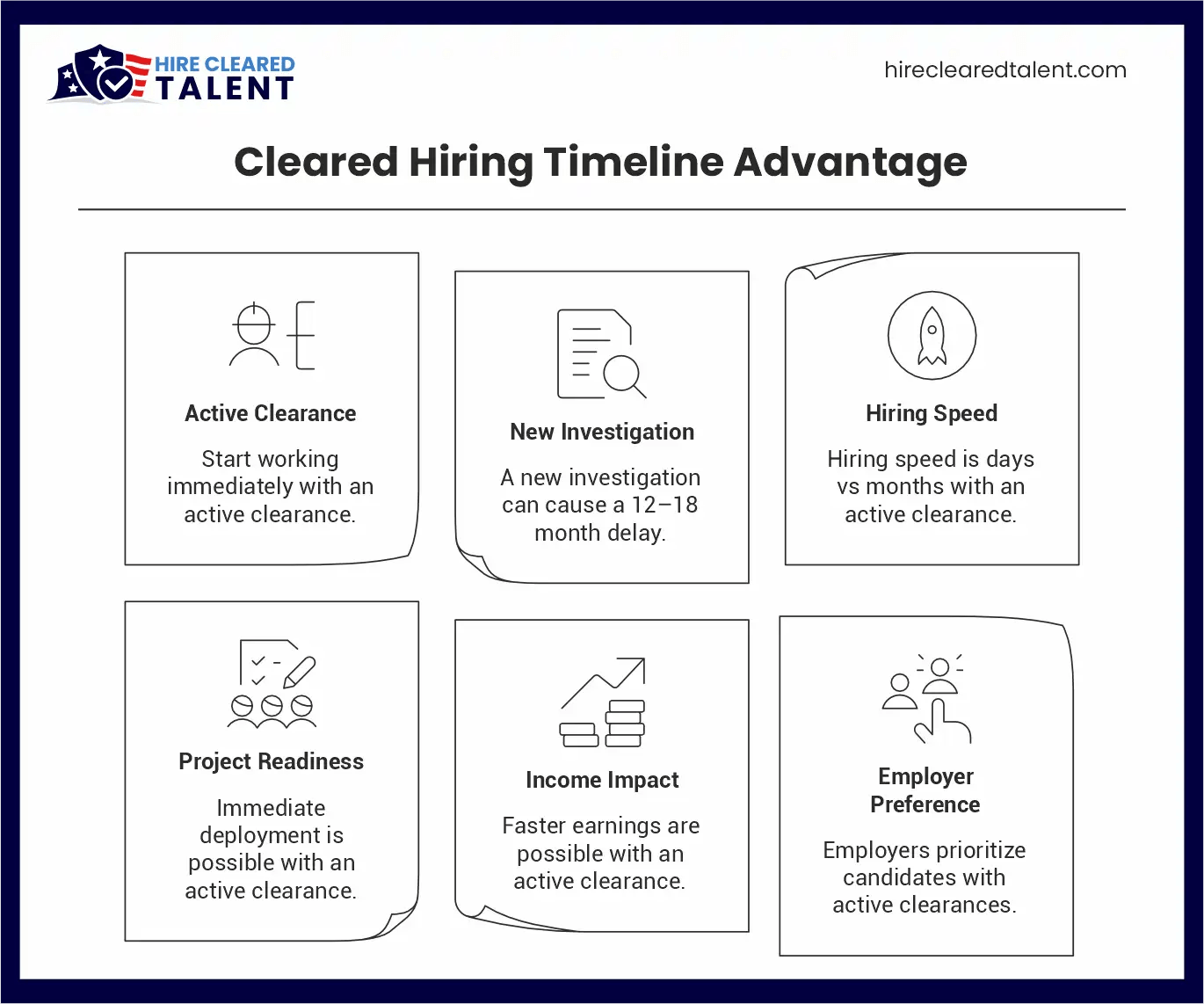
That premium exists because clearances are scarce and slow to create. A new TS/SCI investigation can run 12 to 18 months from submission to adjudication. Defense contractors under contract performance pressure don't have that runway, they need cleared candidates who can step in on Day 1.
Veterans with active clearances eliminate that risk entirely, which is why the market prices the clearance at a consistent premium over what non-cleared candidates receive for equivalent technical work.
If the cleared talent shortage is this acute, and the salary premium this consistent, why are so many cleared veterans still searching in markets that can't read what they're presenting?
The answer is structural. General job boards aren't built to surface clearance level as a primary matching variable. HR screens at commercial companies don't have context for military occupational experience. And most veteran transition programs don't give clear enough guidance about which specific market to enter.
The result is a search that runs longer than it should, often producing initial placements below market rate and the 80% two-year departure figure from Mission Roll Call research reflects exactly that pattern.
Where to Concentrate Attention Right Now?
The cleared market's supply and demand dynamics are as favorable for veteran candidates as they've been in years. More than 56% of cleared hiring managers in 2025 cite the limited cleared talent pool as their single biggest hiring challenge, with an estimated 70,000 more open positions than qualified candidates to fill them. That's a genuine seller's market and veterans with active clearances are the specific profile the market is short on.
But the advantage is time-sensitive. A clearance has a shelf life. A veteran who spends six months searching in the wrong market isn't just experiencing a delayed outcome, they're consuming clearance currency they can't get back.
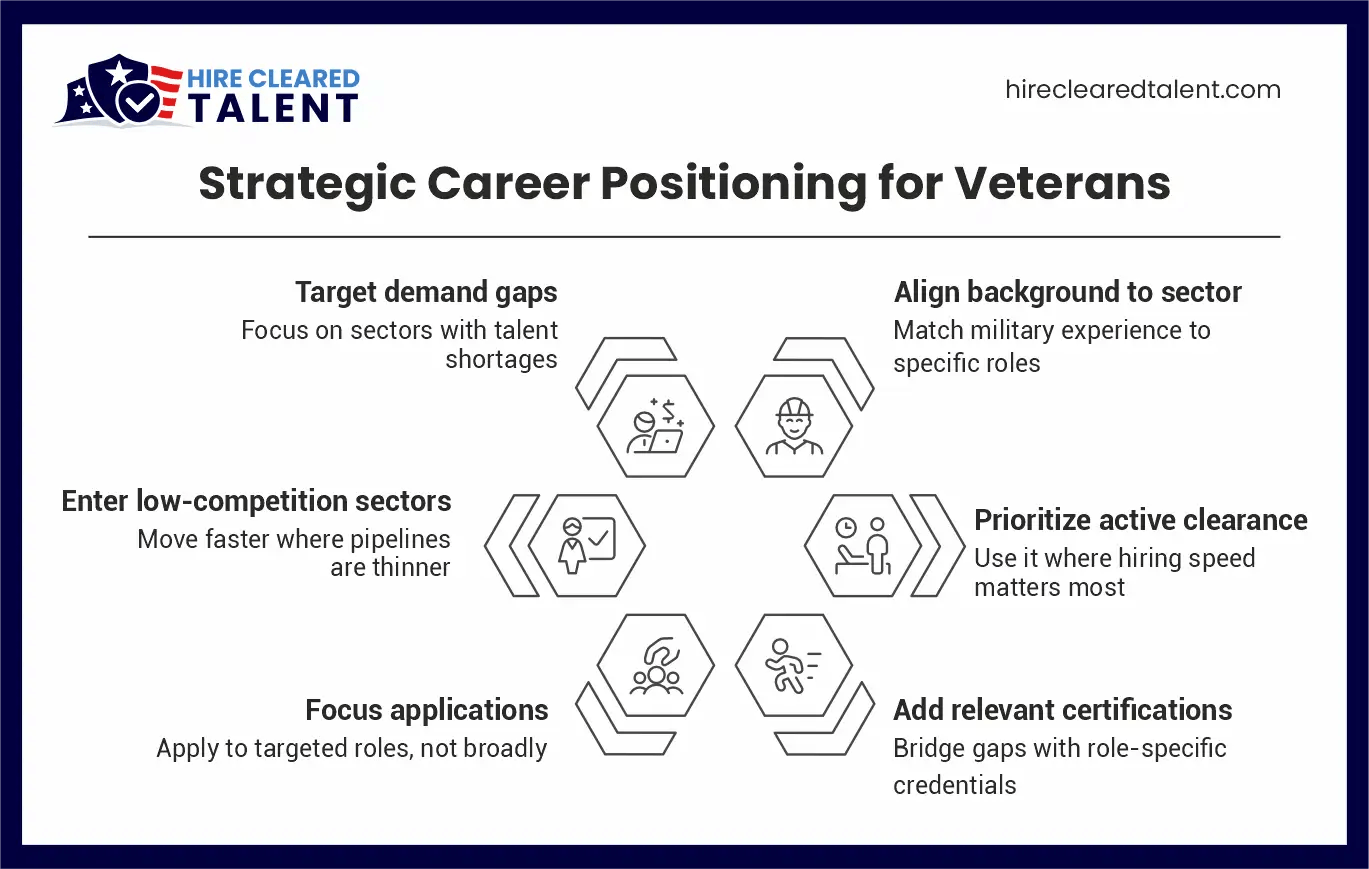
The veterans who convert cleared backgrounds into strong first placements share a consistent pattern: they start early, they search in cleared-specific infrastructure where their clearance level is a primary variable rather than an afterthought, and they present their experience with the operational specificity that cleared hiring managers actually need to match a candidate to a requirement.
Where to focus in the current cleared market?
Cybersecurity - highest documented supply gap, fastest BLS growth projection, active clearance as an immediate differentiator over civilian candidates.
AI and data analytics - federal investment is accelerating, operational judgment from military service is a genuine competitive advantage, and cleared roles in this space are expanding faster than the pipeline can fill them.
Intelligence analysis - direct skill transfer from military occupational specialties, strong salary benchmarks, and thinner competition than technical roles.
Program management - defense contracting runs on cleared PMs, veteran operational experience maps directly, and demand is persistent across virtually every contract vehicle.
Space, critical infrastructure, logistics security, and information operations - smaller markets individually, but with lighter competition and strong alignment to specific veteran backgrounds.
None of this requires a veteran to reinvent their background. It requires presenting existing experience - accurately, specifically, in the right market to employers who have the context to understand what they're looking at. That's the gap this market has. And closing it is what moves placement timelines from months to weeks.
Your Clearance Has Value. Put It in Front of Employers Who Know That.
HireClearedTalent is a hiring marketplace built specifically for the cleared federal job market where clearance level is a primary matching variable, and where defense contractors and federal agencies find the candidates their contracts actually require.
If you're a veteran with an active clearance, this is the market where your background is evaluated correctly.
Create your profile on HireClearedTalent and put your cleared background in front of employers who are actively hiring right now in the sectors where demand is growing fastest.
So, do you need clarity about where your experience fits in the current cleared market and know how to position it effectively?
Schedule a Call with Our Experts
FAQ-
Q1- Which industries are hiring veterans the fastest in 2026?
A- Cybersecurity, IT, defense contracting, logistics, and data roles show strong demand. These sectors value technical skills and mission experience. Hiring remains steady due to ongoing workforce gaps.
Q2- Why are veterans in high demand across technical roles?
A- Veterans bring discipline, security awareness, and real-world problem-solving. Many hold clearances and hands-on operational experience. Employers value this combination for mission-critical roles.
Q3- How do security clearances impact job opportunities for veterans?
A- Active clearances speed up hiring and increase job access. Employers prioritize candidates who can start without investigation delays. This often leads to higher-paying roles.
Q4- What are the fastest-growing career paths for veterans transitioning to civilian jobs?
A- Cybersecurity, cloud, intelligence analysis, and project management roles are growing fast. These roles align well with military experience. Certifications strengthen entry into these fields.
Q5- How can veterans identify high-demand roles that match their background?
A- Map military skills to civilian job descriptions and review job market data. Focus on roles with consistent openings and skill overlap. Target industries with ongoing talent shortages.
Q6- Do certifications help veterans access high-demand roles faster?
A- Certifications provide standardized proof of skills. They improve resume visibility and recruiter trust. Many employers use them as a baseline filter.
Q7- What locations have the highest demand for veteran talent?
A- Demand is strong near defense hubs and tech centers like Virginia, Texas, and California. These regions host contractors and federal agencies. Remote roles are also increasing.
Q8- How can veterans transition into cybersecurity roles quickly?
A- Start with foundational certifications and build practical skills. Apply for entry-level roles like SOC analyst or security support. Consistent applications and networking improve outcomes.
Q9- What hiring challenges do veterans face despite high demand?
A- Resume translation issues, lack of certifications, and limited networking slow hiring. Some roles require civilian experience alignment. Clear positioning helps overcome these gaps.
Q10- How can employers better connect with available veteran talent?
A- Use veteran hiring programs, adjust screening processes, and recognize military experience. Engage candidates before separation through programs like SkillBridge. Faster processes improve hiring outcomes
Weekly newsletter
Get the latest blog updates, practical hiring insights, and featured reads delivered straight to your inbox.
Read about our Privacy Policy.