
-1788202138638-236188648.jpeg)

If you're hiring cleared talent in 2026, the math is no longer in your favor. There are somewhere between 500,000 and 700,000 open cleared positions across the country right now, against a much smaller pool of professionals who actively hold clearances and are open to moving. The cleared population itself has dropped by nearly a million people since 2013.
Demand keeps climbing. Supply keeps shrinking. And the companies still running a 2019 playbook are losing every week without understanding why.
Your competitors aren't just other defense primes anymore. Commercial cyber firms, cloud providers chasing federal contracts, and even some non-cleared tech companies have figured out that hiring someone with an active TS/SCI is faster than sponsoring a new one. The pool is the same. The number of hands reaching into it has doubled.
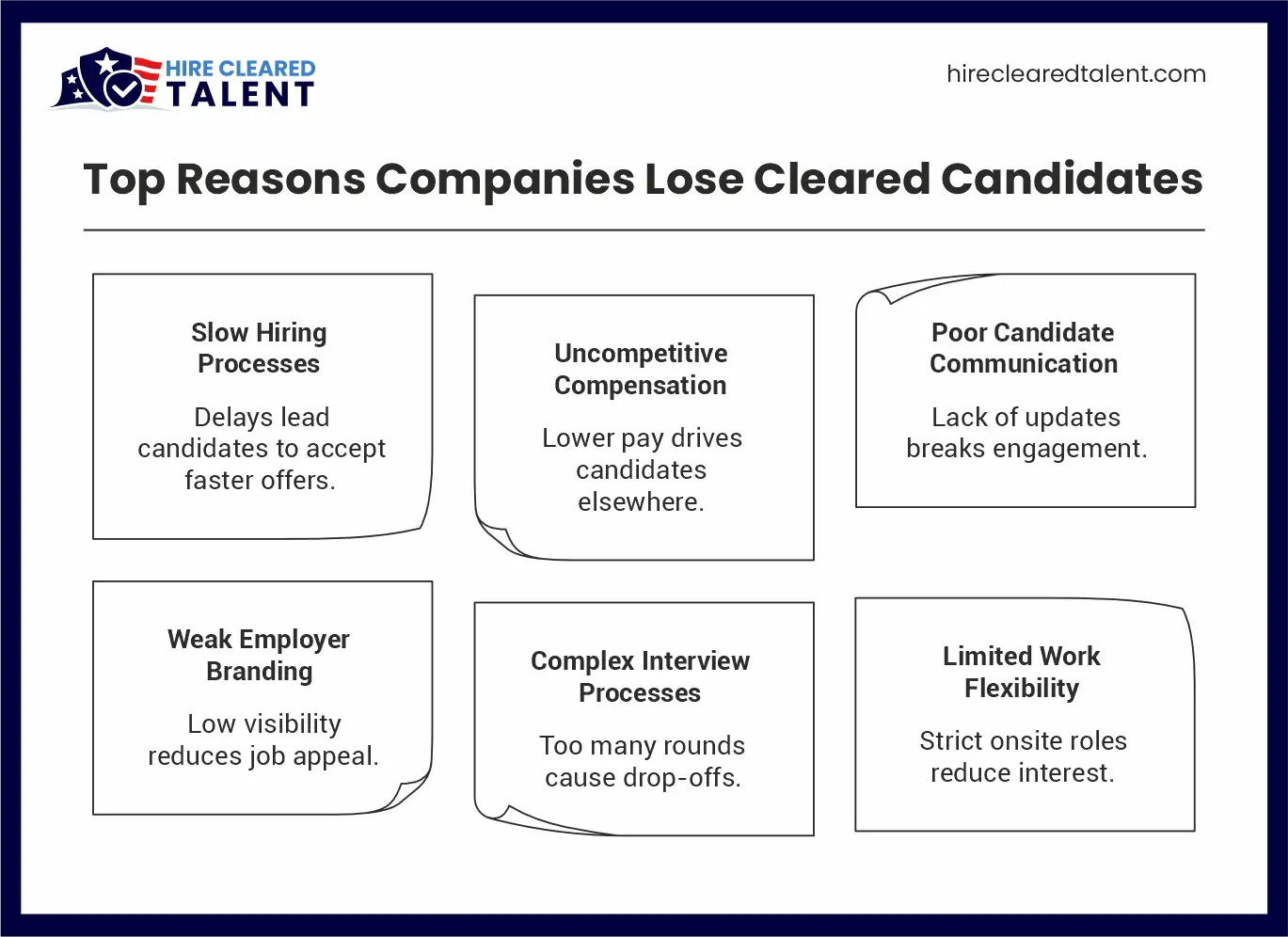
Best Strategies for Recruiting Cleared Professionals
Let’s have a look-
Strategy 1: Compensation Is the Price of Admission
Pay drives this market. As per ClearanceJobs' 2026 Security Clearance Compensation Report average total compensation for cleared professionals hit $126,125 in 2025, up nearly 6% in a single year. Seventy percent of cleared professionals got a base pay increase. Twelve percent saw raises above 10%.
One in eight cleared workers received double-digit raises in a single year. If your annual review process caps merit increases at 3.5%, you're funding your competitors' hiring funnel.
Money alone won't keep them. The same report found 78% of cleared professionals say they're at least somewhat likely to change jobs in the next year. Pay is the bargaining chip. It isn't the reason they stay.
Strategy 2: Speed Wins More Offers Than Salary
A 2024 ClearanceJobs survey showed demand for cleared experts grew 12% year over year, with the sharpest growth in cybersecurity, data analytics, and intelligence operations. The Defense Counterintelligence and Security Agency reported an average end-to-end processing time of 243 days for background investigations as of Q3 fiscal 2025.
When you find someone who already holds the clearance you need, move with urgency that probably feels uncomfortable inside your normal hiring process. A two-week interview loop is two weeks too long. A panel that requires four senior people to align calendars will lose you the candidate by week three.
You want a target. The teams winning right now close cleared offers in ten business days or less, start to finish. First conversation to signed letter. If your average is 35 days, you already lost most of the candidates you wanted.
Here's What Most People in This Industry Won't Say Out Loud
After two decades of watching cleared hiring, the honest reason most strategies fail is structural. Your recruiting function is disconnected from the program managers who actually understand the work.
You have a recruiter who has never sat in a SCIF, trying to fill a role for a contract whose technical demands are buried in a SOW nobody handed her. She writes a job description from a template. She runs it through compliance. She posts it on three platforms. Then she wonders why qualified candidates either ignore the posting or ghost halfway through the loop.
Cleared candidates can read a generic posting in thirty seconds and tell whether the company understands the work. Put your TA team in program standups. Let them hear the technical conversation. Response rates will move within a quarter, and you can measure it.
Read more- Cleared Talent Recruitment: Key Trends Federal Contractors Need to Know in 2026
Strategy 3: Build a Passive Candidate Pipeline Before You Need It
About 92% of cleared professionals are already employed.Only 8% are actively job-seeking at any given moment. If your sourcing strategy depends on inbound applicants, you're fishing in the smallest pond available.
Where do you find the other 92%?
Build relationships before you have a req. Stay in touch with the candidate who turned you down last year because her kid was about to start school.
Sponsor regional cleared meetups where mid-career engineers actually show up. Make sure your company name is the first one a cleared professional thinks of when her current contract starts winding down. Not the fifteenth.
Strategy 4: Offer the Flexibility You Can Actually Approve
Classified work happens in a SCIF. Nobody disputes that. But the cleared workforce has noticed, loudly, that some employers found ways to offer hybrid schedules, compressed work weeks, and remote-eligible unclassified hours. Others didn't bother to try.
Mid-career analysts with families are accepting pay cuts of $5,000 to $10,000 to move to contractors who approve one work-from-home day per week for unclass admin and training. That isn't a fringe behavior. That's where the market is moving.
If a competitor across the parking lot offers a 9/80 schedule and you don't, you're losing talent for a reason that has nothing to do with mission, money, or culture. It's the schedule. Audit your contracts for where flexibility is actually allowed under the FSO's reading of the rules. You'll probably find more room than your HR team assumed.
Strategy 5: Sourcing Channels That Actually Work
The reflex is to post on the same three or four cleared job boards everyone else uses, then wait. That works about as well as you'd expect when most of your audience isn't looking.
Better channels to invest in:
Your own alumni network. People who left your company in good standing know the work and may want back in two contracts later. Most companies don't maintain this list but you should.
Transitioning military at installations near your work sites. Service members start looking 12 to 18 months before separation. Show up early.
Employee referral bonuses that match the cost of a missed hire. A $5,000 referral payout looks expensive until you compare it to a req open for six months at $200,000 in unbilled program revenue.
Cleared-specific marketplaces. Pre-filtered by clearance level, polygraph status, and contract availability. The screening work is already done.
Strategy 6: Redesign the Interview Loop for Cleared Hiring
Your standard commercial interview process was built for a market where candidates outnumber jobs. Cleared hiring is the opposite. You need to flip the dynamic of the loop accordingly.
Start with a thirty-minute conversation between the candidate and the actual program lead, not a recruiter screen. Cleared professionals respond to technical credibility. If the first voice they hear belongs to someone who can't answer a basic question about the contract or the work, you've lost trust before the process started.
Cut your panel size. Three interviewers is enough and five is theater. Every additional voice in the loop adds three to five days of scheduling delay and rarely improves the hiring decision. Track your loop length the same way you track time-to-fill. If your average TS/SCI hire takes more than 15 business days from application to offer, identify the choke point and fix it before next quarter.
Send the offer letter the same day the decision gets made. Verbal commitments hold weight in this community, but candidates compare written offers. The contractor who sends paperwork that afternoon usually wins over the one who promises it by Friday.
Strategy 7: Retention Is the Cheapest Recruiting You'll Ever Do
Compensation remains the top driver of job satisfaction, with 67% of cleared professionals naming pay as their primary motivator. Mobility is rising, and retention now requires more than an annual cost-of-living bump.
The teams holding onto cleared talent do three things at once. They run market-rate salary adjustments mid-year instead of waiting for annual review cycles. They have real career path conversations every six months, not annual reviews, nobody believes. They offer program rotations so senior engineers can move between contracts without leaving the company.
That last one matters more than people realize. A TS/SCI cyber lead rarely quits a company. He quits a contract he's been on for four years that has gone stale.
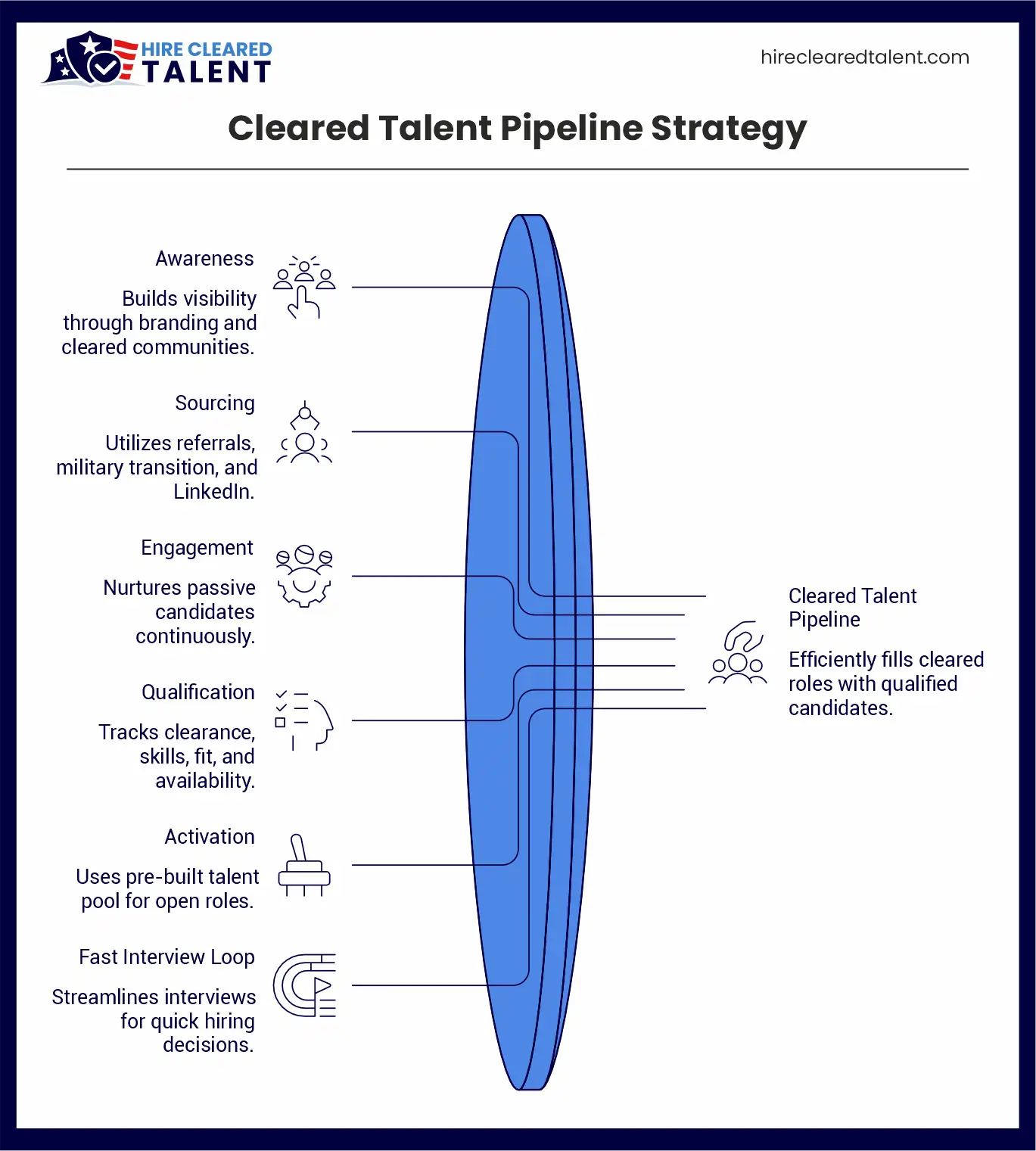
What This Adds Up To?
Recruiting cleared professionals in a competitive market is not a creative branding problem. It's an operational one.
The companies winning right now have collapsed their interview loops, raised salaries mid-cycle, built passive-candidate pipelines that exist before reqs open, and given their recruiters real exposure to the technical work.
The companies losing are still treating cleared hiring like commercial hiring with a background check bolted on. The candidates know the difference. They've been watching for years.
Read more- Security Cleared Staffing Shortages 2026: Why Hiring Timelines Are Breaking
Where HireClearedTalent Fits In?
HireClearedTalent was built for organizations that want to move at the speed this market demands.
Our marketplace connects HR teams and program leads directly with active and passive cleared professionals( Secret, Top Secret, TS/SCI with polygraph, DOE Q and L) without the friction of generic job boards or the overhead of contingency recruiters who don't understand the difference between a SAP and a SCI nomination.
If you're tired of watching reqs sit open while competitors close offers, you can create a profile on HireClearedTalent. We'll show you who's in the pool, what they actually want, and how to reach them before someone else does. Still have any doubts?
FAQ-
Q1- How can companies attract security-cleared professionals in highly competitive hiring markets?
A- Companies can attract cleared professionals by offering flexible work arrangements, faster hiring processes, competitive compensation, career growth opportunities, and mission-driven projects.
Q2- What recruiting channels work best for finding cleared candidates?
A- Specialized cleared job boards, employee referral programs, defense industry events, LinkedIn outreach, veteran hiring initiatives, and federal contractor partnerships are highly effective sourcing channels.
Q3- Why is speed important when recruiting cleared professionals?
A- Cleared candidates often receive multiple offers at the same time, so delays in communication or interviews can lead to losing top talent to competitors.
Q4- How can employers improve retention of cleared employees after hiring?
A- Employers can improve retention through upskilling programs, leadership development, internal mobility, meaningful projects, and transparent career growth opportunities.
Q5- What role does employer branding play in cleared recruiting?
A- Employer branding helps organizations stand out by showcasing mission impact, company culture, contract stability, and employee success stories.
Q6- How can recruiters build long-term pipelines for cleared talent?
A- Recruiters can build pipelines through networking communities, alumni engagement, referral programs, talent nurturing campaigns, and consistent outreach to passive candidates.
Q7- What challenges make cleared hiring more difficult than traditional recruiting?
A- Limited candidate pools, security clearance requirements, lengthy hiring processes, and intense competition make cleared hiring more complex than standard recruiting.
Q8- How can companies reduce candidate drop-off during the hiring process?
A- Streamlined interviews, clear timelines, regular follow-ups, and transparent communication help keep cleared candidates engaged throughout recruitment.
Q9- Why are referral programs effective for hiring cleared professionals?
A- Referral programs work well because cleared professionals often know other qualified candidates with relevant experience and security eligibility.
Q10- How does remote or hybrid work impact cleared recruiting strategies?
A- Offering hybrid flexibility for eligible roles can expand the talent pool and improve competitiveness, even though some classified positions require onsite work.
Weekly newsletter
Get the latest blog updates, practical hiring insights, and featured reads delivered straight to your inbox.
Read about our Privacy Policy.