


Federal agencies just stopped letting candidates self-assess their own qualifications, the checkbox questionnaire that used to sit between your resume and a hiring decision for decades.
OPM's Merit Hiring Plan eliminated it in 2025, alongside a target of cutting time-to-hire to under 80 days. The old system let you rate your own skills. The new one doesn't. Something has to replace that missing signal, and what replaces it is exactly what this piece is about.
Most advice about federal cyber resumes focuses on the document itself: formatting, keywords, bullet structure. That's useful. It's also not the whole picture. This piece is about something different: what's actually happening on the other side of the process, who reads your resume, in what order, checking for what, so you understand what you're really writing for.
The Evaluation Process Changed, Not Just the Resume
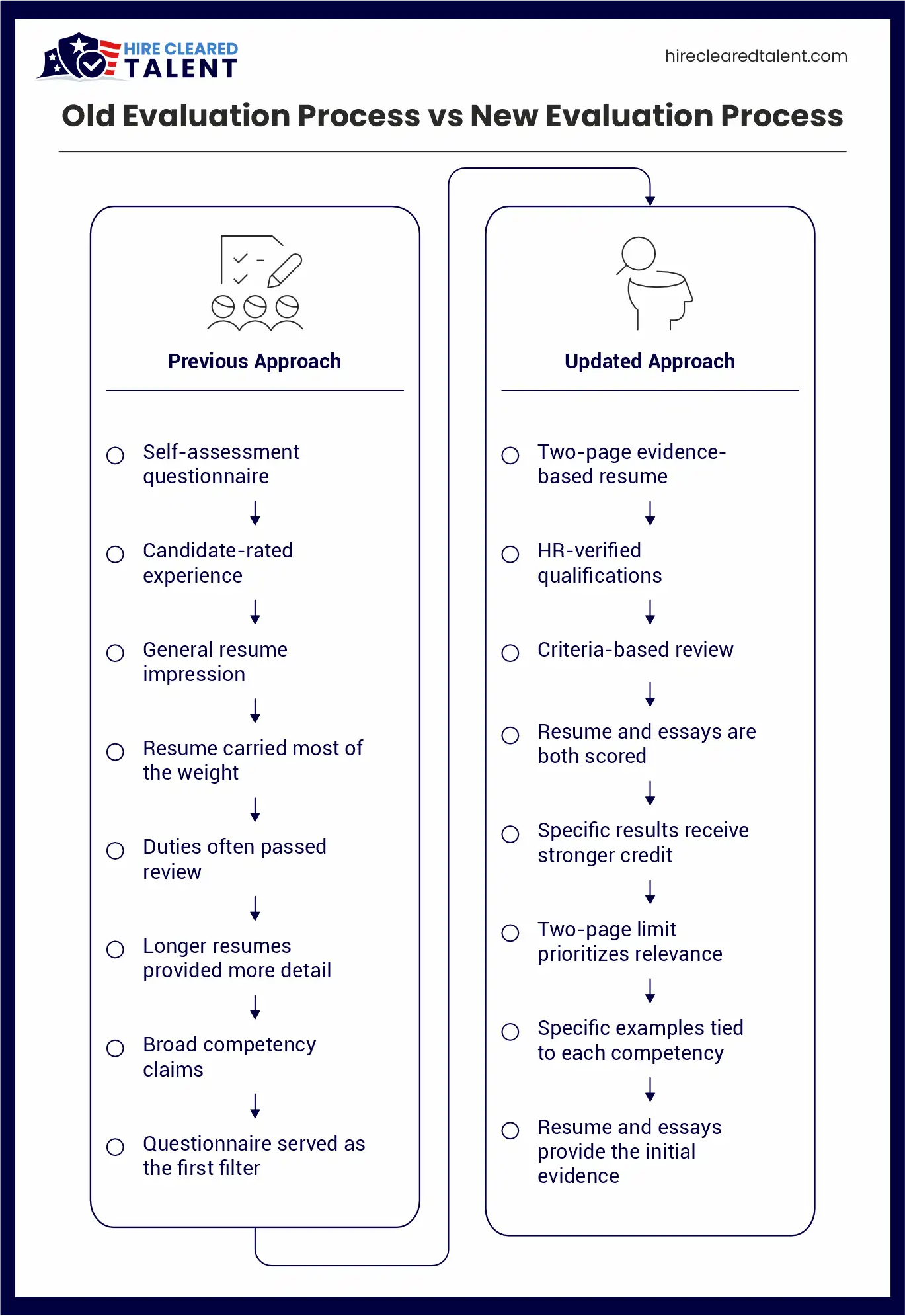
Self-assessment questionnaires had a real function, even with their flaws. They gave HR specialists a fast first filter before anyone read a full resume. Removing that filter without replacing it would slow hiring down, not speed it up.
So, OPM replaced it with two things: a two-page resume that has to carry more evidentiary weight on its own, and, for GS-05 and above, four short essay questions scored as part of the same review.
OPM has also rolled out Structured Resume Review Training across agency HR staff, teaching a more consistent, criteria-based method for reading a resume against a job announcement. That matters more than it sounds like it should. A less structured review leaves more room for a strong-sounding resume to score well even when the evidence behind it is thin.
A structured review checks specific claims against specific criteria. It rewards precision. It penalizes vague duty statements harder than the old process did, because there's now a rubric an HR specialist is actually trained to apply, not a general impression they're forming.
The essay questions deserve their own attention here, separate from the resume itself. Each one runs 200 words, tied to a specific competency the announcement is testing for.
Treat a weak essay answer as costing you the same way a weak resume bullet does, because under the new structured review, it's scored the same way: against specific criteria, not overall impression. A candidate with a strong resume and a generic, rushed essay answer can still lose ground to a candidate who took both parts equally seriously.
What Actually Happens to Your Resume After You Hit Submit?
Your resume doesn't go to a hiring manager first. It goes through a sequence, and knowing the sequence tells you where to put your effort.
USAJOBS runs an initial eligibility check that includes citizenship status, veteran's preference documentation, whether your resume even claims to meet the announcement's basic qualifications. Fail this step and nothing else matters, no matter how strong your cyber experience actually is.
This is the step most candidates underestimate, because it has nothing to do with how good you are at the job and everything to do with whether the paperwork is complete. A missing hours-per-week field, a resume that doesn't explicitly state you meet the time-in-grade requirement, a citizenship declaration left blank: any of these can end an otherwise strong application before a person ever weighs in on your qualifications at all.
Next, an HR specialist rates your resume against the announcement's Specialized Experience requirements, now under the structured review process described above, plus your essay responses if the grade level requires them. This produces a score, and scores above a cutoff land you on a Best Qualified list.
This is the step where quantified, framework-specific bullets earn their keep. It's also close to automatable in spirit even when a person is doing it by hand: the reviewer is checking boxes against your resume's language, not forming a general impression of your career the way a private-sector recruiter might.
Only candidates on that Best Qualified list ever reach an actual hiring manager. This is worth sitting with. The person who decides whether you get the job never sees most of the applicants at all. Your resume's real audience, for most of the process, is an HR specialist checking specific criteria. It is not a hiring manager judging overall fit, at least not yet.
There's a second path worth knowing about too. OPM's plan expands the use of talent pools and shared certificates, standing lists of pre-qualified candidates that multiple agencies can pull from for similar roles instead of running a fresh announcement every time.
A strong resume in a relevant talent pool can put you in front of hiring managers at agencies you never directly applied to, sometimes months after you submitted it. This is a real shift in how federal hiring works, not a minor administrative footnote.
A single well-built application can now generate opportunities across several agencies instead of ending when one specific announcement closes, provided the resume that got you into the pool was strong enough to earn a place in it.
Read more- Step-by-Step Guide to Landing Federal Background Investigator Jobs
What Cyber-Specific Federal Hiring Managers Are Actually Checking For
Once a resume clears HR and reaches an actual hiring manager, cyber roles add a layer generalist federal hiring doesn't have: the DoD Cyber Workforce Framework work role has to match, not just the job title.
A hiring manager reviewing candidates for a specific DCWF work role, Cyber Defense Analyst, Systems Security Analyst, whatever the announcement names, is checking whether your experience maps to that specific role's actual functions, not to cybersecurity in general.
Two candidates with the same certifications can read very differently here. One describes broad security experience. The other describes experience that maps directly onto the named work role's core tasks. The second one reads as a match. The first reads as adjacent, and adjacent loses to a match almost every time when both candidates clear the same HR score.
Certification currency gets checked here too, not just certification presence. Under DoD Manual 8140.03, certifications that qualified you under the old 8570 categories still count, but a hiring manager who works these roles daily notices immediately if your resume still uses 8570-era language, IAT Level II instead of the current work role terminology.
It doesn't disqualify you. It does cost you the appearance of currency, in a field where staying current is half the job description. A hiring manager reading a resume in outdated framework language is, fairly or not, wondering what else about your knowledge might be outdated too.
Two Different Readers, Two Different Standards
It helps to think of your resume as answering two separate questions for two separate readers, because that's genuinely what's happening.
The HR specialist is asking: does this resume's language demonstrably match the announcement's required qualifications? That's a compliance question, close to pass or fail, and it rewards precise, framework-accurate language over persuasive writing. Charm doesn't move this needle. Matching language does.
The hiring manager, once you clear that first gate, is asking something closer to: would I trust this person with the specific work this role actually does? That's a judgment question, and it rewards depth, specificity, and evidence of real hands-on work over generic competence claims.
A resume built only for the first reader can read as checkbox-shaped and forgettable to the second one. A resume built only for the second reader risks never reaching them at all, because it didn't clear the first gate. You need both, in that order, and most federal cyber resume advice only really addresses one of them.
Read more- Step-by-Step Guide to Landing Federal Background Investigator Jobs
The Skills-Based Shift Aimed Directly at IT Roles
OPM is running a specific pilot that federal IT and cyber candidates should know about by name: the Skills-Based Hiring for Information Technology Management Positions Project, moving the IT job series toward fully skills-based hiring, with job-related assessments carrying real weight in the decision instead of resume language alone.
This pilot explicitly includes the roles this audience is applying for: software developers, IT managers, and other 2210-series technical positions where cyber work often lives. The practical implication is straightforward.
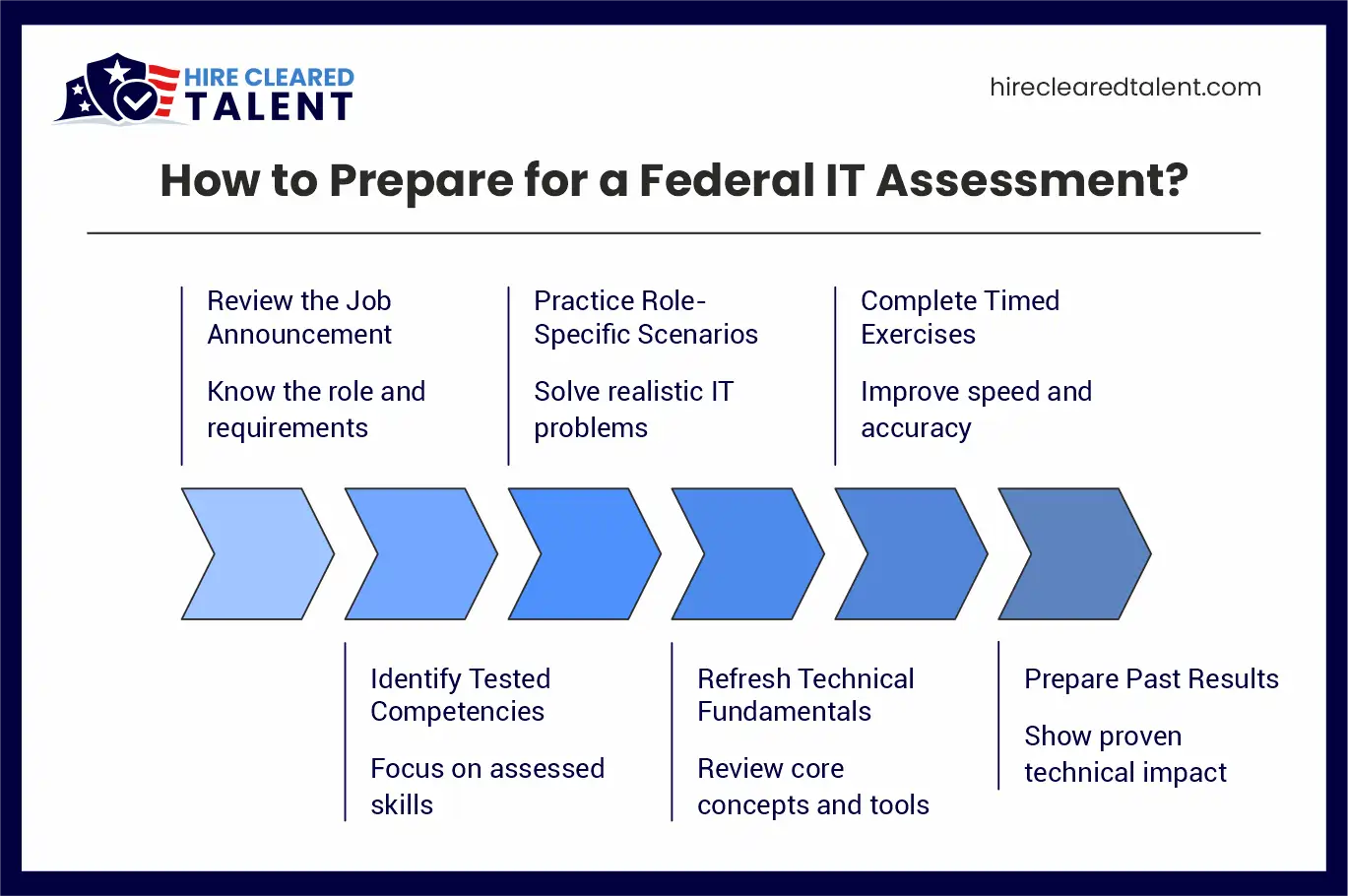
A resume that reads well is necessary but no longer sufficient on its own. If an announcement includes a technical assessment, treat it with the same seriousness as the resume itself, not as a formality after the real decision's already been made.
Hiring managers in this pilot are explicitly being asked to weight demonstrated skill over resume polish, which helps candidates with strong hands-on ability and a less polished writing style, and removes some of the advantage a beautifully worded but thin resume used to carry under the old system.
Expect this pilot's approach to spread. OPM built it as a prototype for other job series once the IT 2210 rollout finishes, which means the assessment-first pattern showing up now in IT roles is a reasonable preview of where other technical federal hiring is headed too.
What This Means for You?
Write your resume for the HR specialist first, since that's the audience you actually have to get past to reach anyone else. Match the announcement's Specialized Experience language directly. Name the specific DCWF work role your experience maps to, not a general cybersecurity summary. Keep certifications current in both fact and terminology, not just current in the sense that you still hold them.
Take the essay questions as seriously as the resume bullets. If an assessment is part of the announcement, prepare for it like it's the interview, because increasingly, it functions like one. And if a role sits in a talent pool or shared certificate, treat that submission with the same care as a direct application. It can surface in front of a hiring manager well after you've stopped thinking about it.
None of this replaces the resume mechanics, the formatting, the bullet structure, the exact CCAR-style rewrite work. It explains why those mechanics work the way they do, and where in the process each part of your resume is actually doing its job.
HireClearedTalent works directly with federal agencies and government contractors hiring for cyber, cloud, and intelligence roles, and its recruiters see this process from the inside on both ends.
If you want a resume reviewed against a specific work role and a real hiring manager's expectation, not a generic template, our team can help you before your next application. So, what are you waiting for?
Schedule a call with our cleared career experts!
FAQ-
Q1. What do federal cyber hiring managers look for first in a resume?
A. They look for clear evidence that you meet the specialized experience and competencies listed in the announcement. Your strongest matching experience should appear early and be easy to verify.
Q2. Should a federal cyber resume be limited to two pages?
A. Yes. Federal resumes submitted through USAJOBS must now be two pages or less. Prioritize recent, relevant experience and remove details that do not support the target position.
Q3. How should I match my resume to a federal cyber job announcement?
A. Review the qualifications, specialized experience, duties, and evaluation criteria. Use the same technical terms when they accurately describe your experience and address every required qualification directly.
Q4. What counts as strong evidence of cybersecurity experience?
A. Show what you protected, investigated, secured, improved, or delivered. Include the environment, tools, scope, actions, and results instead of listing general responsibilities.
Q5. Should I include cybersecurity tools and platforms by name?
A. Yes. Name the tools you have actually used, especially when they appear in the announcement. Examples include SIEM platforms, vulnerability scanners, cloud environments, endpoint tools, scripting languages, and identity systems.
Q6. How should I write federal cyber resume achievements?
A. Use concise, results-focused statements. Add numbers, percentages, timelines, system counts, users supported, vulnerabilities resolved, or improvements in response time when available.
Q7. What is the best format for a cybersecurity resume bullet?
A. Use this structure: action + technical scope + measurable result. For example, “Remediated 120 critical vulnerabilities across 300 endpoints, improving compliance before the annual audit.”
Q8. Should I include my current security clearance?
A. Include your current clearance when it is relevant to the role. State the level clearly, but never add classified, sensitive, or operational details.
Q9. Do cybersecurity certifications matter on a federal resume?
A. Include certifications that are required or relevant to the position, such as Security+, CISSP, CISM, CEH, CCSP, or vendor-specific credentials. Add the certification name and date when requested.
Q10. Do federal cyber resumes need employment dates and weekly hours?
A. Yes. Include the month and year for each position and the number of hours worked per week. Missing details may prevent HR from confirming that you meet the experience requirement.
Weekly newsletter
Get the latest blog updates, practical hiring insights, and featured reads delivered straight to your inbox.
Read about our Privacy Policy.