


You hold a security clearance and you plan to travel, but you feel nervous about rules, reporting, and risks. Many cleared travelers miss a step, and that can cost jobs, access, or time.
Where you travel, who you interact with, and how you report those activities all become part of your security profile. The shift to continuous vetting means travel-related risks are now identified much faster than before. That makes proactive compliance essential.
Travel Guidelines For Security Clearance Holders cut through the confusion, and show clear steps to follow.
This post will tell you what to report, how to notify your Facility Security Officer, how to use DISS and the Defense Travel System (DTS), when to activate your Government Travel Charge Card (GTCC), how to enroll in the Smart Traveler Enrollment Program, and how to protect classified information, devices, and personal safety.
Travel Is a Reportable Activity, Not Just Personal Movement
International travel must be reported in advance in most cases. This includes vacations, personal visits, and short trips.
The requirement exists because foreign travel increases exposure to:
Foreign intelligence collection
Unintentional information sharing
Undocumented interactions
Continuous vetting systems are designed to track such exposure. Agencies now rely on real-time data to monitor personnel risk and respond quickly when needed, reducing
Key Takeaways
You must report all personal foreign travel before leaving, even short trips to Mexico or Canada, according to SEAD 3 rules.
Contractors had an 18-month compliance window for using the Defense Information System for Security (DISS), ending August 24, 2022. Using DISS is now required for reporting cleared employee travel.
Report your travel early and follow the Joint Travel Regulations (JTR) and SEAD 3 guidance.
Avoid high-risk countries like Russia, Iran, North Korea, or Cuba, traveling there can raise concerns with your security clearance review.
After returning from abroad, complete a debriefing and report any new foreign contacts or incidents right away in DISS as required by SEAD 3; failure to do so may risk your clearance status.
More- Security Cleared Staffing Shortages 2026: Why Hiring Timelines Are Breaking
Pre-Travel Requirements
Before you pack your bags, talk with your office of security about reporting requirements. Use the Defense Information System for Security (DISS) to log details and meet SEAD 3 rules, or you might face headaches down the road.
Notify and obtain approval for foreign travel
Notify your Facility Security Officer, and get approval for all foreign travel, including personal trips and vacations. Security Executive Agent Directive 3, SEAD 3, makes this a reporting requirement for anyone with access to classified information or in sensitive positions.
Report all travel plans before departure, even if you are on leave; even beach selfies count.
Report early, report often.
Contractors under DoD oversight had an 18 month compliance window from February 24, 2021, which ended August 24, 2022. The Defense Information System for Security, DISS, became the system of record, and the DISS bulk upload tool went live on August 24, 2022.
Contractors using the bulk upload tool must report cleared employee travel at intervals no more than 30 days. Cleared employees must notify their FSO, and those stationed abroad must report personal travel to other countries too.
Submit travel details in compliance with SEAD 3 guidelines
Traveling while holding a security clearance requires careful steps. Submit your travel details to meet the SEAD 3 guidelines. Start by creating an account in the Aircraft and Personnel Automated Clearance System (APACS).
Fill out a Personnel Request form to ask for necessary travel clearances. Once you save this form, it will give you a unique Personnel Request ID Number. Use this number in your Defense Travel System (DTS) authorization comments.
Be sure to follow all instructions in the DoD Foreign Clearance Guide (FCG). This guide helps with processes specific to each country. Completing these steps correctly is crucial for compliance with SEAD 3 regulations under the National Industrial Security Program (NISP).
Read more- Security Clearance Levels Explained: A Guide for Cleared Professionals
Security Measures During Travel
Stay alert while you’re on your trip. Keep your devices and sensitive information safe from prying eyes. Avoid places known for crime or political unrest to protect yourself better during travel.
Follow the rules set by SEAD 3 closely to keep your security clearance intact.
This is not just about being cautious, it's about being smart with every step you take. You have worked hard to earn that clearance, so treat it like gold!
Protect sensitive information and devices
Keep sensitive information safe while traveling. Clear your devices of personal data before you leave. Travelers often forget this step, but it is crucial. Avoid storing classified national security information on easily accessible electronic devices; this can put your security clearance at risk.
Do not share private details with acquaintances or in public spaces. This may make you a target for foreign intelligence services, who see clearance holders as prime targets. Use strong passwords and secure networks for online activities; public Wi-Fi increases the chances of data breaches.
Always be aware of your surroundings and protect what matters most to you.
Avoid high-risk destinations
Traveling to high-risk areas can be a big mistake for security clearance holders. Countries like Pakistan, North Korea, Iran, and Russia are known trouble spots. Visiting these places can make things tricky for your security clearance review.
For example, a two-week vacation in Panama followed by a side trip to Cuba could raise eyebrows during an evaluation.
Staying away from risky destinations is smart. Engaging in activities that attract attention may lead to problems too. For instance, drug use or illegal gambling is strictly off-limits, even if legal abroad.
Be careful about who you meet; exploitation and blackmail can happen easily in those areas. Better safe than sorry!
Read more- Security Cleared Staffing Shortages 2026: Why Hiring Timelines Are Breaking
Post-Travel Obligations
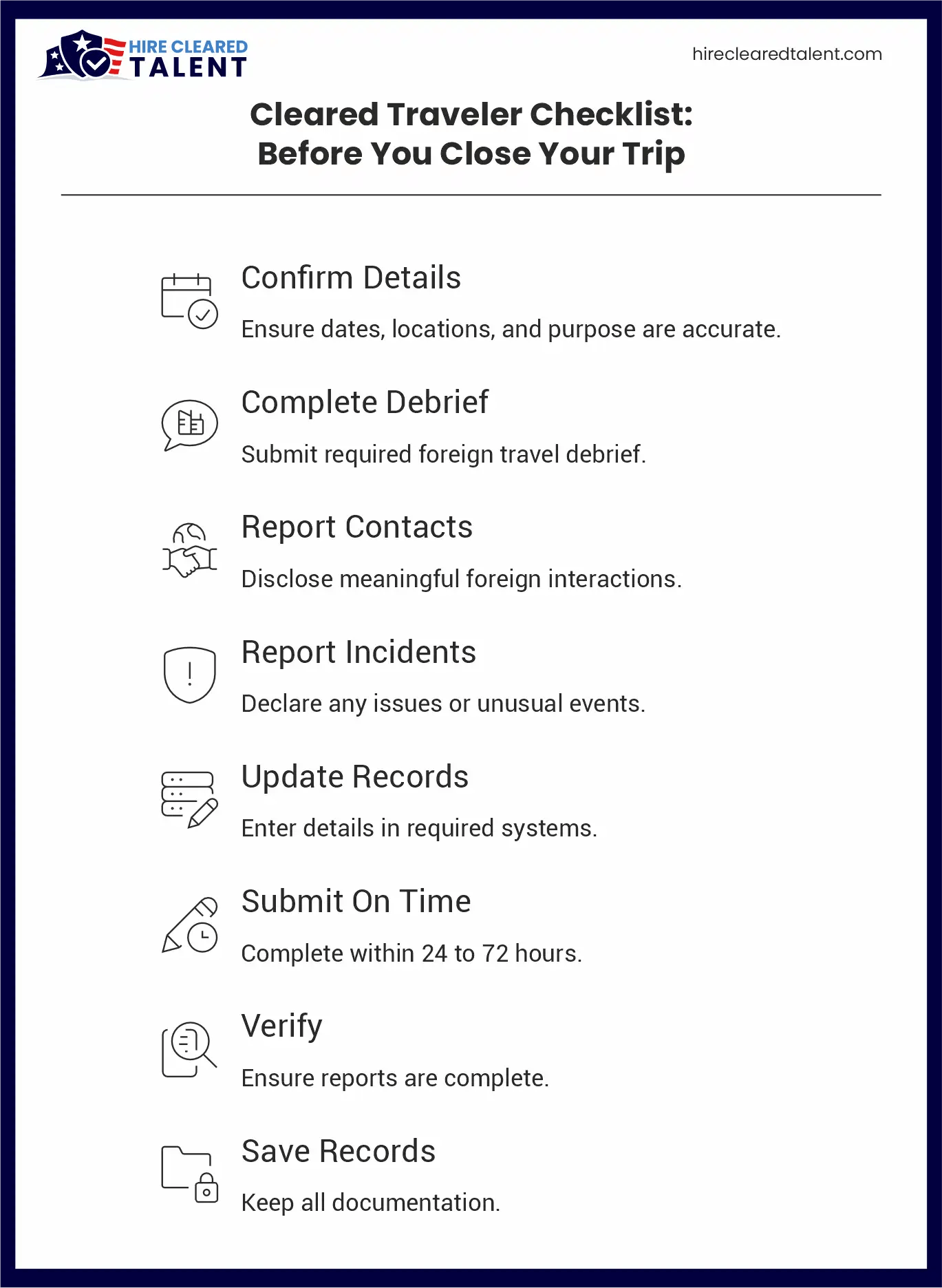
After your trip, you have some important tasks. You need to complete a debrief about your foreign travel and report any new contacts or incidents you had while away. These steps are crucial for keeping information safe and following government rules.
They help protect not just you, but also the wider community involved in national security.
If you're curious about how to navigate these obligations better, you're in luck! There are resources out there designed to guide you through the process effectively.
Complete foreign travel debriefing
Cleared employees must complete a foreign travel debriefing after any trip abroad, as required by SEAD 3. This process helps keep sensitive information safe. During the debriefing, you will report any unusual incidents or contacts you had while traveling.
Self-reporting is mandatory and critical for maintaining your clearance eligibility.
Your security office will review what you share during this meeting. They aim to identify potential risks to national security and vulnerabilities that may have arisen during your travels.
Tully Rinckey PLLC and DCSA offer additional resources to help with post-travel requirements, ensuring you're on top of everything needed after returning from overseas adventures.
Report any foreign contacts or incidents
Clearance holders must report any foreign contacts or incidents during their travels. This includes suspicious interactions or security issues they may encounter. Fleeting chats with service staff do not need reporting.
However, more significant contacts should be documented.
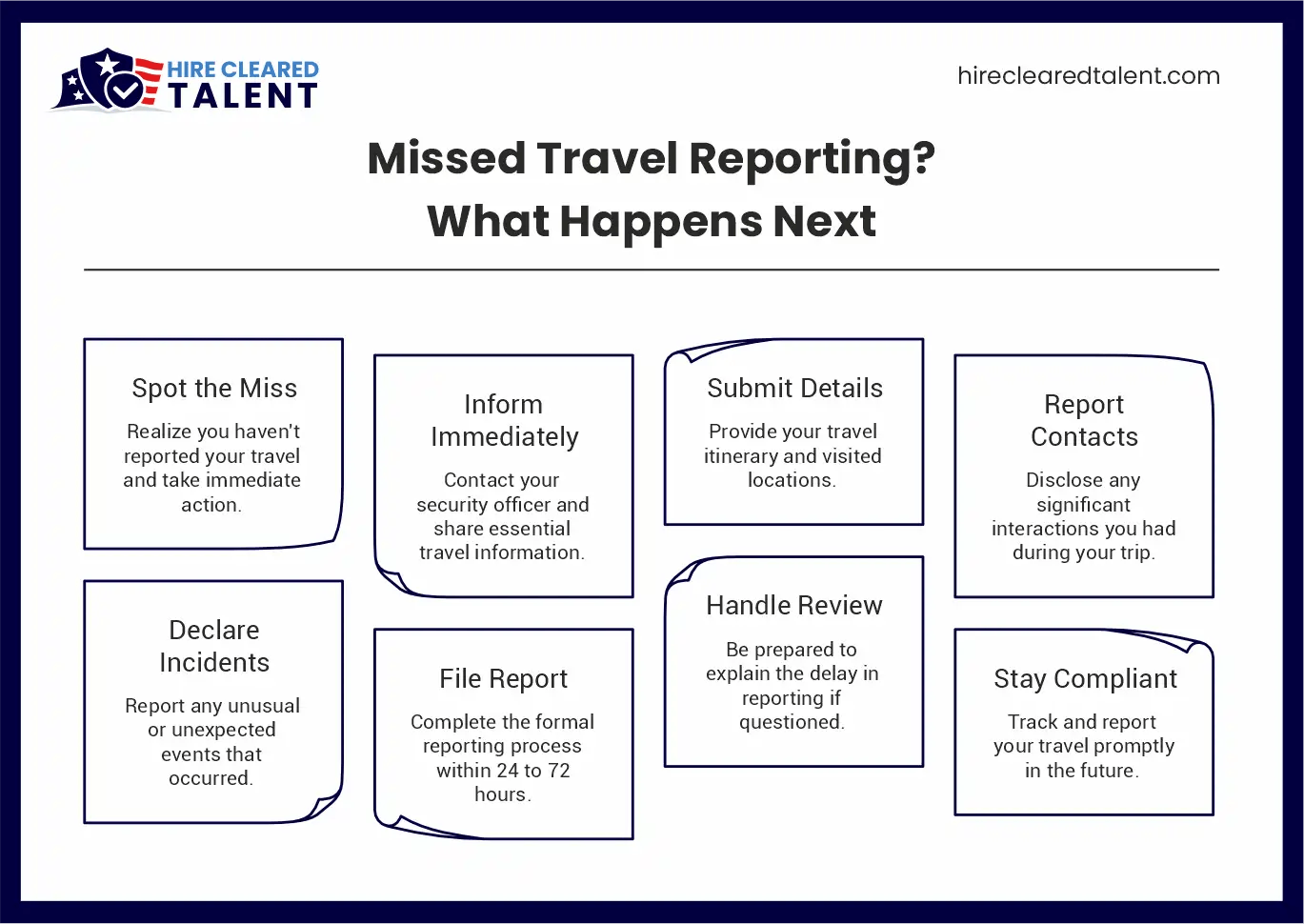
Travelers must also report thefts, lost documents, and other problems immediately after returning home. This needs to happen as soon as possible in the Defense Information System for Security (DISS).
Prompt reporting is crucial for compliance with SEAD 3 guidelines. Delaying can lead to serious issues down the road.
Conclusion
Travel does not put your clearance at risk, poor compliance does. Follow these travel guidelines if you hold a security clearance. First, notify your Facility Security Officer before leaving. This helps keep everyone informed and safe. Protect sensitive info and avoid high-risk places while traveling; some countries can cause issues for clearance holders.
'After returning, report any foreign contacts or incidents as required by SEAD 3 guidelines. If you want to translate your clearance into stronger career outcomes, explore HireClearedTalent.
Build your profile to get matched with roles aligned to your clearance and experience. Do you want to understand where you stand in today’s market and how to position yourself for the right opportunities?
Schedule a Consultation Call Today!
FAQ-
Q1- How far in advance should I report foreign travel for my security clearance?
A- You should report foreign travel as early as possible, ideally around 30 days before departure or as required by your organization. Early reporting allows your security office to assess risk and assign any required briefings.
Q2- Do I need to report personal travel outside the United States if I hold a security clearance?
A- Yes. All foreign travel must be reported, regardless of purpose. Personal trips, vacations, and family visits all fall under reporting requirements.
Q3- What happens if I forget to report my foreign travel before leaving?
A- You should inform your security officer immediately and submit complete travel details. Delayed reporting can trigger additional review under continuous evaluation.
Q4- Which countries require additional scrutiny for cleared professionals traveling abroad?
A- High-risk or adversarial countries receive greater scrutiny. Your security office will guide you based on current threat assessments and internal policies.
Q5- Do I need a pre-travel security briefing before going abroad?
A- Many agencies require a defensive or security briefing before foreign travel, especially for higher-risk destinations. These briefings cover cyber risks, surveillance threats, and safe conduct practices.
Q6- What kind of foreign contacts must be reported after travel?
A- You must report any meaningful, ongoing, or repeated interaction with foreign nationals. This includes professional discussions, personal connections, or situations where influence could develop.
Q7- Can using public Wi-Fi during international travel impact my security clearance?
A- Yes, if it exposes sensitive information. You should avoid unsecured networks or use approved secure access methods provided by your organization.
Q8- Do I need to report short layovers or transit stops in foreign countries?
A- In many cases, yes. Even brief stays may need to be documented depending on your organization’s guidelines. Always confirm with your security officer.
Q9- What should I do if I am approached by a foreign national asking about my work?
A- Do not share any work-related or sensitive information. Disengage from the conversation and report the interaction after returning if it seemed unusual or persistent.
Q10- How soon should I submit a travel report after returning?
A- Most organizations expect reporting within 24 to 72 hours after return. Timely submission keeps your records accurate under continuous evaluation.
Weekly newsletter
Get the latest blog updates, practical hiring insights, and featured reads delivered straight to your inbox.
Read about our Privacy Policy.