


Zero Trust is not a future cybersecurity strategy, but the current one that is redefining the methods of securing the identity, devices, applications, and information of the federal agencies.
What does it mean for network security specialists? Network security specialists can no longer depend only on the perimeter security approach because this approach gives way to continuous verification, least privilege, identity controls, micro segmentation, and monitoring. Modern organizations require people with the ability to apply these controls in cloud, hybrid, and on-premise networks.
From the viewpoint of career development, the change matters because Zero Trust keeps being among the top cybersecurity skill gaps along with artificial intelligence and cloud security. According to CyberSeek site, there are more than 514,000 job vacancies in cybersecurity in the USA currently, which means how competitive the hiring process remains in this sphere.
Nowadays, cybersecurity specialists who apply for government jobs cannot count on their expertise in firewalls and network monitoring only. The modern employers prefer candidates who are experienced in such fields as identity access management, endpoint security, automation, secure cloud infrastructure, and policy enforcement.
Let us consider the changes that have taken place and see what skills are crucial now.
The Core Principles of Zero Trust
Zero Trust rests on three ideas. Simple to state. Genuinely hard to operationalize at a government scale.
Never trust, always verify
There is no automatic trust given to any user, device or application that is already in the network perimeter; all requests must be checked, no matter where they come from.
Assume breach
Design the system as though an attacker is already inside it. That mindset shift changes what you build. Instead of focusing on improving the network perimeter, you focus on implementing monitoring and containment solutions that reduce the amount of damage when something does get through, because it will happen. It really is a new approach rather than a stricter old one.
Micro-segmentation
Divide your network into several isolated zones instead of having one huge trusted zone. A compromised device in one segment shouldn't be able to reach everything else. This is the part that takes the most actual engineering work to retrofit into an existing environment. It's also where a lot of implementations stall, because it means touching systems nobody wants to touch.
Key Government Policies Driving Zero Trust Adoption
Three documents anchor federal Zero Trust policy. Their relationship with each other, and their connection to the current administration, are much more important than remembering any of them independently.
Executive Order 14028 was signed in May 2021. It required federal civilian agencies to develop a strategy to implement Zero Trust Architecture along with several other cybersecurity policies. Then, in January 2022, OMB Memorandum M-22-09 transformed this order into a list of concrete and time-limited requirements that needed to be fulfilled before the end of fiscal year 2024. Phishing-resistant multi-factor authentication was one of those requirements.
Finally, NIST Special Publication 800-207, Zero Trust Architecture, serves as a technical guide underpinning both of the documents mentioned above. Released in 2020, it contains a description of the architecture itself – namely, the policy engines, policy administrators, and enforcement points that enable continuous verification. Agencies and contractors alike build toward this document. Not toward a marketing definition of Zero Trust.
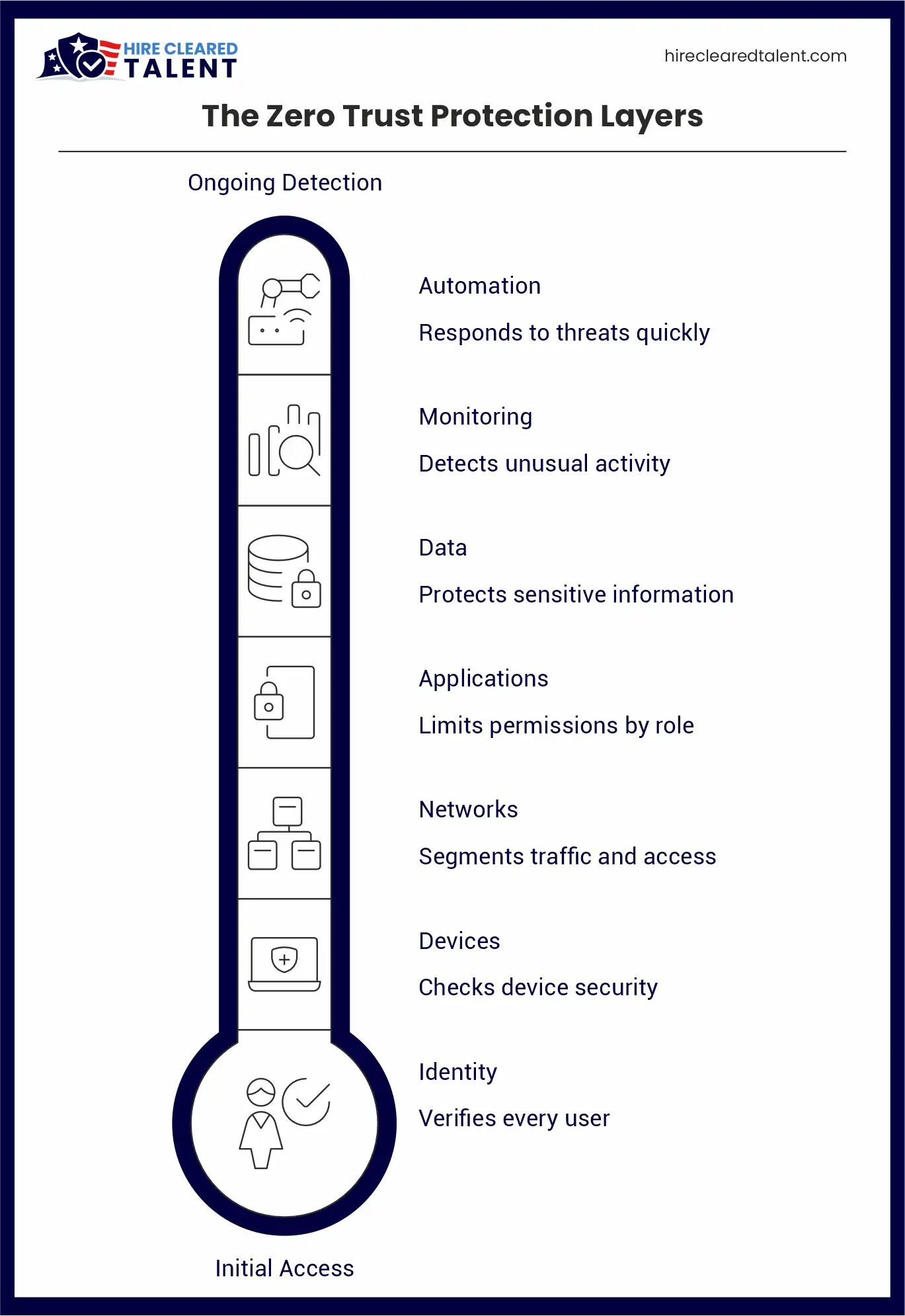
CISA's Zero Trust Maturity Model, currently on version 2.0, gives agencies a way to measure where they actually stand. Pillars five: Identity, devices, networks, applications and workloads, and data. Stages four: Traditional, initial, advanced, and optimal. This is the framework that agencies follow in describing their progress, and this is the framework contractors must understand completely if they want to advise on implementation.
Executive Order 14306 of 2025 altered less than was reported in the press.
It amended two other Biden-era orders, not EO 14028 itself, cutting specific reporting and pilot requirements the administration judged weren't reducing breach rates. It also pointed federal cybersecurity forward on two fronts largely absent from the original 2021 order.
A requirement for agencies to move toward TLS 1.3 by January 2030, in preparation for post-quantum cryptography. New attention to AI's role in both attacking and defending federal systems. The core mandate held. The scope around it shifted toward what the next several years of threats actually look like.
Read more- Hire Military Veterans: Why Smart Employers Are Prioritizing Veteran Talent ?
How Zero Trust Is Redefining Network Security Roles?
The architecture change is reshaping the job descriptions built around it, in three specific directions.
Identity management moved from a supporting function to the center of the job
Under a perimeter-based model, identity was one control among many. Under Zero Trust, identity is the control everything else depends on, since there's no perimeter left to fall back on.
Therefore, the identity and access management function is one of the hottest security professions at the moment. The federal job postings no longer want individuals who just manage the MFA, privileged access controls, and federated identity systems; rather, they expect the candidates to be able to design and implement them.
There is no avoiding the need for cooperation between the security professional and others. Micro-segmentation and continuous verification touch application teams, network engineers, and system owners who never used to need a security conversation for a routine change. A network security specialist in a Zero Trust environment spends real time coordinating with the people who own the applications and workloads being segmented, not just the people who own the firewall. That coordination is part of the job description now. It used to be an occasional escalation.
Continuous monitoring and analytics replaced periodic review as the default mode
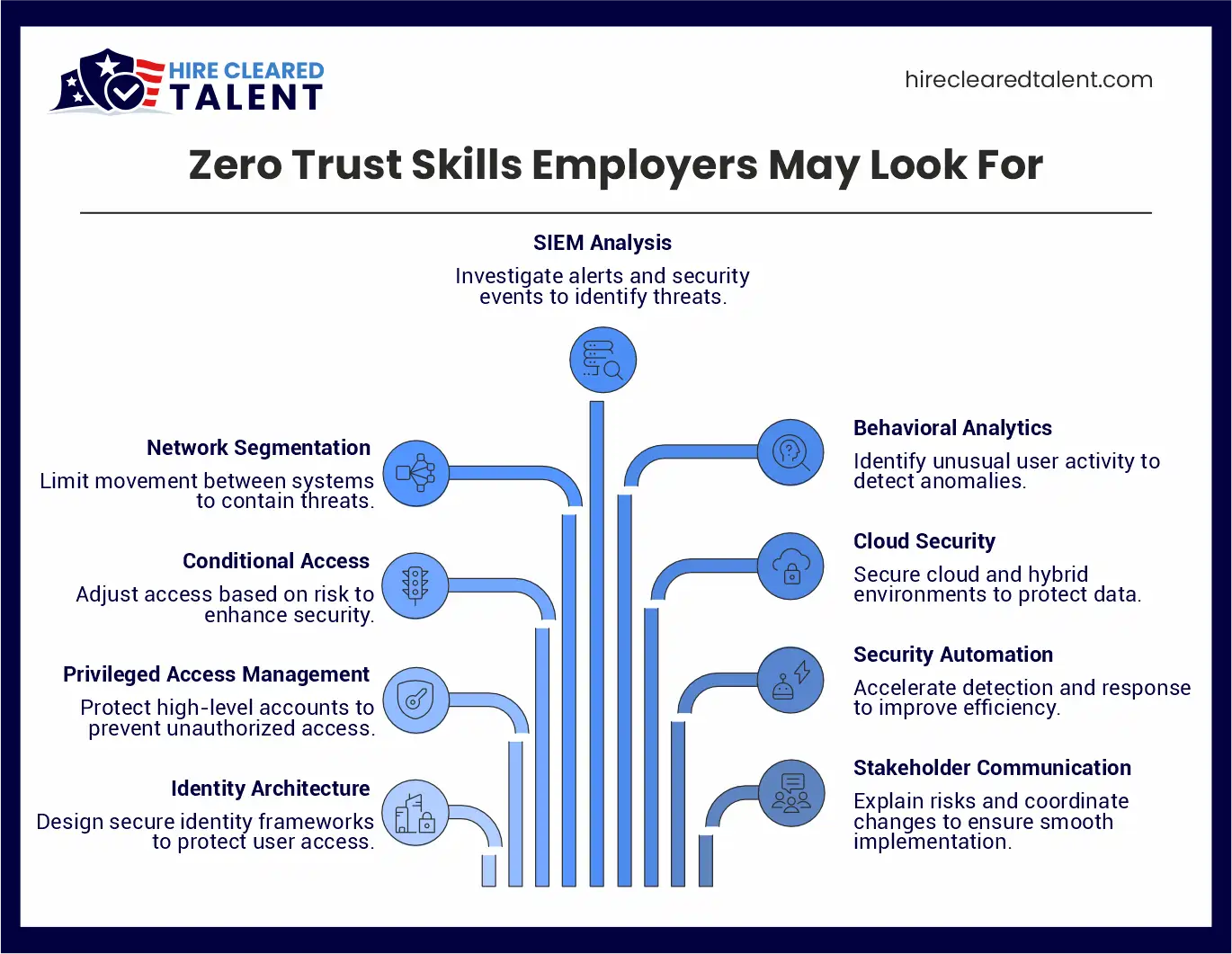
Assume-breach thinking only works if something is actually watching all the time. Roles built around Security Information and Event Management platforms, behavioral analytics, and automated anomaly detection have grown accordingly. The skill that matters most in them isn't running the tool. It's knowing which alert is real and which is noise, fast enough for it to matter before something spreads.
Bring those three changes together and the job is no longer the same. Five years ago, the day-to-day responsibilities of a network security specialist focused on the perimeter, on rules for the firewall and for accessing the network through a virtual private network. That same role today spends real time on identity policy, reviewing which applications a given credential can reach, checking anomaly alerts from a monitoring platform, and coordinating a segmentation change with an application team that owns a system the security team doesn't directly control.
Same title in a lot of job postings. Substantially different jobs underneath it all. A position in federal network security five years from now is no longer a specialized perimeter guard but rather an identity and analytics savvy generalist whose job it is to understand the end-to-end process of verifying, monitoring, and containing a single request.
Challenges in Implementing Zero Trust
None of these are theoretical friction. It's the actual daily experience of the people doing this work.
Legacy systems weren't built for continuous verification
A lot of federal infrastructure predates the concept by decades. Retrofitting Zero Trust principles onto a system that assumes implicit trust by design is genuinely harder than building it in from scratch. This is the single most commonly cited reason agencies fall short of their maturity targets, and it's not going away quickly. Some systems will need to be replaced, not retrofitted, and that takes budget cycles Zero Trust policy doesn't control on its own.
Security vs. Usability: Who Owns the Balance?
Continuous verification adds friction for legitimate users too, not just attackers. An agency that verifies every request so aggressively that employee's route around the system to get their work done hasn't actually improved security. It's just moved the risk somewhere less visible. Getting this balance right is as much a design and communication skill as a technical one, and it's a skill federal job postings are only recently learning to describe accurately, if they describe it at all.
Neither challenge has a purely technical fix, which is exactly why the roles built around Zero Trust increasingly need people who can operate on both the engineering side and the policy or communication side at once. A security team that can implement micro-segmentation but can't explain to a frustrated program office why a workflow slowed down loses the political capital it needs to finish the rollout.
Why Zero Trust Implementations Stall?
Challenge | Operational Impact | What Agencies Need |
Legacy systems | Modern controls cannot be applied easily | Phased modernization |
Limited budgets | Replacement projects move slowly | Multi-year funding plans |
User friction | Employees may avoid security controls | Better workflow design |
Complex segmentation | Critical systems are difficult to isolate | Detailed asset mapping |
Poor communication | Business teams resist rollout changes | Clear stakeholder engagement |
Skills gaps | Technical and policy work become disconnected | Cross-functional expertise |
The Future of Zero Trust in Government Security
The next phase of federal Zero Trust policy is already visible in what EO 14306 pointed toward: quantum-readiness and AI.
The TLS 1.3 and Post-Quantum Cryptography Timeline throughout 2030 indicates that encryption upgrading is turning into a separate specialization within Zero Trust jobs rather than a separate course managed by a separate team. AI cuts both directions in this framework. It's increasingly part of the continuous monitoring layer, flagging anomalies faster than a human analyst could alone.
It's also a new category of risk Zero Trust principles now have to account for, since an AI system making automated decisions inside a network needs the same never-trust verification a human user does. An AI agent with standing access to a system is exactly the kind of implicit trust Zero Trust was built to eliminate, whether the agent making the request is a person or not.
Expect the roles built around this framework to keep splitting into more specific tracks: identity architecture, continuous monitoring and analytics, and Zero Trust-specific compliance and assessment work. Not consolidating back into a single generalist security title. The direction has been toward more specialization for years now, and nothing in the current policy environment points out the other way.
Conclusion
Zero Trust isn't a passing framework that a change in administration was ever likely to undo, and the roles built around it aren't a temporary bump in demand. Identity moved to the center of network security. Monitoring became continuous instead of periodic. Security work now runs through coordination with teams it used to operate independently of. Those changes outlasted a presidential transition. They're the actual shape of the job now, not a phase that's going to pass.
Cleared Talent Network connects cleared professionals in network security and identity to Federal agencies and prime contractors developing Zero Trust architectures by directly placing talent into the initiatives that are creating it.
Whether you are developing a career in this area or recruiting for it, don't miss to Create your free profile on HireClearedTalent and connect with a recruiter to see how the jobs currently stand.
Book a call with our expert team
FAQ-
Q1. How is Zero Trust changing the role of network security engineers in government?
A. Zero Trust is changing the job from simply protecting the network perimeter to protecting every user, device, application, and resource. Government network security engineers now work more with identity controls, segmentation, device security, access policies, and continuous monitoring.
Q2. Why are identity and access management skills becoming more important for network security professionals?
A. With Zero Trust, being inside the network does not automatically make someone trusted. Network security teams need to confirm who the user is, what device they are using, and what they are allowed to access. This makes identity and access management a much bigger part of the role.
Q3. Does Zero Trust make traditional network security skills less important?
A. No. Skills such as firewalls, routing, DNS, VPNs, traffic analysis, and network monitoring still matter. The difference is that professionals now need to combine these skills with identity security, cloud security, endpoint protection, and policy-based access controls.
Q4. How does microsegmentation affect government network security jobs?
A. Microsegmentation requires security teams to divide networks into smaller protected areas instead of treating the entire network as one trusted environment. Network security professionals need a better understanding of traffic flows, application dependencies, access rules, and how systems communicate with each other.
Q5. How does Zero Trust change firewall management in government environments?
A. Firewalls still play an important role, but they are no longer the only line of defense. Security professionals need to connect firewall policies with user identity, device security, workload requirements, and access permissions to control who reaches specific resources.
Q6. Why is continuous monitoring important in Zero Trust environments?
A. Zero Trust does not assume a user or device should remain trusted after the first login. Security teams need to keep watching user behavior, device status, network activity, and access patterns. This helps them respond faster when something changes or looks suspicious.
Q7. How does Zero Trust change the way network and cybersecurity teams work together?
A. Zero Trust brings network, cloud, identity, endpoint, application, and SOC teams closer together. Network security professionals often need information from several systems before access decisions are made, so collaboration becomes a larger part of the job.
Q8. What Zero Trust skills should government network security professionals develop?
A. Key skills include identity and access management, network segmentation, cloud security, device security, traffic analysis, security monitoring, policy enforcement, and automation. Professionals who understand how networks connect with applications, users, devices, and data will be better prepared for Zero Trust environments.
Q9. How does Zero Trust affect network security roles in cloud and hybrid environments?
A. Network security teams can no longer rely on users and systems being located inside a traditional agency network. They need to secure access across cloud platforms, remote users, on-premises systems, and hybrid environments using consistent security policies.
Q10. Is automation becoming more important for Zero Trust security roles?
A. Yes. Zero Trust environments generate large amounts of security data and access decisions. Automation helps teams apply policies consistently, detect issues faster, and respond to security events without relying on manual processes for every action.
Weekly newsletter
Get the latest blog updates, practical hiring insights, and featured reads delivered straight to your inbox.
Read about our Privacy Policy.