


The cleared talent shortage isn't a forecast anymore, it's the operating reality of every defense contractor and federal agency in the country right now. Veterans with active clearances are the most direct solution to that problem. Here's what employers who understand this market are actually doing about it.
70K+Cleared positions with no candidate to fill them.
56% Recruiters naming cleared pool shortage as top challenge.
$119K Average salary for cleared professionals in 2025.
Before any employer can make a rational case for veteran hiring strategy, they need to understand the baseline condition of the cleared labor market. There are an estimated 70,000 more open positions requiring active security clearances than there are cleared professionals available to fill them.
That number hasn't contracted. The cleared talent market is projected to grow at 7–10% annually through 2025, with the sharpest acceleration in cybersecurity, artificial intelligence, data analytics, and intelligence operations.
That's the market context. Now here's where veterans fit into it. Every service member who separates with an active clearance is, by definition, ready-to-deploy in a way that no civilian candidate regardless of technical skill can match without going through a full adjudication process that routinely takes 12 to 18 months.
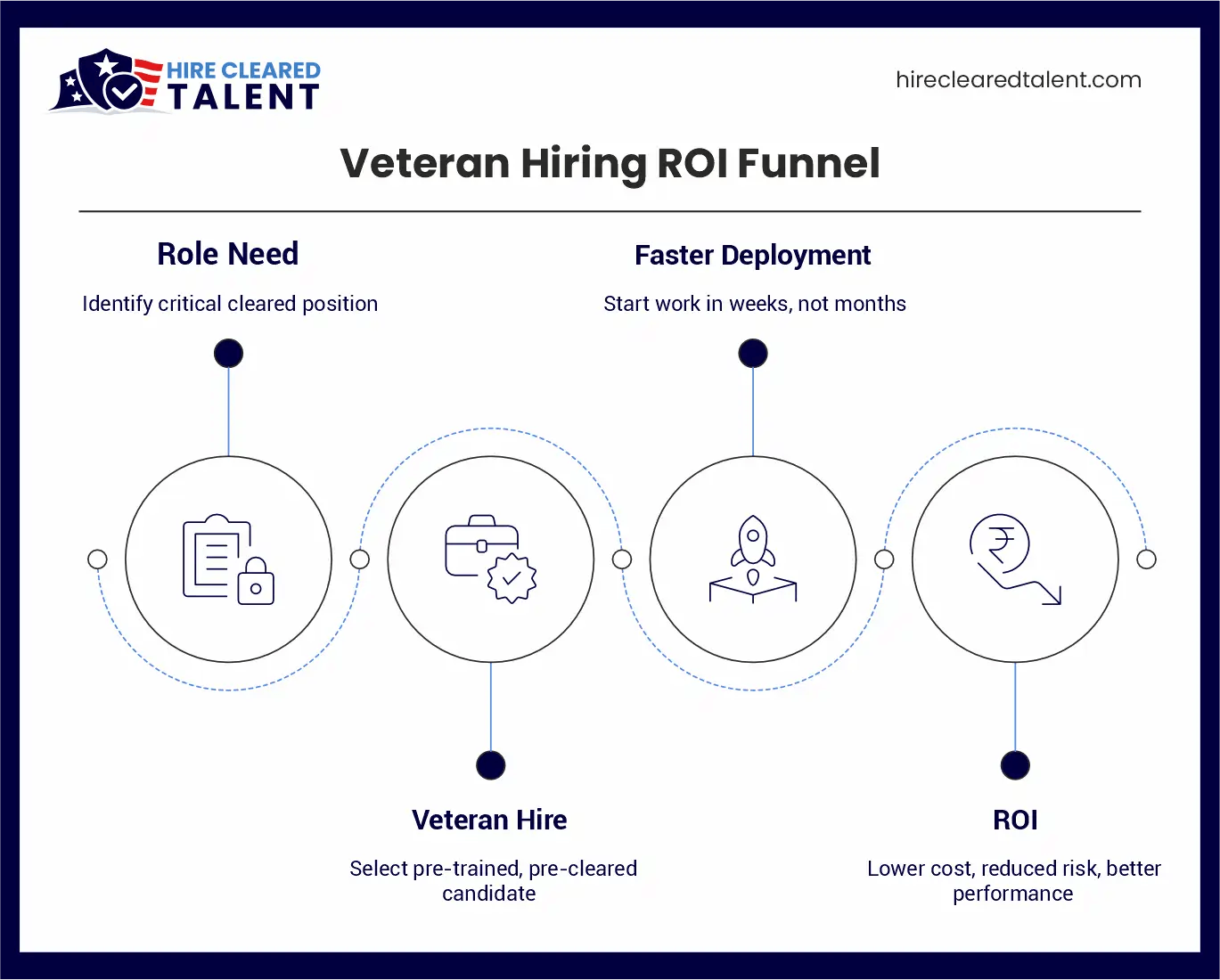
Sponsoring a new clearance isn't just expensive. It leaves a billet vacant for over a year while your contract deliverables don't pause. Hiring a cleared veteran doesn't just fill a seat. It compresses your time-to-mission by a margin that no other candidate category can replicate.
Think of an active clearance the way a cleared program manager thinks about it not as a credential on a resume, but as infrastructure. Sponsoring a civilian candidate through initial adjudication is building that infrastructure from the ground up. Hiring a veteran with an active TS/SCI is inheriting infrastructure that's already passed every inspection.
What Veterans Actually Bring to Cleared Roles?
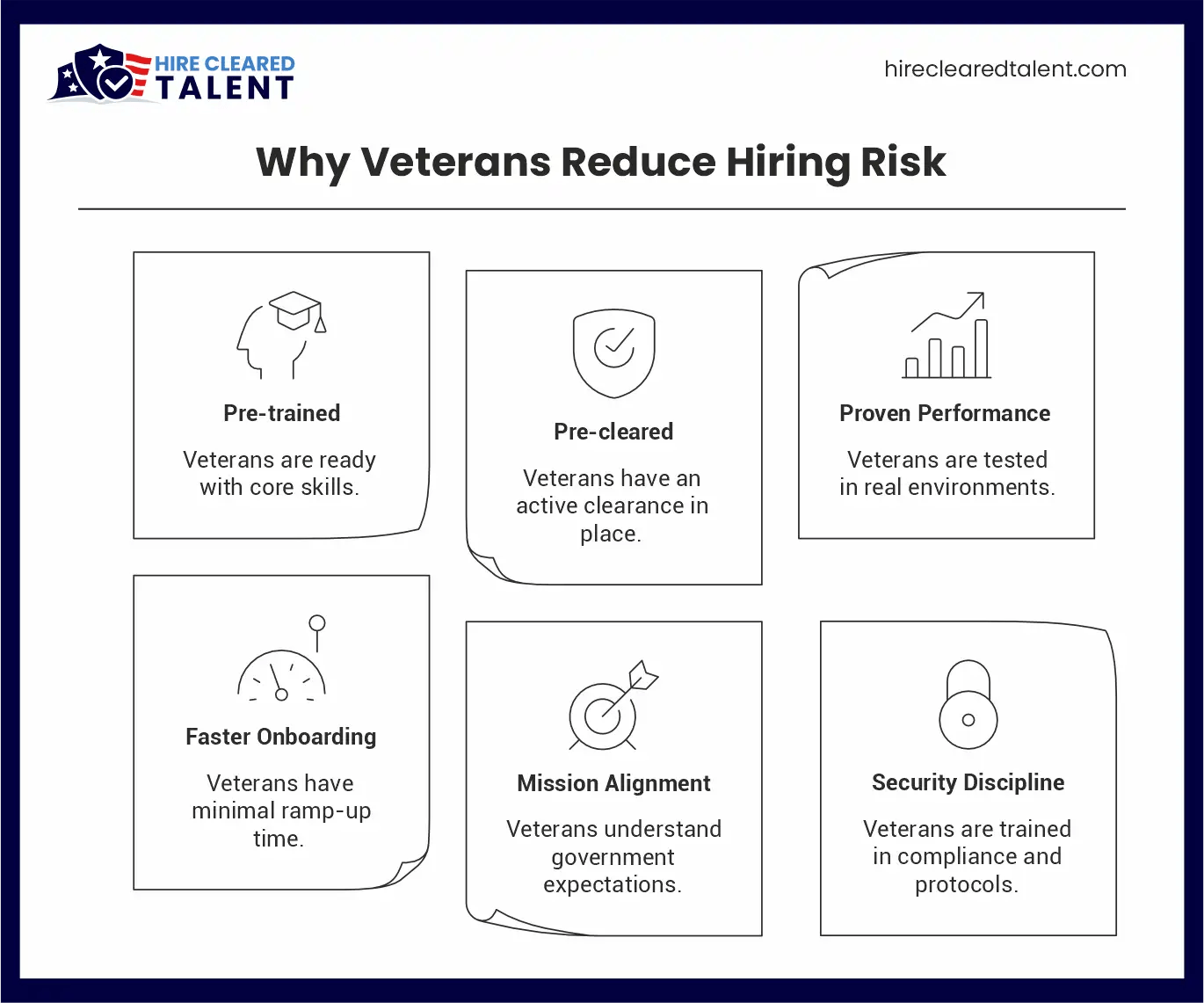
The generic case for veteran hiring discipline, leadership, mission focus understates what's operationally relevant in the cleared context. Veterans who held technical or intelligence roles in classified environments didn't learn security compliance from an onboarding module. They built careers inside the exact governance framework that defines federal contracting. That difference matters in practice, not just on paper.
Active clearances at separation- Veterans separating from intelligence, signals, cyber, and special operations communities frequently hold TS/SCI or above. That clearance is active, adjudicated, and often polygraph-eligible, which means a contractor can put them on a sensitive program within weeks, not months.
OPSEC and classification discipline from day one- There's no learning curve on handling classified material, marking requirements, or SCIF protocols. Veterans have been living inside those rules. For cleared employers, this eliminates a non-trivial onboarding risk.
Operational context that translates directly- A former signals intelligence analyst who spent years supporting deployed forces understands collection priorities, analytic tradecraft, and finished intelligence production not from coursework, but from doing the work in real environments. That context is not teachable in six months.
Mission accountability under pressure- The cleared contracting environment rewards professionals who can operate independently with incomplete information, meet hard deadlines on classified deliverables, and escalate the right issues at the right time. Military experience, particularly at the NCO and warrant officer levels, develops exactly this capacity.
Federal cultural alignment- Veterans understand how government agencies actually work - the bureaucratic rhythms, the chain-of-command dynamics, the COR relationship, the difference between what a requirement says and what the customer actually needs. That familiarity accelerates performance on government contracts.
The Translation Problem That Employers Own
Veterans don't fail in the cleared hiring market because of what they lack. They fail because most employers have built screening processes that treat military experience as a translation problem and then put the burden of that translation entirely on the candidate.
An applicant tracking system configured for civilian job title hierarchies will routinely filter out a 10-year Army cryptologic warrant officer because his resume doesn't contain the phrase "intelligence analyst" in the right field.
A hiring manager who doesn't know the difference between a 35N MOS and a 25B won't recognize that the first candidate is precisely what their cleared signals program needs. These aren't edge cases. They're systematic failures that repeat across the industry at scale.
The obligation to fix this is on the employer side. The organizations consistently winning the cleared veteran talent competition have made concrete changes to their processes.
What losing employers do?
Run MOS codes through a generic ATS. Require civilian job title equivalents that veterans don't have. Move at the same pace regardless of clearance status. Rely on job descriptions written for any industry in any decade.
What winning employers do?
Cross-reference MOS and rating codes to clearance levels and technical competencies. Train recruiters to read a DD-214 with the same fluency as a civilian resume. Build expedited tracks for candidates with active clearances. Write job descriptions that speak directly to military background.
What the Market Looks Like Right Now for Cleared Veterans?
The federal workforce turbulence of the past 18 months has created a hiring window that didn't exist two years ago. As government agencies have reduced civilian workforce capacity, program offices are running leaner which means contractor teams are being asked to carry more mission load, and the premium on experienced, cleared professionals who don't require extensive onboarding has increased sharply.
At the same time, veterans and cleared professionals who were anchored in stable federal employment are now moving more actively into the contracting market. According to the Partnership for Public Service, the Defense Department and VA alone employ more than 435,000 veterans in the federal workforce - a population whose career calculus is actively shifting right now.
These professionals already know the cleared environment, already have adjudicated clearances, and are looking at the private contracting market with more openness than at any point in the past decade.
And the broader veteran labor market reinforces the urgency of moving decisively. According to the U.S. Bureau of Labor Statistics, the veteran unemployment rate in 2024 was 3.0 percent lower than the 3.9 percent rate for nonveterans. Veterans who are separating and looking aren't sitting idle. They're getting offers. The employer who hesitates loses.
"What's the real cost of leaving a cleared billet vacant for 14 months while a sponsored candidate moves through adjudication when a veteran with that exact clearance was available in your pipeline six weeks after they separated?"
Where Veteran Hiring Creates the Clearest ROI?
Not every cleared role has the same hiring urgency, but there are specific program categories where the veteran talent advantage is most decisive and most measurable.
Cybersecurity and information operations- With over 500,000 unfilled cybersecurity positions nationwide, cleared cyber roles are among the most contested in the market. Veterans with backgrounds in defensive cyber operations, signals intelligence, or communications security walk in with both the clearance and the operational cyber context most civilian candidates spend years acquiring.
Intelligence analysis and collection management- All-source analysts, SIGINT operators, HUMINT debriefers, and collection managers with active clearances are consistently the hardest-to-fill categories across the defense and intelligence contractor community.
Veterans in these specialties are a direct match and the shortage is acute enough that most cleared employers who build reliable pipelines into this population hold a genuine competitive advantage on contract staffing.
Program and project management on classified contracts- Veterans at the O-4 through O-6 and senior NCO levels have managed complex operations under resource constraints, against hard deadlines, with accountability structures that map directly to the federal contracting environment. They don't need to be taught what a deliverable or a milestone review looks like.
Roles requiring polygraph eligibility- Full-scope and counterintelligence polygraph requirements shrink the available talent pool to a fraction of the already-scarce cleared market. Veterans from agencies and units with regular polygraph requirements are essentially the only candidates who bring that background to a new employer without starting from zero.
Building a Veteran-Forward Cleared Hiring Pipeline: The Practical Framework
Intention without infrastructure doesn't produce results. If an employer wants to actually capture cleared veteran talent before the competition does, these are the changes that produce measurable outcomes not the ones that belong on a commitment poster.
Audit your ATS configuration for military experience- Most applicant tracking systems are built around civilian job title hierarchies. If your system is screening resumes before a human sees them, it's almost certainly filtering out qualified veterans. At minimum, add MOS code cross-references and clearance level fields as priority scoring criteria.
Build recruiter competency in military-to-civilian translation- A recruiter who can't read a DD-214 and recognize clearance level, MOS specialty, and terminal rank isn't equipped to hire cleared veterans effectively. This is a training investment, not a hard cost.
Create expedited hiring tracks for candidates with active clearances- Every week a cleared billet sits vacant has a measurable cost. Veterans with active TS/SCI clearances should move through a compressed review timeline not a slower one because your standard process wasn't designed with clearance urgency in mind.
Rewrite job descriptions for military audiences- If your posting says "5+ years of intelligence analysis experience required" without mentioning MOS 35F or equivalent service-specific designations, you're invisible to the most qualified candidates in that specialty. Cleared job descriptions should speak directly to the military community they're trying to reach.
Position compensation to reflect the cleared premium. According to ClearanceJobs, the average salary for cleared professionals reached $119,000 in 2025, with TS/SCI and polygraph holders averaging over $141,000. Veterans who know their clearance value and most of them do will not accept below-market offers because of a veterans preference assumption. Price for the market.
Use cleared-specific hiring channels, not general job boards. The cleared veteran talent pool doesn't conduct job searches the same way civilian candidates do. Reaching this population requires presence in the channels and marketplaces where cleared professionals actually look, not repurposed civilian recruiting infrastructure.
The Window Is Open, But It Won't Be Forever
The combination of factors driving the current veteran hiring opportunity - federal workforce contraction, cleared talent shortage, post-9/11 veterans reaching peak experience levels, and active clearances moving into the contracting market is not a permanent condition. It's a window.
Organizations that build the infrastructure to reach cleared veterans now will have a structural hiring advantage on the next cycle of contract awards. Organizations that wait will compete for a talent pool that has already been substantially absorbed by employers who moved faster.
But the tactical case for veteran hiring in 2026 doesn't require a long argument. Veterans with active clearances are the fastest path from contract award to fully-staffed program. The employers who recognize that and build accordingly are the ones whose program managers aren't scrambling to staff requirements six months after award.
Are you ready to act on this?
HireClearedTalent is built specifically for the cleared space. Employers get access to a pre-qualified pool of cleared veterans across every specialty and clearance level. You can create your profile on HireClearedTalent and get direct visibility to the contractors and agencies actively hiring for roles their background actually fits.
Connect with Cleared Veteran Talent Today!
FAQ-
Q1- What is the ROI of hiring veterans compared to traditional candidates?
A- Faster hiring, lower training costs, and higher productivity drive ROI. Veterans often deliver value sooner.
Q2- How do veterans reduce time-to-hire for cleared positions?
A- Many veterans separate with active clearances, avoiding long adjudication timelines. This allows faster onboarding and deployment.
Q3- What roles benefit most from hiring veterans?
A- Cybersecurity, intelligence analysis, program management, and roles requiring polygraph eligibility see the highest impact. These roles demand both clearance and real-world experience.
Q4- How do veterans improve contract performance for employers?
A- Veterans understand mission requirements, deadlines, and accountability. Their experience helps deliver consistent results in high-pressure environments.
Q5- What makes veterans different from civilian candidates in cleared roles?
A- Veterans have worked within classified environments and understand compliance and security protocols. This reduces onboarding risk significantly.
Q6- How do veterans handle high-pressure and mission-critical tasks?
A- Military experience builds decision-making under pressure and accountability. Veterans are trained to deliver results with limited information.
Q7- Why is clearance status such a critical factor in hiring?
A- Clearance determines eligibility for sensitive roles. Candidates with active clearance can be deployed immediately.
Q8- How can employers effectively attract veteran talent?
A- Use clear job descriptions, highlight mission impact, and work with specialized platforms. Tailor messaging to military experience.
Q9- What challenges do employers face when hiring veterans?
A- The main challenge is translating military experience into civilian roles. Employers may also struggle with understanding military job titles.
Q10- How can employers bridge the translation gap in veteran resumes?
A- Focus on skills, outcomes, and leadership instead of titles. Use structured screening and domain expertise to evaluate candidates.
Weekly newsletter
Get the latest blog updates, practical hiring insights, and featured reads delivered straight to your inbox.
Read about our Privacy Policy.