


Because "veteran-friendly" on a website banner and actually being veteran-friendly are two very different things and you deserve to know the difference before you accept an offer.
Danish had twelve years in signals intelligence, a TS/SCI with full-scope poly, and a separation date circled on his calendar for months. He'd done everything right attended the transition assistance program, updated his LinkedIn, connected with a few veteran service organizations.
Three months after leaving service, he'd had a handful of interviews and one offer from a mid-size federal IT services firm that talked extensively about its veteran hiring initiatives during the recruiting process. He took the job. Six weeks in, he was the only veteran on a team of eighteen, his clearance was sitting idle because the contract hadn't been stood up yet, and the "veteran resource group" met twice a year over catered lunch.
Danish wasn't bitter. He was just doing what a lot of veterans do after a hiring mismatch quietly updating his resume and starting over.
That experience is more common than it should be. And the gap that produced it isn't hard to close, but you have to know where to look.
"Veteran-Friendly" Is a Marketing Position. Veteran Commitment Is an Operational Reality.
Here's the first thing to understand about the veteran hiring organization landscape in 2025: the signal-to-noise ratio is terrible. Virtually every employer of any size in the federal contracting and defense space puts "veteran-friendly" somewhere in their recruiting materials. Some of them mean it. Many don't, not because they're being dishonest, exactly, but because intention and infrastructure are different things.
An organization can genuinely want to hire veterans and still have no meaningful process for onboarding them, no career pathways that account for how military experience translates into civilian advancement, and no internal advocates who understand what it actually means to come out of a SCIF and land in a cubicle.
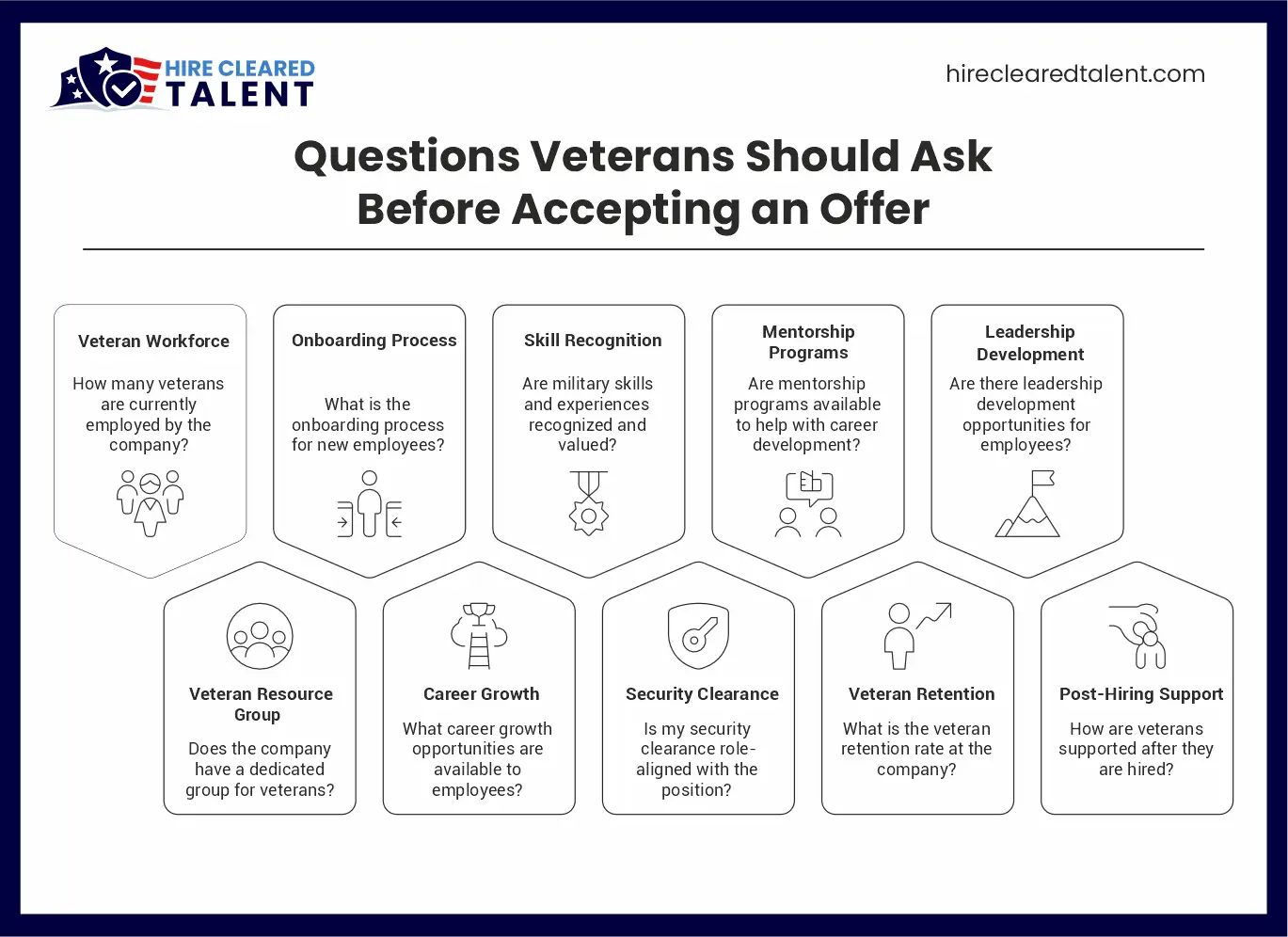
Tips to Find the Best Veteran Hiring Organizations
The seven tips below are designed to help you tell the difference, systematically, before you sign anything.
Tip 1: Look at What They Track, Not What They Say
Organizations that are serious about veteran hiring track veteran retention, not just veteran hiring. Those are different metrics, and only one of them tells you whether veterans actually stay and advance once they're through the door.
When you're evaluating a prospective employer, ask specifically: what percentage of your current workforce is veterans, and how does that number compare to what you hired three years ago?
If they can answer that question with real numbers, that's a meaningful sign. If the answer is a pivot to how many veterans they've hired in the past year, that tells you they're measuring inputs headcount at the moment of hire rather than outcomes.
A company that loses veterans at a higher rate than it hires them isn't a veteran-friendly employer. It's a revolving door with a flag in the lobby.
Baylor Scott & White Health, for instance, reports a veteran retention rate of approximately 80% which is actually a useful benchmark, not because you're necessarily looking at that sector, but because it gives you a number to hold other organizations against when you're asking the question.
If a defense contractor or federal IT firm can't tell you their veteran retention rate, that silence is information.
Tip 2: Understand Whether Your Clearance Will Actually Be Used
This one is specific to the cleared community, and it's worth its own heading. Veterans who hold active TS/SCI or higher bring enormous value to a prospective employer, but only if there's cleared work to do.
Contract timelines in the federal space are unpredictable in ways that even senior program managers can't always forecast. An organization that hires you for a cleared position that hasn't been funded yet, or where the period of performance hasn't been confirmed, isn't being deceptive. But they're also not a reliable near-term employer of your clearance-specific skills.
Think of an active security clearance the way a seasoned contractor thinks about a prime contract vehicle; it only generates value when there's work behind it. Before you accept any offer, ask directly: is this position tied to a funded contract? What is the period of performance? Is there a base period and option of years, and what's the track record on options being exercised?
A legitimate employer with cleared work standing behind the requisition will answer those questions without hesitation. One that hedges tells you something important about the stability of the role.
Tip 3: Verify the Veteran Resource Group Has Actual Influence - Not Just Existence
Nearly every organization of any meaningful size has some version of a veteran employee resource group. Most of them are well-intentioned and under resourced. A few of them are genuinely connected to hiring decisions, leadership development, and policy conversations inside the organization. The difference matters enormously to how you'll actually experience the culture after you're hired.
Here's what most people in this industry don't say out loud: a veteran ERG that meets quarterly and produces a newsletter is a cultural decoration. It doesn't affect how promotions are decided, how military experience is evaluated against civilian credentials when someone is considered a leadership role, or whether the organization will actually support a reservist when the unit gets activated.
The ERGs worth paying attention to are the ones where members hold senior positions, and the group has a documented history of influencing HR policy not just building camaraderie. Ask to speak with a current member before accepting an offer. Listen for whether they describe the group as a social outlet or as something that has actually changed how the organization operates.
Read more- How to Qualify for Federal Security Clearance Jobs?
Tip 4: Check How the Organization Handles the Translation Problem
The most persistent friction point in veteran civilian employment isn't finding a job. It's the translation problem the gap between what a veteran did in uniform and how that experience maps to a civilian job grade, title, and pay band. And different organizations handle this with wildly different levels of sophistication.
Among the roughly 17.6 million veterans in the United States in 2024, the ones who fare best in the civilian labor market particularly in terms of compensation are those whose military specialties translate clearly to civilian roles.
Veterans with more specialized military training and work experience had significantly higher civilian earnings and employment rates than infantry and combat veterans, according to January 2025 data from the U.S. Census Bureau's Veteran Employment Outcomes report.
But even within technical specialties, the translation problem is real. A former 35N signals intelligence analyst and a civilian intelligence analyst with a BA from a state university may have equivalent capabilities but many organizations still structure their internal job grades around credential proxies that disadvantage veterans.
Ask employers specifically: how do you evaluate military experience when determining job grade and compensation for a veteran hire? A sophisticated answer will involve a structured process. A generic answer about "valuing military service" tells you the translation problem hasn't been seriously addressed.
Tip 5: Look at Their Federal Contract Portfolio - Not Just Their Branding
For cleared veterans specifically, the quality of an employer is partly a function of what contracts they're winning and what's in the pipeline.
An organization with a healthy, diversified contract portfolio - multiple agencies, mix of IDIQ and single-award, a track record of winning recompetes is a structurally more stable employer than one riding a single large contract that's up for recompete in eighteen months.
This isn't information you have to take on faith. FPDS.gov is publicly available and will show you contract award history for any company that does federal work. GovWin and other procurement intelligence platforms track pipeline and award data.
A quick search will tell you whether a company's federal revenue is concentrated or distributed, and whether their recent awards are in areas that align with your clearance and specialty. An employer who tells you their business is strong but can't point to recent contract wins is giving you a narrative, not evidence.
Read more- Cleared Talent Recruitment: Key Trends Federal Contractors Need to Know in 2026
Tip 6: Pay Attention to the Interview Itself
How an organization interviews you for a cleared position tells you almost everything about how much they understand the cleared talent market. Specifically, pay attention to whether the recruiter or hiring manager understands the difference between clearance types, whether they ask intelligent questions about your background investigation history, and whether they understand the implications of the timeline involved in transferring or sponsoring a clearance.
Recruiters who ask you to "get your clearance reinstated" before starting a job as if clearances work like driver's licenses are operating without basic knowledge of how the adjudication process works.
Hiring managers who treat a TS/SCI and a Secret as functionally equivalent in terms of access and value don't understand what they're hiring for.
Over 500,000 unfilled cybersecurity positions exist nationwide, and the cleared subset of that demand is intense which means employers who genuinely understand cleared hiring have strong incentives to get it right. The ones who don't aren't going to suddenly develop that expertise after you join.
Tip 7: Ask About the Path After Year One
The veterans who have the best outcomes in federal contracting and defense employment aren't necessarily the ones who found the best first job.
They're the ones who found an organization with a genuine internal development structure mentorship, rotation opportunities, a realistic pathway to program management or technical leadership that supported them past the initial onboarding phase.
FY 2024, the federal executive branch hired 56,318 veterans out of 256,684 total new hires, according to the Office of Personnel Management's annual Veterans Employment Report. That's a substantial pipeline of cleared professionals entering the federal ecosystem. What that number doesn't tell you is how many of them were still in the same organization two years later, growing toward something.
Ask directly in your final interview: can you walk me through what a typical career path looks like for someone at this level who performs well in this role? A vague answer "we have lots of opportunities" is not a career path. A concrete one tells you the organization has thought seriously about retention.
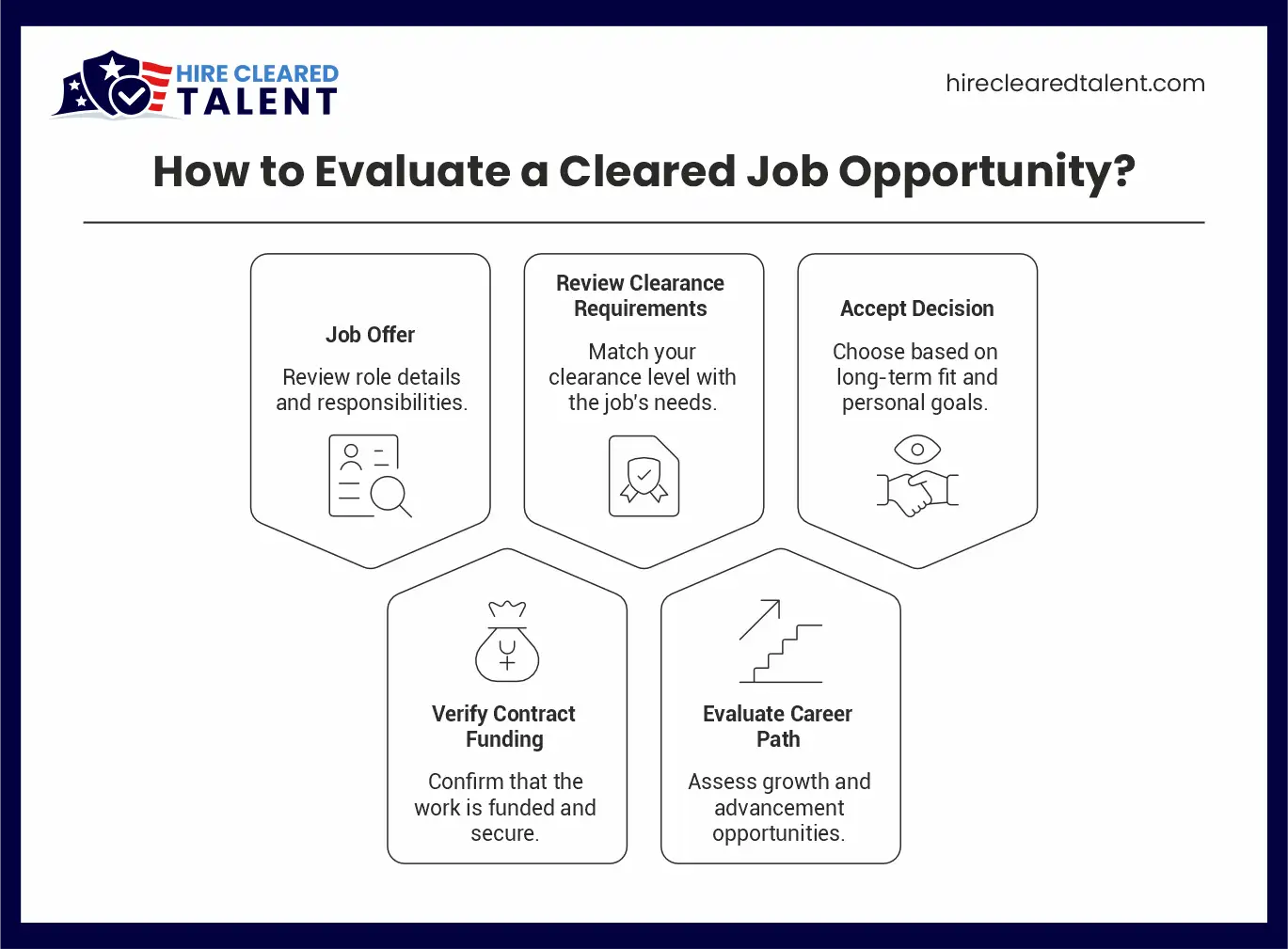
Where HireClearedTalent Fits Into This?
We've spent years watching cleared veterans navigate exactly this process sometimes well, sometimes poorly, and usually with less information than they deserved going in. HireClearedTalent was built to change that.
Our marketplace connects security-cleared professionals specifically with federal agencies and defense contractors who've been vetted for the things that actually matter: contract stability, clearance utilization, internal veteran development infrastructure, and the ability to tell you plainly what a career path looks like three years in.
We don't work with every organization that wants cleared talent. We work with the ones who can answer the questions on this list. That distinction is the whole point.
If you're approaching separation, or you're already on the market and the results have been frustrating, explore what's available at HireClearedTalent. The employers in our network have earned their place there. That's not a marketing position. It's the standard we hold them to. If you are a veteran and looking for a job, you can create your employeer login on hireclearedtalent and find the best opportunity for you.
Still having any queries?
Book a FREE Consultation with our experts
FAQ-
Q1. How can veterans use their military experience more effectively during job searches?
A. Focus on translating military responsibilities into business outcomes, leadership skills, technical capabilities, and measurable accomplishments relevant to civilian roles.
Q2. What should veterans look for before applying to an organization?
A. Review the company’s veteran hiring initiatives, career development opportunities, benefits, military skill translation support, and long-term advancement pathways.
Q3. Why are veteran retention rates important when evaluating employers?
A. Retention rates help indicate whether veterans are finding long-term success and support within an organization rather than simply being recruited.
Q4. How can I tell if a company understands military experience?
A. Organizations that understand military backgrounds often provide military skills translators, veteran recruiting teams, mentorship programs, and managers trained to evaluate transferable military experience.
Q5. Should veterans prioritize culture fit or salary when evaluating employers?
A. Both matter, but long-term career growth, leadership support, mission alignment, and advancement opportunities often have a significant impact on job satisfaction and retention.
Q6. Why do some veteran-friendly employers still struggle with retention?
A. Some organizations successfully recruit veterans but fail to provide onboarding support, career progression opportunities, mentorship, or workplace environments that support long-term success.
Q7. How important are mentorship programs for veteran career transitions?
A. Mentorship programs help veterans navigate workplace culture, build professional networks, and accelerate career development during the transition process.
Q8. How can veterans evaluate career growth opportunities before accepting an offer?
A. Review internal promotion pathways, training programs, certification support, leadership development initiatives, and employee testimonials.
Q9. What industries actively hire veterans today?
A. Government contracting, cybersecurity, healthcare, logistics, technology, defense, manufacturing, and federal staffing organizations frequently hire veteran talent.
Q10. Why do federal contractors actively recruit veterans?
A. Veterans often bring leadership experience, operational discipline, security clearance eligibility, teamwork, and mission-focused problem-solving skills that align well with federal environments.
Weekly newsletter
Get the latest blog updates, practical hiring insights, and featured reads delivered straight to your inbox.
Read about our Privacy Policy.