


The email arrived late in the evening. A short message confirmed what many professionals spend months hoping to hear: the clearance was active and the hiring team was ready to move forward.
For those working toward roles in national security programs, that moment often marks a major career shift. A security clearance does more than qualify someone for a single position. It opens the door to a segment of the workforce built around long-term demand, stable funding cycles, and projects tied to critical national missions.
Yet many capable professionals never enter this world. The barrier is rarely skill or experience. More often, it is a lack of clarity about how the cleared hiring system operates, how clearances interact with employment, and how professionals position themselves for opportunities in this specialized market.
Understanding these mechanics makes a difference. Once the structure of cleared hiring becomes clear, the path into cleared roles and the long-term career growth that follows becomes far easier to navigate.
Why Cleared Careers Matter More Than Ever?
Cleared careers are no longer niche, they’re essential.
Federal agencies and government contractors continue to modernize systems, secure cloud infrastructure, and defend against increasingly sophisticated cyber threats. That work requires trusted professionals with both technical skills and clearance eligibility.
According to the U.S. Bureau of Labor Statistics, employment for information security analysts-a core cybersecurity role-is projected to grow 29% from 2024 to 2034, far faster than the average for all occupations.
Compensation reflects this demand. In 2025, average salaries for cleared professionals reached approximately $119,131, with 68% of cleared workers receiving pay increases, according to national compensation data.
For professionals willing to navigate the clearance process, the opportunity isn’t just immediate, it’s durable.
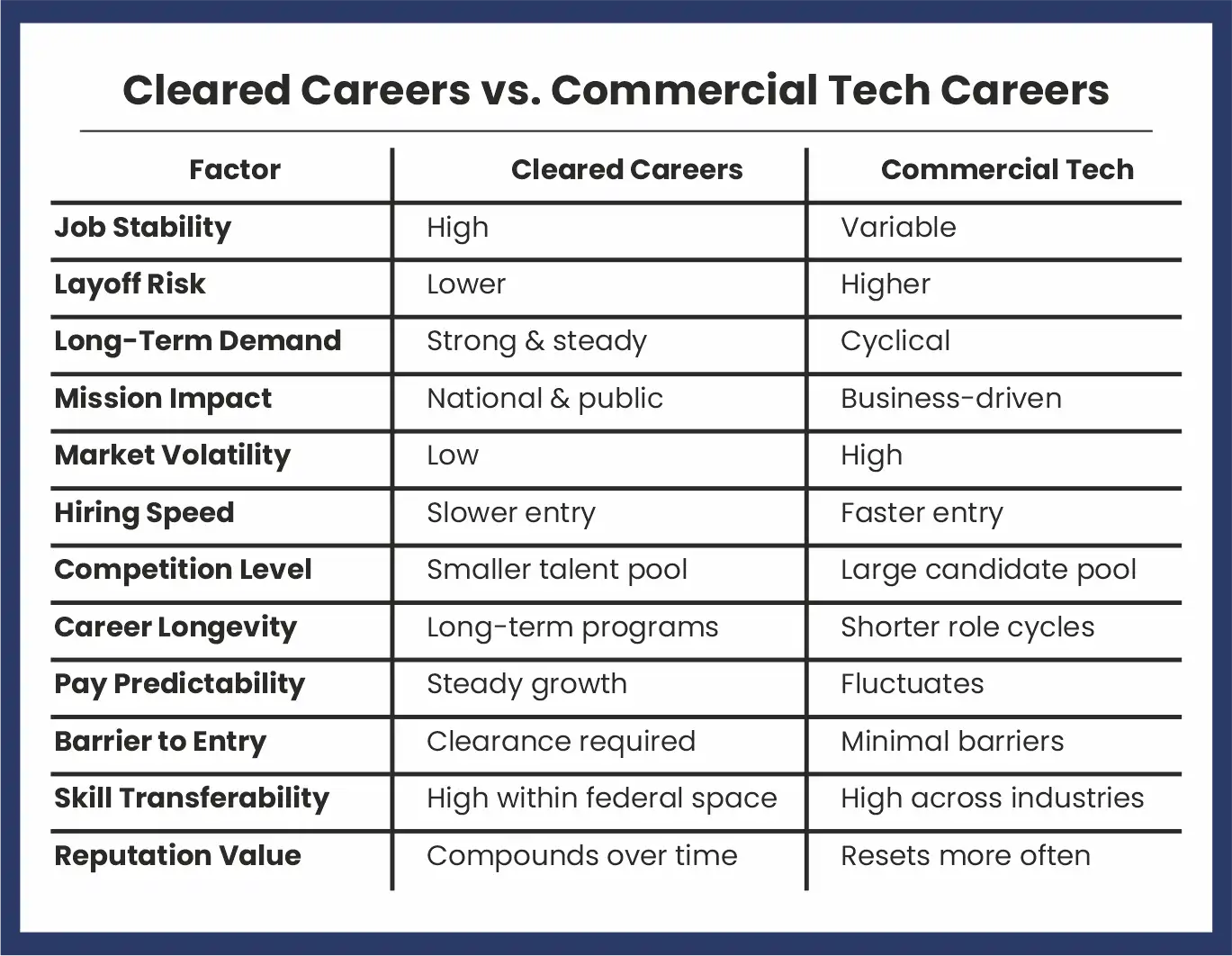
Clearing Up the Myths: How Security Clearances Actually Work
One of the biggest misconceptions is that individuals can independently apply for a clearance.
You can’t.
Security clearances are sponsored by an employer or government agency. That means your job search strategy must align with employers willing to sponsor or already seeking cleared talent.
Clearance eligibility generally considers:
U.S. citizenship
Background and conduct history
Financial responsibility
Foreign contacts or travel
Criminal or legal issues
Having student loans, job changes, or foreign travel does not automatically disqualify you. Transparency matters far more than perfection.
If you’re new to the cleared world, your first goal isn’t “get a clearance.” It’s get hired into a role that sponsors one.
How to Position Your Resume for Cleared Roles?
Cleared resumes are different and using a standard commercial resume is one of the most common mistakes candidates make.
Recruiters and hiring managers in cleared environments look for clarity, accuracy, and readiness.
Resume tips that work for cleared jobs:
Clearly list clearance status (Active / Inactive / Eligible / Previously Held)
Include clearance dates when available
Highlight compliance, documentation, and regulated environments
Emphasize government, defense, or federal-adjacent experience
Keep formatting clean, structured, and direct
If you’re transitioning from the commercial sector, translate your experience. Cloud migrations, identity access management, incident response, system hardening, and compliance work map directly to cleared environments.
Certifications That Accelerate Cleared Careers
In cleared hiring, certifications are not optional, they’re accelerators. They signal baseline knowledge, commitment, and readiness to operate in regulated environments.
High-impact certifications for cleared roles include:
CompTIA Security+ (often required for DoD 8570 / 8140 roles)
CISSP (for senior and leadership positions)
CompTIA CySA+ or CASP+
Cloud certifications (AWS or Azure) with a security focus
Security+ is often the fastest on-ramp into cleared IT jobs. CISSP becomes valuable once you’re targeting architecture or leadership roles.
Certifications don’t replace experience, but they shorten the distance between opportunity and offer.
Using Niche Job Boards Effectively (Where Cleared Hiring Actually Happens)
Cleared hiring doesn’t happen on general job boards alone. Recruiters rely on niche platforms because they need speed, accuracy, and verification.
That’s where specialized platforms like HireClearedTalent matter. Instead of competing with thousands of unqualified applicants, you’re visible to employers actively hiring for cleared and clearance-eligible roles.
Smart job search tips for cleared roles:
Complete your profile fully and accurately
Be honest about clearance status
Keep location and availability updated
Focus on roles aligned with your clearance level
Apply early-speed matters in cleared hiring
Cleared hiring is competitive, but it’s also relationship-driven. Visibility in the right ecosystem changes outcomes.
What Hiring Managers in Cleared Roles Actually Look For?
Here’s what most candidates don’t realize:
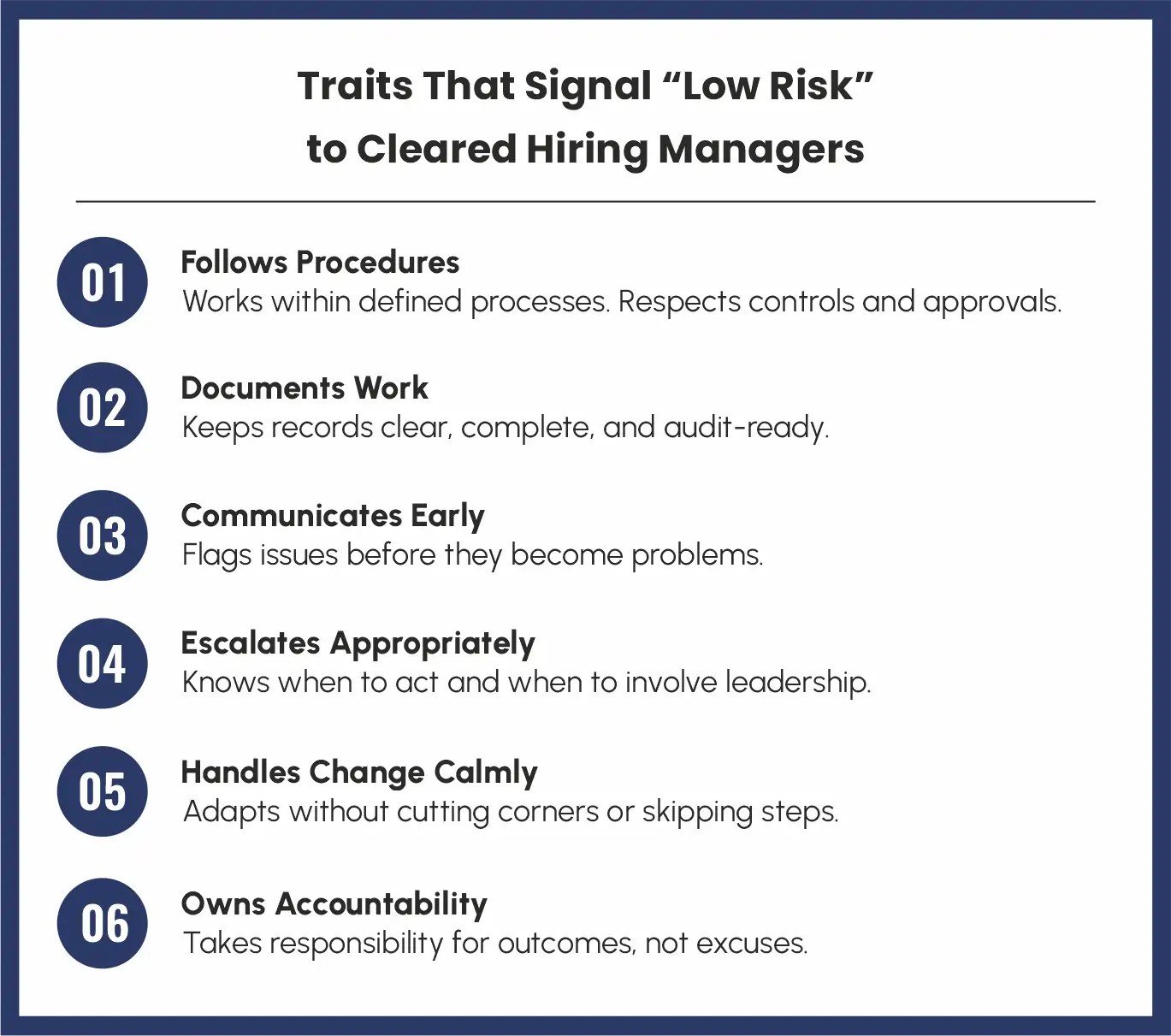
Hiring managers aren’t just evaluating skills. They’re evaluating risk, reliability, and trust.
In cleared environments, the cost of a bad hire is high. Programs are audited. Access is restricted. Timelines are unforgiving.
That’s why interview questions often focus on:
Process discipline.
Documentation habits.
Handling change and escalation.
Working within structured environments.
If you come from the commercial world, this is where you can stand out-by demonstrating maturity, accountability, and respect for process, not just technical skill.
How to Talk About Your Clearance (Without Overexplaining)?
Clarity beats storytelling in cleared hiring.
Be direct. Be accurate. Be brief.
If your clearance is active, say so.
If it’s inactive, explain the timeline.
If you’re eligible or previously held one, be precise.
Clearance issues rarely disqualify candidates. Surprises do.
The fastest-moving candidates make it easy for recruiters to trust what they see.
Location, Relocation, and Onsite Reality
Cleared roles remain more location-dependent than commercial tech jobs, but flexibility has increased.
Some roles require full-time onsite presence. Others support hybrid schedules. A smaller, but growing-set allows limited remote work, depending on clearance level and mission requirements.
Alignment matters.
If you’re open to relocation, state it early. If you’re region-bound, focus your search intentionally.
Many cleared professionals build long-term careers by anchoring themselves near federal hubs like Northern Virginia, San Diego, Colorado Springs, Huntsville, Tampa, San Antonio, and the DC metro area.
Career Growth in Cleared Roles: What Comes After the First Job
Landing your first cleared role is only the beginning.
Cleared careers reward consistency, trust, and depth. Many professionals build decades-long careers moving across programs, agencies, and missions.
Common growth paths include:
IT Support → Cybersecurity Analyst
Systems Engineer → Cloud Security Architect
SOC Analyst → Incident Response Lead
Technical Specialist → Program or Security Manager
Unlike commercial tech roles, cleared careers value continuity. Strong performers are remembered and rehired.
Why Cleared Professionals Stay in the Market?
There’s a reason cleared professionals rarely leave once established.
Cleared careers offer:
Greater job stability
Lower exposure to commercial layoffs
Competitive compensation
Work tied to national impact
Clear advancement paths
In 2025, clearance processing timelines remained lengthy- Secret clearances averaged about 138 days, while Top Secret investigations averaged roughly 243 days, reinforcing the value of already being inside the system.
That barrier to entry protects those who’ve already crossed it.
The Long Game: Reputation Beats Titles
Cleared environments are smaller than they look.
Programs change. Contracts recompete. Teams move, but reputations follow.
Reliable professionals get referrals.
Strong performers get called back.
People who handle pressure well get remembered.
This is why cleared careers often advance through network momentum, not job hopping alone.
Every role becomes part of your long-term profile-even if it never appears on a public resume.
A Realistic Path Forward
Cleared careers aren’t about shortcuts. They’re about alignment, patience, and preparation.
Start with clearance-sponsoring roles. Build technical credibility. Earn relevant certifications. Stay consistent. Most importantly, put yourself where cleared employers already look.
Final Thoughts: Build the Career, Not Just the Job
A cleared career isn’t something you stumble into. It’s something you build deliberately.
The professionals who succeed aren’t always the most technical. They’re the ones who understand the system, prepare early, and show up ready.
So, now are you ready to take the next step?
If you’re serious about building a cleared career, don’t navigate it alone.
HireClearedTalent connects job seekers with employers actively hiring for security clearance roles across IT, cybersecurity, engineering, and federal programs.
Whether you’re:
Breaking into cleared work
Advancing an existing cleared IT career
Exploring new opportunities with an active clearance
Click here and create your profile and explore cleared job opportunities today. A cleared career doesn’t start with guesswork. It starts with the right roadmap. Still need any help?
Schedule a consultation with our experts
FAQs
1. How do I get hired into my first cleared job if I don’t already have a clearance?
Most people enter cleared careers through roles that sponsor a clearance. Focus on employers and programs open to clearance-eligible candidates rather than roles that require an active clearance on day one.
2. What types of roles are most likely to sponsor security clearances?
Entry-level IT support, cybersecurity analyst, systems administration, engineering, and program support roles are the most common clearance-sponsoring positions, especially on long-term federal contracts.
3. How long does it typically take to receive a security clearance in 2025?
Clearance timelines vary by level, but in 2025 Secret-level investigations often take several months, while Top Secret investigations can extend longer. This is why employers prioritize candidates already cleared or clearance-eligible.
4. How should I list my clearance on my resume without oversharing?
State the clearance level and status clearly (active, inactive, or previously held) without adding sensitive details. Accuracy and clarity matter more than explanation.
5. What certifications help most when applying for cleared IT or cyber jobs?
Certifications like Security+, CISSP, and CompTIA certifications are widely recognized in cleared environments and often required for compliance-driven roles.
6. How important is documentation experience for cleared roles?
Documentation is critical. Cleared environments value professionals who can follow procedures, maintain records, and operate in audit-ready environments.
7. What interview traits matter most to cleared hiring managers?
Hiring managers prioritize risk awareness, reliability, communication, and process discipline, not just technical skill. Trust and judgment are central to cleared hiring decisions.
8. How do cleared careers differ from commercial tech careers?
Cleared careers tend to offer greater stability, long-term demand, and mission-driven work, while commercial tech careers may move faster but are more exposed to market volatility.
9. Can I transition into a cleared career from the commercial tech sector?
Yes. Professionals from regulated industries, cybersecurity, cloud, or IT operations often transition successfully by demonstrating maturity, accountability, and respect for structured processes.
10. How do niche job boards improve my cleared job search?
Cleared-focused job boards connect candidates directly with employers hiring for clearance-dependent roles, reducing competition and improving visibility compared to general job sites.
Weekly newsletter
Get the latest blog updates, practical hiring insights, and featured reads delivered straight to your inbox.
Read about our Privacy Policy.