


Your clearance is the single most valuable line on your resume. If you bury it on page two, you're handing your competitors a head start. If you slap it in the wrong spot or use the wrong terminology, you can confuse the ATS parsers that read your resume before any human does. Either mistake costs you interviews.
After 20 years inside cleared hiring, the pattern is consistent. The candidates who get pulled out the stack first aren't really the ones with the most experience. They're the ones whose clearance is like, unmistakable in the first 5 seconds of a recruiters screen. Kinda simple, really, and a bit unfair, but also true.
Here’s how to position yours for maximum impact in 2026.
Where to Put Security Clearance on a Resume?
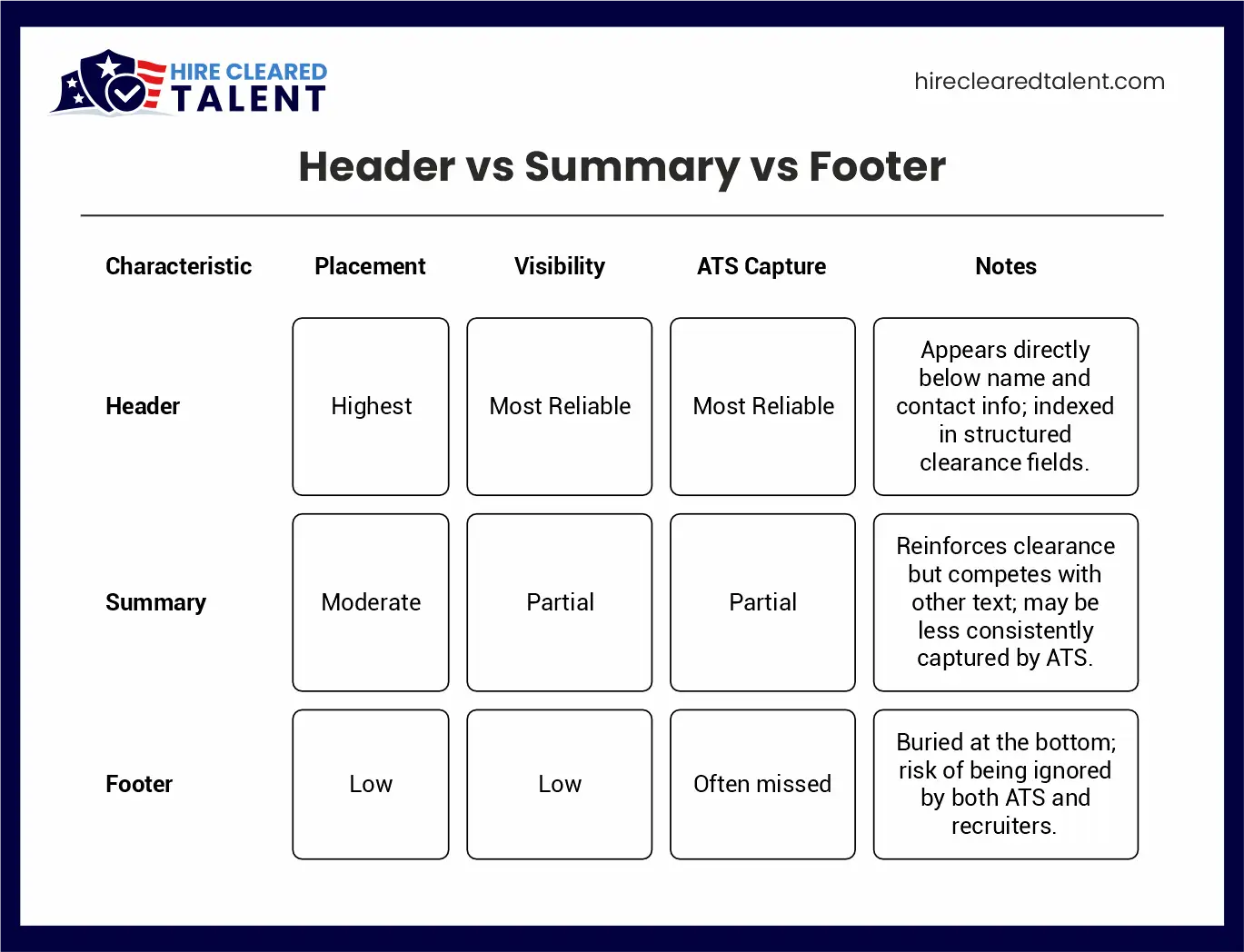
Put your clearance in the resume header, directly below your name and contact line. Not in the summary. Not at the bottom of the page, but the header.
Header placement reflects how cleared hiring works mechanically. Defense contractor recruiters browse LinkedIn and resume libraries using those keyword combos like “TS/SCI”, “Top Secret”, and “Active Polygraph”.
But when your clearance is sitting in the header, it tends to get indexed as the main identifying bit. When it sits buried in a summary paragraph, it competes for attention with everything else.
There's a second reason that matters more in 2026. Major defense primes use Workday, iCIMS, and similar applicant tracking systems that parse resumes into structured fields.
According to a Workday ATS parser audit conducted by Resume Optimizer Pro, clearance language placed in the resume header is captured into the structured "Security Clearance" field at a notably higher rate than the same wording buried in a summary paragraph or work-experience bullet.
That structured field is what recruiters filter on. If your clearance doesn't land in it, your resume drops out of qualified candidate searches before a human ever sees it.
The placement is simple. Header first. Then a brief reinforcement in the summary. Then a dedicated section for the full details.
How to Format Security Clearance Information?
Be specific. Vague clearance language gets ignored or misread by both the ATS and the recruiter.
Good header format:
JANE SMITH
[email protected] | (555) 123-4567 | linkedin.com/in/janesmith
Active TS/SCI with CI Polygraph (current, last adjudicated 2024)
Notice what is there. The level. The polygraph type. The status. The adjudication year. Every one of those is a search filter or screening question a recruiter applies. You're answering all four questions before they ask.
Now compare that to what most candidates write: "Top Secret Clearance" or "Security Clearance Holder." Both technically true. Both leave the recruiter unsure whether it's active, when it was last adjudicated, and whether you've got a poly. That uncertainty costs you the screen.
The Status Words That Matter?
There are four status descriptions used in cleared hiring, and using the wrong one will get your resume tossed faster than you might think.
· Active: You currently hold the clearance and you're actively using it in your current role. This is the strongest status to claim.
· Current: You hold the clearance, but you may not be accessing classified material in your day-to-day work. Still a strong status, particularly for engineers and analysts who hold clearance but work on unclassified portions of a contract.
· Eligibility on file: You're within the 24-month reinstatement window but not in a cleared billet right now. Recruiters can move you to a cleared position quickly because reinvestigation is faster and cheaper than a new investigation.
· Inactive (within reinstatement window): A separation from a cleared role inside the last 24 months. List it. A previous clearance still has real value because reinvestigation moves faster than a fresh investigation, per Best Military Resume's 2026 cleared candidate guide.
Whatever your status, name it precisely. "Active" when it's active. "Eligibility on file" when you separated 8 months ago. Recruiters distinguish among these. They also notice when candidates use loose language to make an inactive clearance sound active. That gets you screened out at the verification stage.
Read more- How to Qualify for Federal Security Clearance Jobs?
The Dedicated Section Below?
After the header reinforcement, make a dedicated "Security Clearance" or maybe a "Clearances and Certifications" section, laid out with the full detail. Like, this is the part the recruiter checks after they’ve already decided that you’re worth a closer look.
Format like this:
SECURITY CLEARANCE
Top Secret/SCI, DoD CAF, T5 investigation, last adjudicated August 2024
CI Polygraph, last passed June 2025
Eligibility for DOE Q (separate sponsorship available)
Three things to notice. First, you list the adjudication date, not the date you first received the clearance. Recruiters need the date that determines your scope and reinvestigation timing.
Second, you separate the clearance and the polygraph since they're tracked as different items. Third, if you hold or are eligible for additional clearances (DOE, NATO, foreign disclosure), name them.
Example of a Resume with Security Clearance
If you’re wondering whether placement really matters that much, here’s a current little data point, almost like a signal. In December 2025, the Government Accountability Office said more than 60% of the FY 2024 personnel security clearance data it reviewed was inaccurate or incomplete. Resume Optimizer Pro’s take, citing GAO-26-107100, made that the headline.
So, in practical terms for you it basically means this: federal HR teams and contractor recruiters can’t just assume their system of record is correct, not even close. They lean harder on what’s on your resume and they will ask for the exact clearance level, the clearance status, the polygraph type and the adjudication language too.
If a recruiter has to call your FSO to verify what your resume says, your application slows down by a week. The candidate whose resume matches the security officer's data exactly moves through three steps faster than the one who left things ambiguous.
LinkedIn Mirror
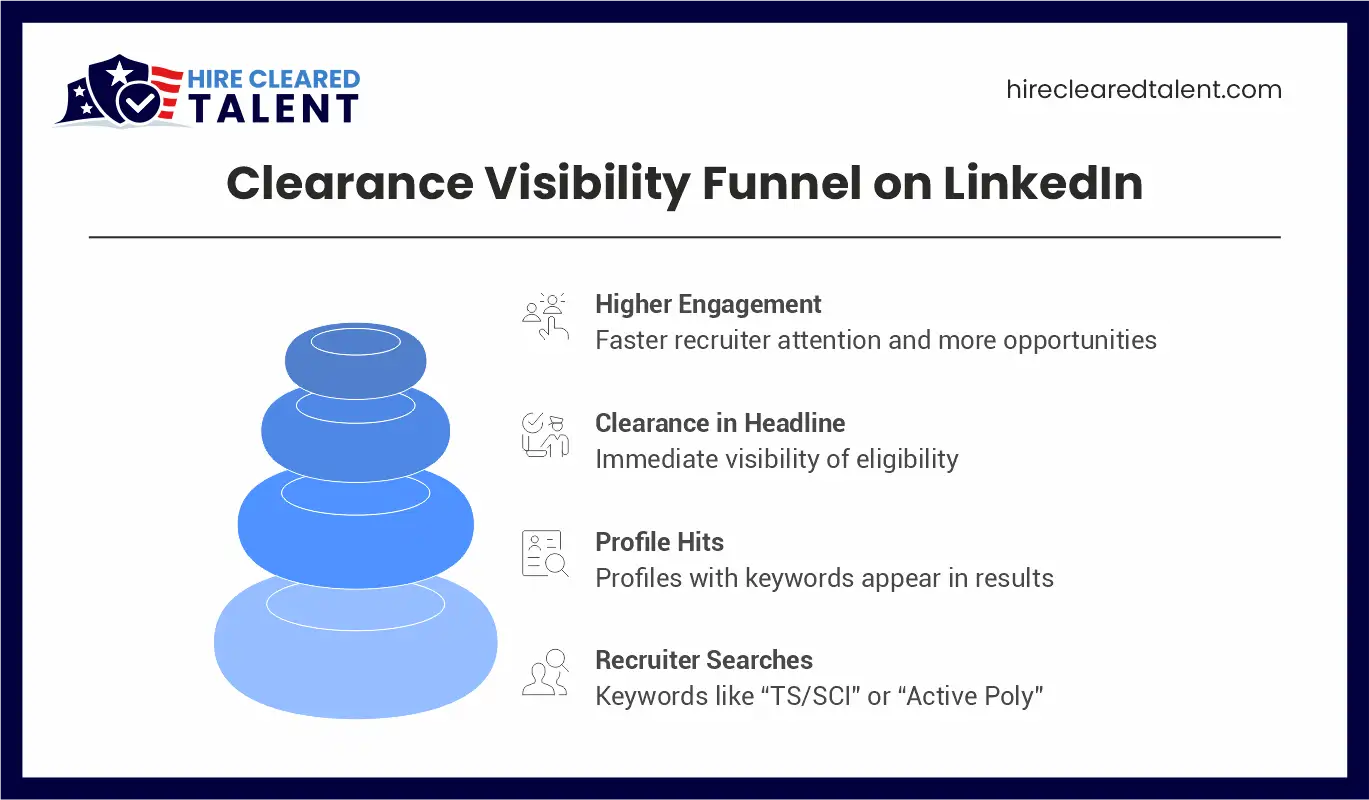
This is the same case for your LinkedIn profile, which must have the exact heading as the one on your CV. The recruiters will search you on LinkedIn using similar clearance keywords used against your CV, and indexing is identical as well. Place your clearance in your LinkedIn header, About, and Skills sections.
A working LinkedIn headline format:
Senior Cybersecurity Engineer | Active TS/SCI w/ Full Scope Poly | DoD & IC Programs
That headline shows up in recruiter search results with your clearance immediately visible. Compare it to "Senior Cybersecurity Engineer" alone, which forces the recruiter to click through to check your profile before they know whether you're worth contacting.
Common Mistakes to Avoid When Listing Security Clearance
A few items to leave off, basically. Don’t name particular agencies you supported if that work was classified, or at least if you can’t say it without breaking rules. Don’t try to describe the whole polygraph ordeal, including the questions and stuff, or even which agency ran it, unless that same agency is the one that actually gave you your clearance, you know.
Also, don’t include classified program names, codewords, or contract numbers. And don’t list specific facilities or SCIFs where you were, keep it more general.
Your resume gets read by recruiters, FSOs, and sometimes program leads. All of them know what classification means. You don't need to prove your clearance by leaking details. You need to demonstrate professional discretion, which is part of what they're hiring for.
Read more- Preparing for Interviews in Security Cleared Roles: Key Questions
Where HireClearedTalent Comes In?
Once your clearance is positioned correctly, the next step is getting your resume in front of the right employers. HireClearedTalent is the marketplace built for cleared professionals like you. We connect active and passive cleared candidates with federal agencies and defense contractors across the United States, working with every level: Secret, Top Secret, TS/SCI with polygraph, and DOE Q/L.
When you create a profile on HireClearedTalent, your clearance level, polygraph status, last investigation date, and contract availability are captured in structured fields. Qualified employers see you. Generic job boards leave that work to chance. We don't.
If you're ready to put a properly positioned clearance in front of employers who actually need it, create your profile on HireClearedTalent and start exploring active roles at your clearance level today. Your clearance is a credential. Treat it like one. Place it where it belongs and let the right employers find you.
Need more clarity to understand how hireclearedtalent can help you achieve your goals?
Book your call with our experts
FAQ-
Q1- Where is the most effective place to list a security clearance on a resume?
A- Security clearances should be listed near the top of your resume, typically under your name or in a dedicated “Clearances & Certifications” section for maximum visibility.
Q2- Should I include the clearance level on my resume?
A- Yes, include the exact clearance level (e.g., TS/SCI, Secret) to signal eligibility for sensitive roles to recruiters and hiring managers.
Q3- Is it better to put active or expired clearances on a resume?
A- Active clearances are most valuable. Expired clearances can be listed, but clarify their status and date to avoid confusion.
Q4- Should I mention the agency or employer for which I hold the clearance?
A- You may include the agency if it strengthens credibility, but avoid sharing sensitive or classified details.
Q5- How do I incorporate my clearance into my resume summary or headline?
A- Mention it in the headline or summary with your role and clearance level, e.g., “TS/SCI-Cleared Systems Engineer with 5+ Years Experience.”
Q6- Does listing a clearance improve chances with federal contractors?
A- Yes, contractors prioritize candidates with active clearances because it reduces hiring delays and increases project eligibility.
Q7- Can I list multiple clearances on a resume?
A- Yes, list all active clearances with their levels, and optionally include dates or agencies, prioritizing the highest level.
Q8- Should I mention clearance for civilian roles or only federal positions?
A- Primarily for federal or contractor positions where a clearance is required. It may be irrelevant for standard private-sector roles.
Q9- How detailed should the clearance section be on a resume?
A- Keep it concise: clearance type, level, and status. Avoid sensitive operational or project details.
Q10- Can including a clearance make a resume stand out?
A- Absolutely. A prominently displayed clearance signals readiness for sensitive roles and can fast-track recruiter attention
Weekly newsletter
Get the latest blog updates, practical hiring insights, and featured reads delivered straight to your inbox.
Read about our Privacy Policy.