


An active security clearance is one of the most valuable professional assets in the federal and defense labor market. Letting it lapse even unintentionally can take months or years to fix. Here's what you actually need to know to protect it.
The cleared workforce sits at roughly 4.3 million Americans in the United States, according to estimates across federal reporting sources and yet the gap between cleared demand and cleared supply has widened every year for the past half decade.
Demand for cleared specialists is rising at 7–10% annually, driven by cybersecurity requirements, intelligence modernization, and defense program expansion, according to analysis from GovCon LLC.
The math is straightforward: active clearances are scarce, and the professionals who hold them and maintain them in good standing have real, documented leverage in the job market.
But that leverage disappears the moment a clearance goes inactive. And with average end-to-end background investigation processing times running 243 days as of Q3 fiscal 2025 including 215 days just for the investigative phase according to Federal News Network's coverage of DCSA's workload data, a lapsed clearance isn't a minor inconvenience. It's a career interruption measured in months.
The seven practices below address the specific decisions and habits that separate cleared professionals whose eligibility stays clean and active from those who learn these lessons the hard way.
The 24-Month Rule Is a Deadline, Not a Buffer
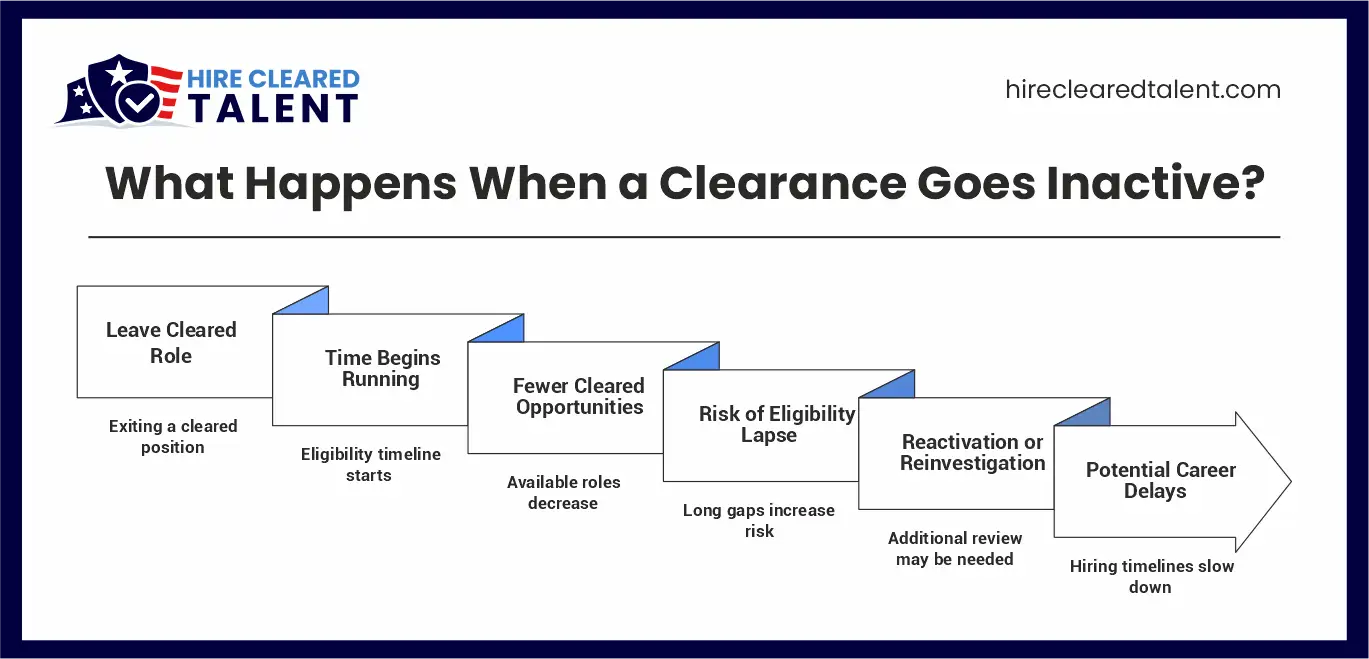
The current framework gives cleared professionals 24 months after leaving a cleared position before their eligibility lapses entirely. That window feels generous until you account for how quickly it closes.
A few months of job searching, a contract delay, a role that turned out not to require access suddenly you're eighteen months out with no cleared sponsor on your record.
The FY 2026 NDAA includes a proposal to extend that reactivation window from 24 months to 60 months, which would be a meaningful change for professionals in career transitions. But that proposal hasn't been signed into law as of this writing, and the cleared job market doesn't operate on proposals.
Plan under the current 24-month rule and treat the extension as a welcome surprise if it passes, not a safety net to rely on now.
What this means practically: if you're approaching the 12-month mark without a cleared sponsor, start treating clearance maintenance as an active priority, not a background item.
7 Ways to Keep Your Clearance Active
1. Maintain Continuous Sponsorship, Even When You're Between Contracts
A clearance without a sponsor is a clearance on a timer. The system doesn't hold your eligibility in a waiting state while you figure out your next move; it simply begins counting down from the date you left your last sponsored position.
The most effective way to avoid that countdown is to not start it. When transitioning between contracts or employers, the goal is a direct handoff, your new facility security officer (FSO) accepting the transfer before your previous sponsor terminates your access. That transition, handled correctly, requires direct FSO-to-FSO communication.
Don't leave that to paperwork timelines. Contact your incoming FSO before your last day, share your current FSO's direct contact information, and follow up to confirm the transfer is in motion.
An active clearance, the JOBSwithDOD 2025 clearance guide notes, requires an eligible position meaning you need an employing organization actively sponsoring your access, not simply a clearance record that hasn't technically expired yet. That distinction matters most during gap periods between contracts.
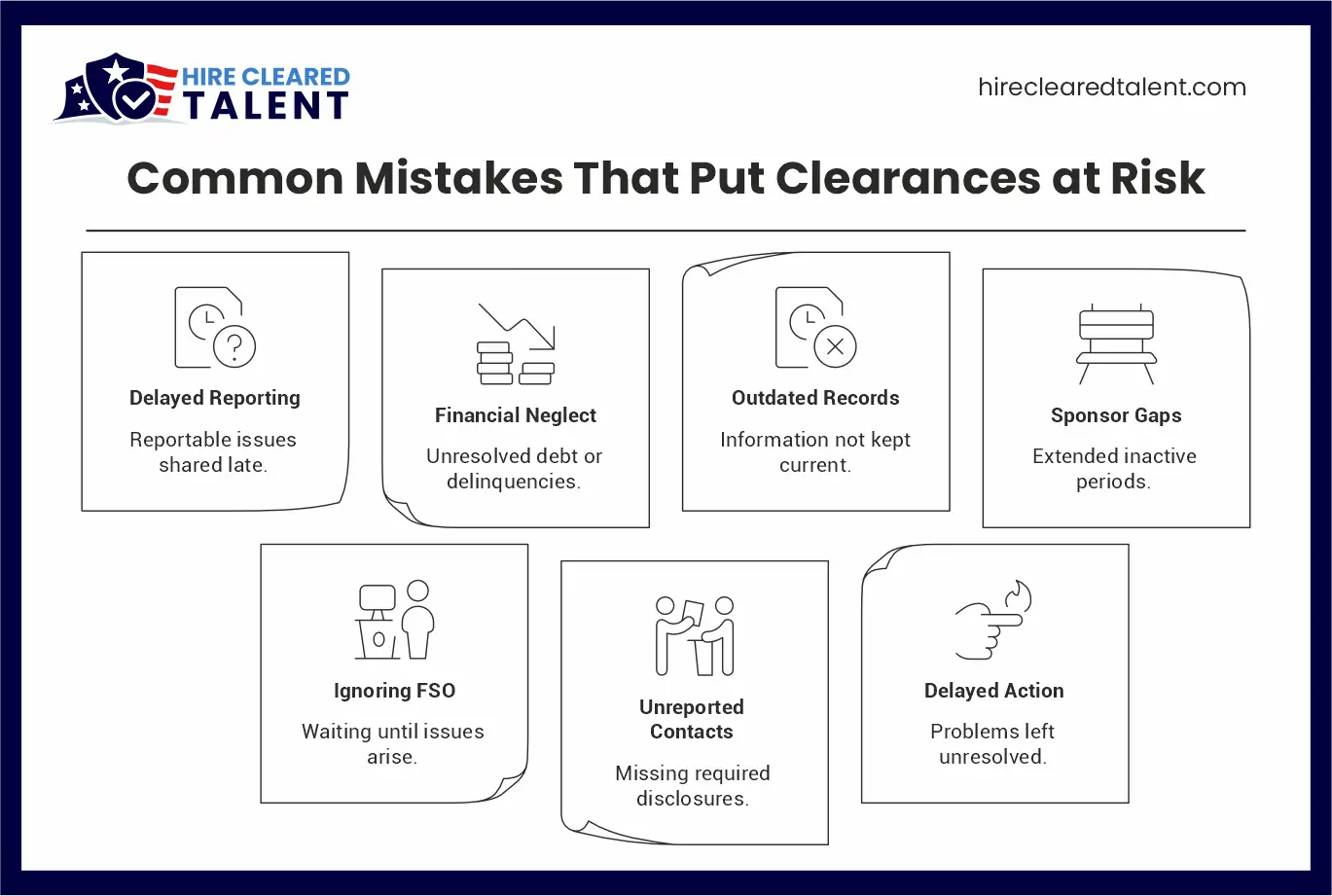
2. Self-Reporting Isn't Optional and Delay Makes It Worse
Here's what most people in this industry don't say out loud: a significant percentage of the clearance revocations and administrative holds we see in this market aren't triggered by the underlying issue, they're triggered by the failure to report it.
A financial problem that gets reported promptly, documented, and addressed is adjudicated entirely differently than one that surfaces during a routine record check three years after it happened.
Adjudicators have explicit guidelines that treat self-reporting as a mitigating factor. Concealment, even unintentional concealment through delayed reporting, works in precisely the opposite direction.
The categories requiring prompt self-reporting are specific: financial changes including bankruptcy, wage garnishment, or any debt more than 120 days delinquent; any arrest, regardless of outcome; foreign contacts involving bonds of affection or obligation with non-U.S. nationals; court-ordered mental health care; and changes in household or marital status.
The pattern matters more than the complete list when in doubt, report it. The cost of an unnecessary report is essentially zero. The cost of a missed one can be a revocation and a Tier 5 reinvestigation starting from scratch.
Read more- Military Transition: Mapping to Security Cleared Civilian Careers
3. Understand What Continuous Vetting Actually Means for You Right Now
The periodic reinvestigation cycle every five years for Top Secret, every ten for Secret is no longer the primary mechanism for monitoring clearance holders.
As of 2021, all DoD clearance holders, approximately 3.6 million people, were enrolled in continuous vetting under the Trusted Workforce 2.0 initiative.
Automated checks against credit records, criminal databases, public records, and other data sources now run regularly often daily or monthly rather than waiting for a scheduled review cycle.
What that means in practice: behaviors that used to surface only at a five-year review now surface in near-real time. A new debt crossing reporting thresholds, a financial delinquency, an arrest these create alerts almost immediately.
The cleared professional who assumes they have years before anyone notices a developing problem is operating on a model of the system that no longer exists.
Continuous vetting has compressed the accountability timeline dramatically, and personal financial and behavioral management matters more now than it did five years ago.
4. Treat Your Financial Record With the Same Discipline You'd Apply to Any High-Stakes Risk
Financial issues are the leading cause of clearance denials and revocations, consistently, year over year. The adjudication guidelines don't require that you be financially comfortable, they require that you manage what you have responsibly and transparently.
Think of your credit report the way a seasoned counterintelligence officer thinks about a known vulnerability in a system: if you're aware of it and doing nothing about it, it isn't a manageable risk. It's a liability waiting to surface at the worst possible time.
Cleared professionals who monitor their credit quarterly, address delinquencies before they cross reporting thresholds, and document their response to any financial hardship are demonstrating exactly the personal reliability adjudicators weigh in clearance decisions.
And the financial stakes of keeping that record clean are significant. Average compensation for cleared professionals reached an all-time high of $119,131 in 2025, with 68% of cleared professionals receiving salary increases that year.
That premium only applies to cleared professionals whose records remain in good standing.
5. Keep Your SF-86 Data Current, Don't Wait for the Next Investigation
Your SF-86 is not a one-time submission. It's a living record of the information the government uses to evaluate your trustworthiness, and it needs to reflect your current life, not your life as it was when you last filed.
Foreign travel, new foreign contacts, changes in household composition, financial changes that meet reporting criteria, these belong in your record as they occur.
A common oversight: professionals who travel internationally for personal reasons and don't flag it because it seems irrelevant. Every trip to a country of counterintelligence concern, every contact with foreign nationals that rises to the level of an ongoing relationship; these belong in your record.
The gap between what your record reflects and what a thorough investigation would find is precisely what adjudicators are trained to identify. And under continuous vetting, they may identify it faster than you'd expect.
The JOBSwithDOD 2025 guide lists the specific categories requiring immediate reporting. Review them annually against your actual life circumstances, not just when an investigation is coming up.
Read more- How to Qualify for Federal Security Clearance Jobs?
6. Use Your FSO as a Resource, Not a Last Resort
Your facility security officer is probably the most underutilized resource in a cleared professional's career management.
FSOs process access transfers, field inquiries about your record, and often maintain direct relationships with DCSA adjudicators and program security officers across the agencies their organization supports. They're also the first person who'll know if something in your record has flagged.
Most cleared professionals only contact their FSO reactively when a problem has already developed, when a contract transfer is urgent, or when a new offer is on the line and clearance status is blocking the start date. That's the wrong model.
A cleared professional who checks in with their FSO proactively who asks about what's in their record, confirms investigation dates, and flags anything on the horizon has significantly more ability to address issues before they become formal adjudication matters.
With DCSA's case backlog near 300,000 cases as of late 2024, the professionals who move most efficiently through the system are those who've kept their documentation clean and their FSO relationships active. That's not circumstance. It's preparation.
7. Get the Facts Straight on Mental Health and Clearance Maintenance
The adjudicative guidelines around mental health have evolved substantially over the past decade, and the cleared community's understanding of them hasn't always kept up. The old assumption that any mental health treatment would automatically jeopardize a clearance isn't consistent with how the guidelines actually operate.
What adjudicators evaluate is whether a psychological condition materially affects a person's judgment, reliability, or ability to protect classified information not whether they've ever sought support.
What does require reporting: court-ordered mental health care, and any condition identified by a mental health professional as materially affecting judgment. Seeking voluntary counseling, therapy, or stress management support is not automatically a reportable event and is generally viewed as evidence of responsible self-management.
The greater risk comes from not seeking help when it's warranted and having a deteriorating situation surface through work performance, conduct, or continuous vetting than from proactively managing a concern with professional support.
So here's a question worth sitting with honestly: are you making decisions about seeking care based on the actual adjudicative guidelines as they exist in 2025 or based on assumptions about the process that haven't been accurate for years?
What Keeping Your Clearance Active Actually Means for Your Career
The practices above aren't administrative formalities. They're the specific behaviors that determine whether a cleared professional's most valuable career asset keeps generating returns or goes dormant at the worst possible time.
With demand for cleared talent growing at 7–10% annually and the supply of active clearance holders constrained by processing backlogs and eligibility lapses, the professionals who actively manage their clearance status hold real leverage in this market. But leverage only works when the asset behind it is intact.
How HireClearedTalent Can Help?
HireClearedTalent operates exclusively in the cleared hiring market which means we understand the mechanics of clearance maintenance, transfer timing, and sponsorship that general employment platforms don't address.
The employers in our network aren't just posting cleared job titles; they've been evaluated for contract stability, active cleared work, and the infrastructure to sponsor and support the cleared professionals they hire.
If you're navigating a contract transition, approaching the end of a period of performance, or positioning yourself for the next move in a cleared career, the right marketplace matters more than most professionals realize until they're in the middle of a gap.
For this, you just have to create your profile on hireclearedtalent. Your clearance is the asset. Keep it that way.
Book your 15-minute transition mapping call
FAQ-
Q1. How can I keep my security clearance active if I am between jobs?
A. If you are between jobs, stay engaged with cleared opportunities, maintain accurate records, and understand your clearance eligibility timelines. In some cases, a clearance can remain current for a period even without active use, depending on agency and program requirements.
Q2. Does leaving a cleared position immediately cancel my security clearance?
A. No. Leaving a cleared job does not automatically cancel your clearance. However, inactive clearances and long gaps outside cleared work can affect future reinstatement processes.
Q3. Why is reporting personal changes important for maintaining a security clearance?
A. Major life changes such as foreign travel, financial issues, legal matters, or significant personal circumstances may require reporting. Delayed or inaccurate reporting can create complications during reviews.
Q4. Can financial problems affect my security clearance status?
A. Yes. Unresolved debt, repeated financial issues, or unexplained financial activity may raise concerns during clearance evaluations. Responsible financial management and documentation matter.
Q5. How does continuous vetting affect clearance holders?
A. Continuous vetting allows agencies to monitor certain risk indicators between periodic investigations. Clearance maintenance is increasingly becoming an ongoing process rather than a one-time review.
Q6. Should I maintain connections in the cleared community even when I am employed?
A. Yes. Networking helps professionals stay informed about opportunities, hiring trends, and contract changes within the cleared workforce.
Q7. Can an expired certification affect my cleared job opportunities?
A. While certifications do not directly control clearance status, many cleared positions require active technical certifications for compliance and role eligibility.
Q8. Why should cleared professionals keep employment records updated?
A. Maintaining accurate employment history, addresses, travel records, and contact information simplifies future investigations and reinvestigations.
Q9. Can foreign travel impact an active security clearance?
A. Foreign travel does not automatically create issues, but certain travel activities or relationships may require disclosure depending on agency policies.
Q10. How often do security clearances require review or updates?
A. Security clearance processes increasingly rely on continuous evaluation models, though requirements may vary based on clearance level and agency policies.
Weekly newsletter
Get the latest blog updates, practical hiring insights, and featured reads delivered straight to your inbox.
Read about our Privacy Policy.