


Most people who hold a security clearance worked hard to get it months of investigation, a detailed personal history questionnaire, references, background checks, and in many cases, a wait that stretched nearly a year.
They know what the clearance cost them in time and scrutiny. What they often underestimate is how quickly that investment can unravel and how many of the risk factors that lead to revocation or denial are entirely within their control.
The clearance landscape in 2026 is different from what it was even two or three years ago. The vetting system has fundamentally changed its operating model. Continuous monitoring has replaced the old periodic reinvestigation cycle. Digital behavior is under increasing scrutiny.
Financial pressures from the wider economy are flagging more holders than ever. And the consequences of non-compliance - suspension, revocation, job loss arrive faster now than they used to, because the monitoring infrastructure catches issues in near real time.
This guide breaks down the current rules, the risks that are generating the most flags in 2025 and 2026, and the practical compliance habits that protect your clearance long-term. Whether you're a federal employee, a cleared defense contractor, or a Facility Security Officer managing compliance for a cleared organization, this is the current-state picture you need.
The Landscape Has Changed: Continuous Vetting Is Now the Standard
The single most significant shift in security clearance management over the past three years is the replacement of periodic reinvestigations with continuous vetting (CV) under the Trusted Workforce 2.0 (TW 2.0) initiative.
Under the old model, clearance holders were reinvestigated on a fixed schedule, every 5 years for Top Secret, every 10 years for Secret, every 15 years for Confidential. A lot could happen in those gaps without anyone knowing. The new model eliminates those gaps entirely.
As of early 2026, over 3.8 million cleared personnel are enrolled in continuous vetting, and DCSA is expanding the program to include non-sensitive public trust positions as well.
Continuous vetting runs automated checks against criminal, financial, terrorism, and public records databases on an ongoing basis rather than waiting years between reviews. When a check generates an alert - an arrest, a delinquent account, a foreign contact, it triggers a follow-up investigation immediately rather than sitting undiscovered until the next reinvestigation cycle.
GAO's May 2025 report on TW 2.0 implementation found that the primary benefit agencies reported was access to real-time information on personnel through continuous vetting, with agencies noting it allowed them to "mitigate risk across the enterprise for continued trust of current individuals".
What this means in practice: if you develop a financial problem, get arrested, make contact with a foreign national in a way that triggers a flag, or post something online that raises concern, the system is likely to flag it now rather than years from now.
The compliance window has narrowed significantly. That's not a reason for anxiety, it's a reason to understand exactly what the system monitors and to stay consistently on the right side of it.
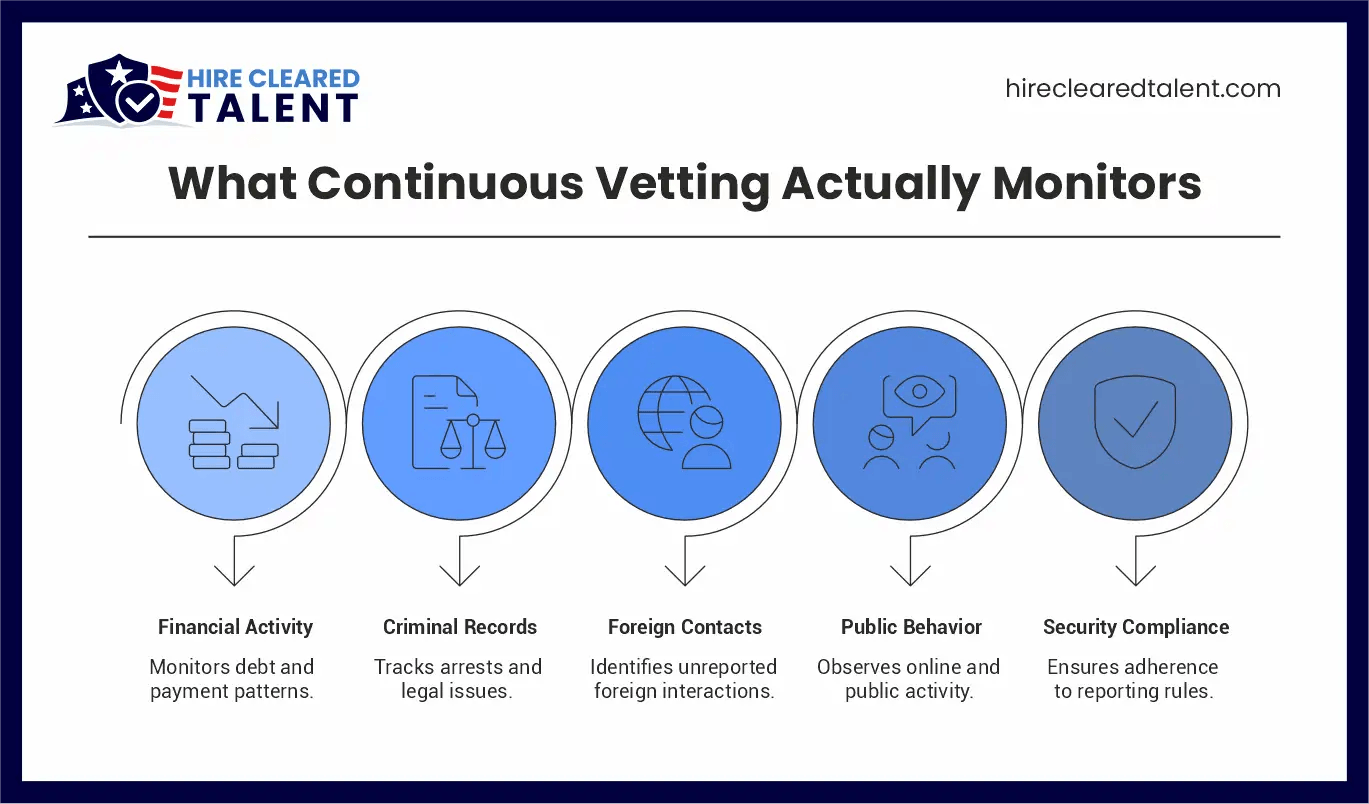
The Top Risk Categories That Flag in 2026
Understanding where most clearance problems originate is the first step in protecting yourself. The adjudicative guidelines that govern security clearance decisions cover 13 categories. In practice, the vast majority of denials and revocations cluster in a much smaller number of areas.
Financial Issues - Still the Leading Risk
Financial problems are the number one cause of security clearance denial and revocation, accounting for approximately 35% of all clearance denials. Excessive debt, collections accounts, patterns of financial irresponsibility, and foreign financial ties are all adjudicative concerns under Guideline F.
In 2026, economic pressures have made this category more relevant than ever. According to ClearanceJobs' January 2026 analysis, financial stability concerns are intensifying in the current environment, with new employment models, gig economy income volatility, and expanded scrutiny around foreign financial interests making proactive financial management more critical for clearance holders.
The good news, and this is genuinely reassuring: investigators care more about your current behavior and your honesty than about past mistakes.
A bankruptcy or debt problem that you disclosed proactively and are actively addressing is evaluated very differently from a financial problem you tried to hide. The clearance system is designed to assess current trustworthiness, not to punish people permanently for hard times they've moved through.
Honesty and SF-86 Disclosure
This category causes more clearance problems than almost any other and almost all of them are avoidable. The SF-86 (or its upcoming successor, the Personnel Vetting Questionnaire, expected to deploy in late 2026 or early 2027) is not just a background investigation form. It's a legal document.
Omissions are not treated as oversights; they're treated as evidence of dishonesty, which is itself an adjudicative concern independent of whatever the underlying issue was.
A defense contractor applicant who didn't disclose an outstanding medical collections balance on his SF-86 reasoning it would probably resolve itself found himself facing not one adjudicative concern but two: the financial conduct and the omission.
The investigators surfaced the account during the investigation. Had he disclosed it and documented a plan to resolve it, the financial issue alone might have been manageable. The omission made it significantly harder.
The rule is simple, and it applies without exception: disclose everything. If you're unsure whether something is reportable, disclose it and let the adjudicator evaluate it. The cost of over-disclosure is zero. The cost of under-disclosure can be your clearance.
Foreign Contacts and Travel
Foreign travel and contact with foreign nationals are among the most heavily monitored areas under continuous vetting, and the scrutiny has intensified as geopolitical tensions have elevated the counterintelligence risk environment.
This doesn't mean that having international relationships is automatically disqualifying, it means that these contacts need to be reported according to your agency's requirements, and that any contact with someone who might be acting in the interest of a foreign government needs to be reported immediately.
you travel internationally for personal reasons, report it according to your agency's pre-travel briefing requirements. If you develop a new relationship with a foreign national, understand your self-reporting obligations.
If someone approaches you in a way that feels like it might be an intelligence contact or social engineering attempt, even if you're not sure report it to your security officer. Erring on the side of reporting protects you.
Social Media and Digital Behavior
Online activity continues to become an increasingly significant part of clearance reviews in 2026. Social media posts, digital associations, and even peripheral online behavior may be reviewed by adjudicators for indicators of judgment, susceptibility to influence, or risk of exploitation. The practical implication: assume your public digital footprint is being reviewed, and conduct yourself accordingly.
This doesn't require a sanitized or inactive online presence. It requires the same judgment you'd apply to professional communications - avoiding content that could be misread as loyalty to foreign interests, association with extremist viewpoints, or evidence of behavior that would be embarrassing in a hearing.
Personal Conduct and Outside Activities
Guideline E - personal conduct covers a broad range of behaviors that suggest questionable judgment or reliability. This includes dishonesty in any official context, misuse of IT systems, conduct that creates vulnerability to coercion, and behavior that suggests the person might prioritize personal interests over their security responsibilities.
Outside activities - side businesses, consulting arrangements, participation in organizations with foreign ties require disclosure and, in some cases, prior approval.
Cleared personnel who take on consulting work for foreign governments or companies without disclosing and receiving approval create significant clearance risk that could easily be avoided with a brief conversation with their security officer.
Practical Compliance Habits That Actually Protect Your Clearance
Knowing the risk categories is the first half. Building the habits that keep you clear of them is the second.
Self-Report Early and Often
The self-reporting obligation is not optional, and it's broader than most cleared personnel assume. Changes in financial circumstances, foreign travel, new foreign contacts, legal issues, mental health treatment (note: seeking treatment is almost never a clearance risk in itself - the failure to self-report relevant behavior is what creates problems), outside employment, and coercive contact all have reporting requirements.
The habit to develop is this: when something changes in your life that might conceivably touch one of the 13 adjudicative guidelines, the default answer is to report it to your security officer and let them advise you.
Security officers are not adversaries in this process. Their job is to keep you and the organization in compliance. Getting ahead of an issue with your FSO's guidance is almost always better than having it surface through continuous vetting without prior disclosure.
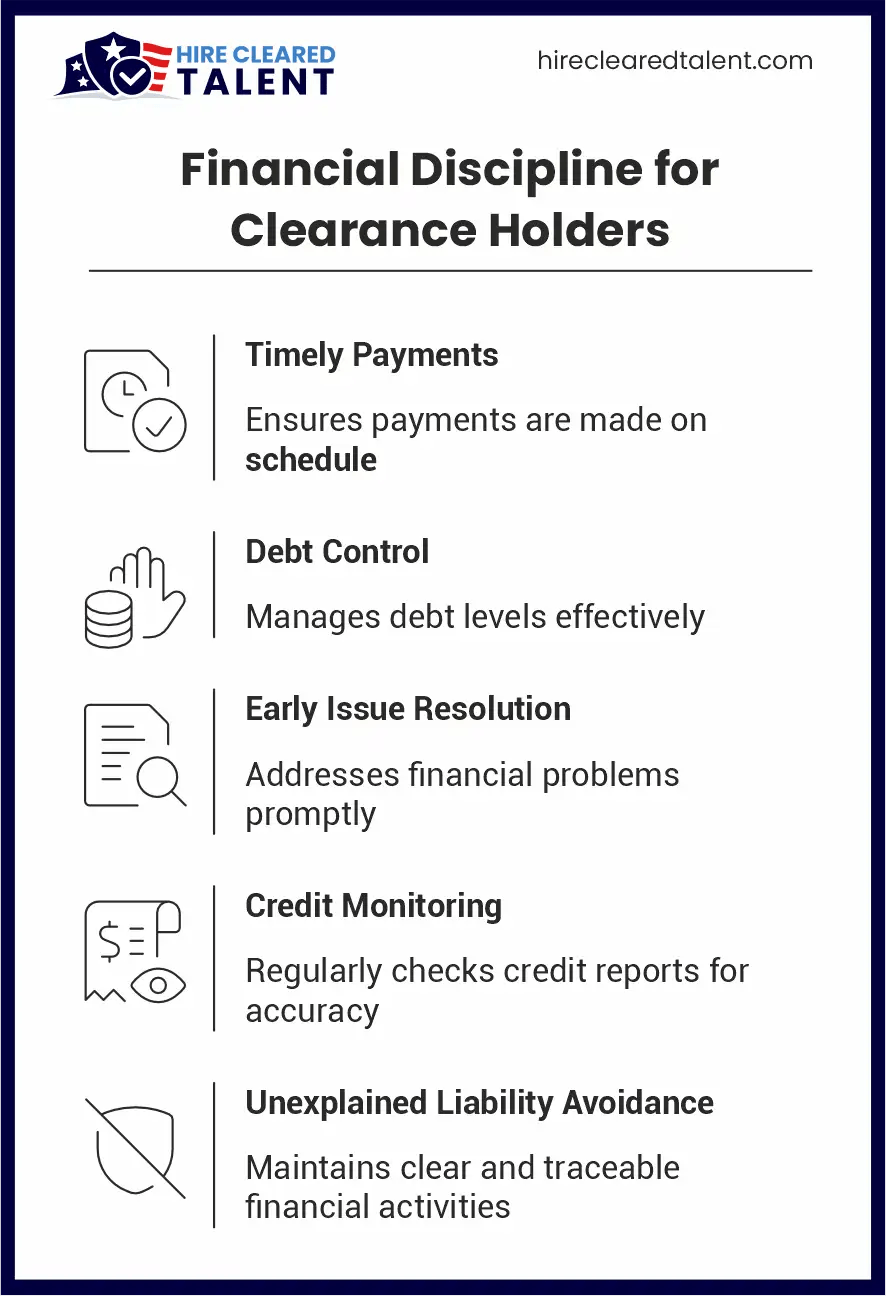
Manage Your Financial Profile Proactively
This means keeping debt-to-income ratios reasonable, addressing collections accounts rather than ignoring them, not taking on foreign financial obligations without disclosure, and checking your credit report annually for errors or accounts you didn't open.
If you're experiencing genuine financial difficulty - layoff, medical crisis, divorce document your situation and what you're doing to address it. The pattern of active management matters as much as the numbers themselves.
Treat the SF-86 and PVQ as Legal Documents
When a reinvestigation or form update comes around or when the new Personnel Vetting Questionnaire deploys approach it with the same care you'd give to a sworn statement. Review your previous submissions. Update your foreign contacts, travel history, financial circumstances, and any other reportable changes.
If you're uncertain about how to characterize something, ask your FSO or consult a security clearance attorney before submitting.
Conduct a Regular Personal Security Review
Set a calendar reminder quarterly to ask yourself: Has anything changed since my last check? New financial accounts or debts? Foreign travel or new international contacts? Any legal issues, even minor ones? Any outside employment or business interests? New organizational memberships? Any attempts by anyone to elicit sensitive information?
This doesn't need to take long - fifteen minutes of honest self-examination against the 13 guidelines. What it does is catch issues before they accumulate into something significant, and it builds the habit of treating your clearance as an active responsibility rather than a background status.
Stay Current on Your Agency's Security Awareness Training
Security awareness training exists for a reason. The threat environment changes, the reporting requirements evolve, and the ways that foreign intelligence actors attempt to develop access to cleared personnel shift in sophistication.
Treating mandatory security training as a checkbox rather than as genuinely useful information is a habit that cleared professionals can't afford.
What the Numbers Actually Say About Clearance Risk?
Some perspective on how this actually works in practice is useful here.
Approximately 5.1 million Americans hold active security clearances at any given time, with roughly 1.3 million holding Top Secret or TS/SCI-level access. Against that backdrop, approximately 2% of security clearance applications are denied annually, according to data from the National Counterintelligence and Security Center.
That's a relatively small share of the total volume but in absolute numbers, it represents tens of thousands of people per year. Most of those denials involve issues that were either preventable or that the applicant made significantly worse by failing to disclose proactively.
Meanwhile, DCSA reported that its initial investigation backlog dropped to approximately 100,000 cases in January 2026, down 65% from the start of 2025 meaning the system is processing clearances faster, which also means it has more capacity to address revocation and adverse action cases. The infrastructure is increasingly efficient in both directions.
The Last Say
Transparency combined with proactive FSO notification preserves careers. Delays create suspicion. Complete documentation demonstrates accountability. Clearance adjudication prioritizes patterns over isolated events.
HireClearedTalent matches active clearance holders with positions requiring specific eligibility levels and experience. Live job openings appear daily from vetted hiring managers.
Create your HireClearedTalent profile to access clearance-required opportunities immediately.
Schedule Expert Consultation
FAQ-
Q1. What are the most common reasons security clearances are revoked in 2026?
A. Financial issues, unreported foreign contacts, and legal incidents remain the top causes. Most cases involve patterns of behavior, not single events.
Q2. How does continuous vetting impact security clearance holders?
A. Continuous vetting monitors financial, legal, and behavioral data in near real time. It reduces delays but requires consistent compliance and transparency.
Q3. Do small financial issues affect security clearance eligibility?
A. Minor issues alone do not usually cause problems. Repeated or unresolved financial inconsistencies can raise concerns over reliability.
Q4. What should you do if you miss a payment or face financial difficulty?
A. Address the issue immediately and report it if required. Early action and resolution reduce risk significantly.
Q5. How important is reporting foreign contacts for clearance holders?
A. Reporting is critical. Even routine or informal foreign interactions may need disclosure depending on the situation.
Q6. Can a single legal incident lead to loss of security clearance?
A. Not always. Clearance decisions depend on severity, frequency, and how the issue is handled and reported.
Q7. What role does personal behavior play in clearance decisions?
A. Behavior patterns are closely evaluated. Consistent reliability and judgment are key factors in maintaining clearance.
Q8. How quickly should you report a potential issue affecting your clearance?
A. Report as soon as possible. Delays in reporting are often treated as a bigger concern than the issue itself.
Q9. What does “pattern of behavior” mean in clearance evaluations?
A. It refers to repeated actions or issues over time. Multiple small concerns can collectively create a higher risk profile.
Q10. How can you demonstrate reliability as a clearance holder?
A. Maintain financial stability, report issues early, and communicate proactively. Consistency in behavior is critical.
Weekly newsletter
Get the latest blog updates, practical hiring insights, and featured reads delivered straight to your inbox.
Read about our Privacy Policy.