


Every year, more than 200,000 service members separate from the U.S. military. Some land quickly. Many don't, not because they lack ability, but because the civilian hiring system wasn't built to read the resume they're carrying.
Veterans bring something the cleared federal market desperately needs right now. Active security clearances. Operational discipline. Leadership track records that most civilian candidates can't touch. And still, thousands of them sit in job searches that drag on longer than they should, undervalued by a hiring process that doesn't know what it's looking at.
That gap isn't inevitable. It's fixable. But fixing it requires being honest about where the friction actually lives and that means naming things that most hiring content never gets around to saying.
The Numbers Aren't as Reassuring as They Look
At first glance, veteran unemployment data looks fine. According to the U.S. Department of Labor, the annual average unemployment rate for veterans was 3.8% in 2025 and at certain points in the year, it dipped below 3%. But that number obscures a sharper story underneath.
Post-9/11 veterans the ones most likely to be cleared, most technically trained, and most actively transitioning saw their unemployment rate climb to 4.3% in November 2025, up from 2.6% in September, according to the Institute for Veterans and Military Families at Syracuse University. Federal hiring freezes and government layoffs drove that spike. And it happened fast.
That's the thing about the cleared federal job market: it can look stable right up until it isn't. A contract re-compete, a continuing resolution, a hiring freeze at a single large civilian intelligence agency any of these can leave dozens of cleared veterans suddenly on the market at the same time. The headline unemployment rate doesn't capture that. The individual veteran sitting on month four of a job search definitely does.
80% of veterans leave their first post-military job within two years, according to research by Mission Roll Call. The first placement isn't the destination. It's often just survival.
Why Veteran Job Searches Stall and It's Not What Most People Assume
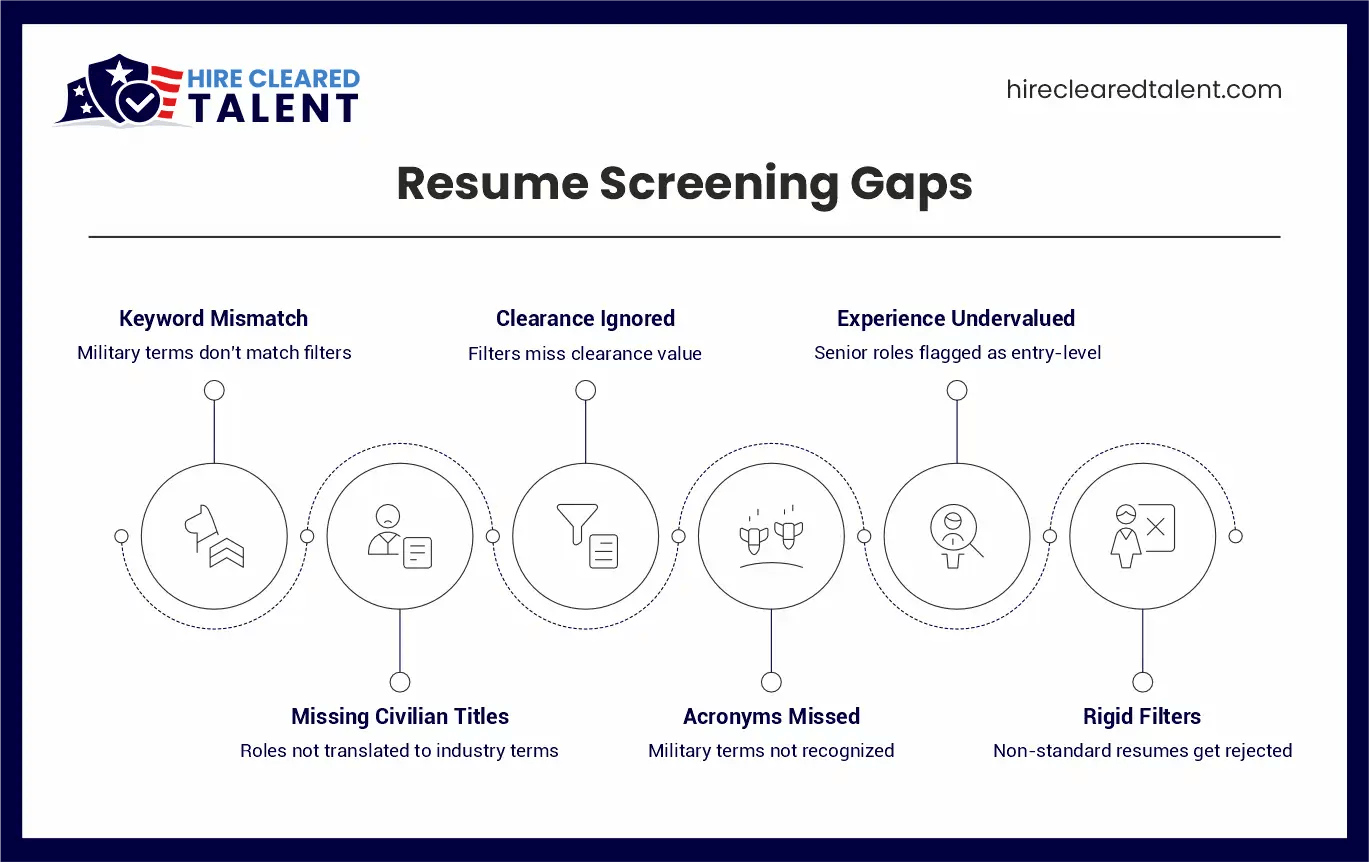
The easy explanation is resume translation. Veterans use military occupational terminology, civilian recruiters don't recognize it, and the application dies in an ATS before a human being ever sees it. That's real. But it's not the whole story and focusing only on the resume misses where a lot of searches actually break down.
Consider what Marcus, a retiring Army Signal Corps staff sergeant with a TS/SCI clearance, runs into when he starts his job search six months out from separation. His clearance is active. His technical background maps directly to cybersecurity roles that a dozen defense contractors are urgently trying to fill.
But his resume reads like an Army document. The skills are there; the translation isn't. A civilian HR screener, given eight seconds and a keyword checklist, passes on his application. The contractor loses a cleared candidate they spent zero dollars vetting. Marcus spends another six weeks applying before someone who actually understands cleared hiring reads his file.
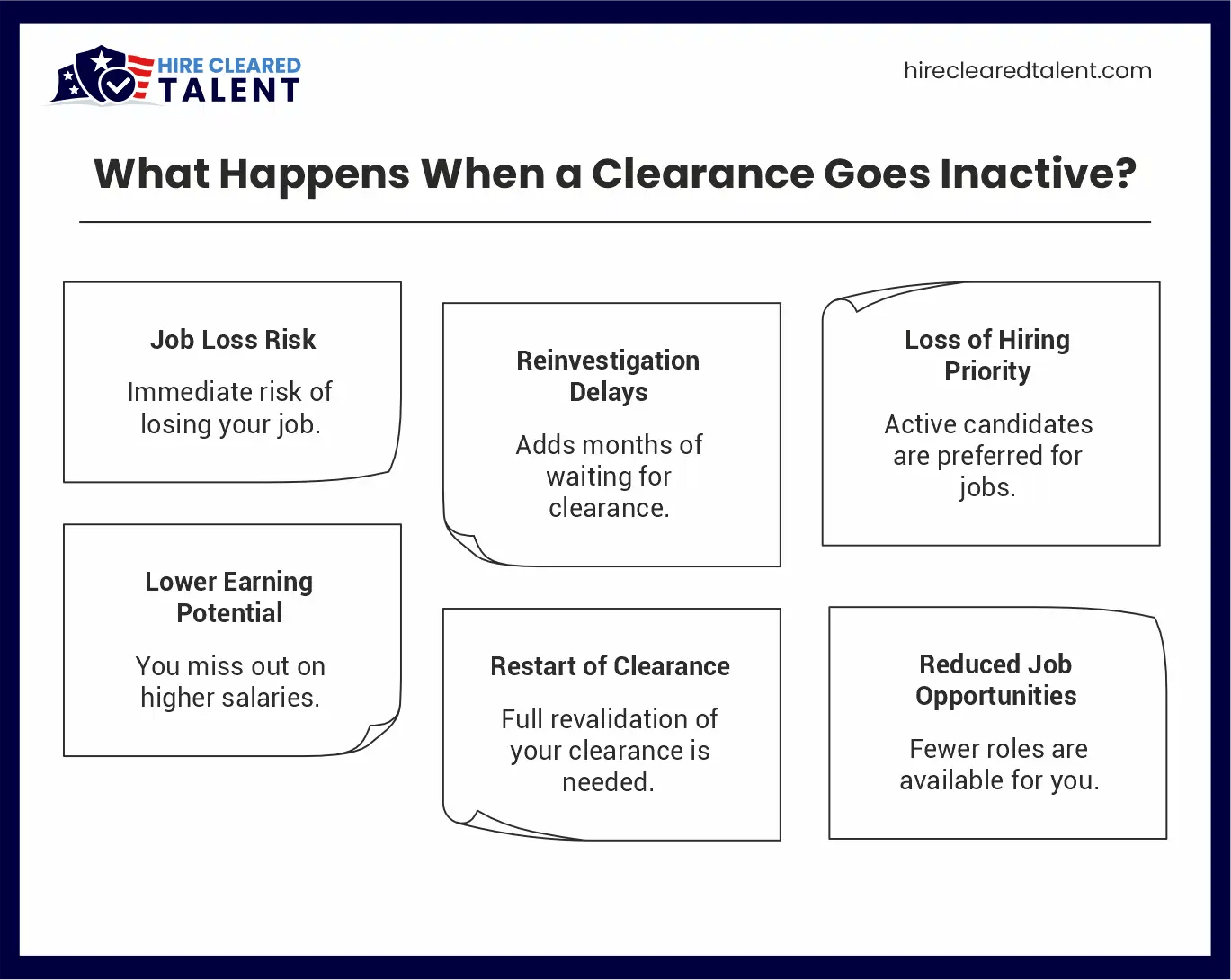
That scenario plays out thousands of times a year. But there's a second, less-discussed reason searches stall: timing. A veteran's clearance is valid for 24 months after separation under most circumstances. But if the original investigation is aging, that window may be shorter.
Candidates who spend months in school on the GI Bill before re-entering the job market sometimes discover their clearance has lapsed. What should have been a job search advantage becomes a re-investigation timeline of 12–18 months. The cleared labor market moves on without them.
Veterans with active clearances are the answer to that problem when the hiring system actually connects them to it.
The Clearance Advantage Is Real. So Is the Risk of Wasting It.
An active security clearance isn't a credential. It's a time-sensitive asset. The defense contracting world understands this acutely - a contractor bidding on a task order can't afford to wait 18 months for a candidate's background investigation to complete.
They need cleared, ready-to-work talent who can step in and bill from day one. Veterans with active clearances fill that gap. But only if they stay engaged in the cleared labor market before that clearance window closes.
Think of an active clearance the way cleared contractors think about a billable seat: the moment it goes dark, you're paying to bring it back online. A veteran who leaves a Secret clearance dormant for 26 months doesn't just face paperwork. They lose the single biggest competitive advantage they had in this market and face the same investigative queue as someone applying for a clearance for the first time.
By 2025, average salaries for security-cleared professionals reached $119,000, with TS/SCI holders averaging over $141,000. Those numbers don't belong to some abstract talent category, they belong to the exact profile that transitions out of military service every year.
Getting that profile properly connected to employers who need it is not a soft career-services problem. It's a market efficiency problem with real dollar consequences on both sides.
What Actually Moves the Timeline?
So, what gets a veteran hired faster? Not a better resume template though that matters. Not another job fair though peer connections help. What actually compresses the timeline is positioning in the right market, with the right information, early enough to act on it.
Here's what that looks like in practice.
Start the clearance clock conversation early. Six months before separation is not too early. Twelve months is better.
A veteran who knows their clearance investigation status, understands when their re-investigation window falls, and has a specific plan to keep that clearance active through their transition is in a categorically different position than one who figures it out at the ETS appointment. The difference can literally be 18 months of job search timeline.
Translate specifically, not generally. "Leadership" means nothing on a cleared resume. "Led a 14-person signals intelligence team supporting three concurrent theater operations, with direct accountability for $4.2M in SIGINT equipment" means something. The difference isn't about civilian vocabulary. It's about specificity.
Federal hiring managers and cleared HR professionals know what an MOS is what they need is scope, scale, and impact translated into terms that map to their requirements documents. Research from INvets confirms that the single biggest failure point is veterans undervaluing their experience and accepting roles well below their skill level often because no one helped them calibrate their market value.
Target the cleared pipeline, not the general market. This sounds obvious, but the majority of transitioning veterans apply through the same general channels as everyone else. The cleared federal market has its own ecosystem of demand, its own hiring timelines, and its own requirements for how candidates present.
A veteran with an active TS/SCI who applies to the general market is like bringing a precision tool to a job that doesn't know what precision looks like. They'll get passed over for candidates who fit the standard civilian template. The cleared market, by contrast, actively prices for what that veteran is bringing.
A Case Scenario
David separates from the Navy after 12 years as a Cryptologic Technician, holding an active TS/SCI with polygraph. He has 90 days until his clearance window starts narrowing. His first instinct is to apply broadly - federal jobs boards, general contractor career pages, a few LinkedIn applications. Six weeks later, he has one callback from a large federal IT services firm, for a role two pay grades below where his experience puts him.
What changes his outcome: a cleared-specific hiring marketplace that matches his clearance level and background directly to open billets from defense contractors and federal agencies who already understand what his background means.
Within three weeks, he's in active conversations with two program managers not HR screens who are staffing cleared positions and can evaluate his technical background accurately. He accepts an offer at $132,000. The general market search would have taken months longer and likely produced a lower offer.
The difference wasn't David's qualifications. It was where those qualifications were visible.
The Underemployment Problem Nobody Mentions
Veteran unemployment gets all the policy attention. Underemployment gets almost none of it. But the research from Mission Roll Call tells a stark story: roughly 80% of veterans leave their first post-military job within two years. That's not a successful transition. That's a transition that lands short and gets corrected later, at significant personal cost.
Why does that happen? Often, it's the same clearance-timing problem in reverse. Veterans take the first available role rather than waiting for the right role because they don't know what the right role looks like, don't know what it pays, and feel the pressure of a ticking clearance clock.
A retired Navy intelligence analyst accepts an administrative contract position at a mid-tier federal agency, watches their clearance go unused, and then re-enters the market two years later having lost both ground and clearance currency.
If a veteran with an active TS/SCI and a decade of signals intelligence experience takes a job that pays them less than their skill set warrants, is that a successful transition, or just a delayed one?
The answer matters, because policy and programs are often measured by "employment rates" rather than placement quality. A veteran who is technically employed but underutilized is still a market failure, just a quieter one. Solving it requires not just connecting veterans to jobs, but connecting them to jobs that accurately reflect their value in the cleared market.
Where Can Defense Contractors and Federal Agencies Do More?
Employers in the cleared space aren't passive in this equation. And some of the friction in veteran hiring is self-inflicted on the employer side.
The standard federal hiring process was not designed with speed in mind. Job requisitions that sit open for 90 days while cleared veterans who've already separated move on to other offers.
Screening processes that filter out non-traditional resume formats, eliminating exactly the candidates whose clearances make them valuable. HR teams that don't have the context to distinguish between an E-7 with 15 years of operational intelligence experience and an entry-level analyst. These aren't hostile conditions, they're just inefficient ones. And they cost employers cleared talent they're urgently trying to find.
The demand side of this market is not comfortable right now. Federal agencies are facing a projected 20% increase in mission-critical vacancies, while security clearance backlogs stretch toward 18 months for new investigations.
The math is not complicated: veterans with active clearances are the single fastest path to filling those billets. The infrastructure to reach them just needs to be used.
And the SkillBridge program which allows service members to work with civilian employers for up to 180 days before their separation date is one of the most underutilized tools in this space.
About 12,000 service members participated in the first half of FY 2024, according to the U.S. Government Accountability Office. For cleared contractors, it's essentially a zero-cost trial of a cleared candidate before they ever hit the open market. The program exists. Using it aggressively is a choice.
The Role of Targeted Hiring Infrastructure
General job boards don't solve this problem. They're built for a different market. Posting a cleared TS/SCI position on a platform optimized for general commercial hiring is the equivalent of submitting an SF-86 via carrier pigeon, it technically gets there, but you're going to wait.
What works is market alignment: connecting veterans who understand the cleared hiring environment to employers who operate within it. That means platforms where clearance levels are first-class data, not an afterthought.
It means search infrastructure that surfaces candidates by investigation recency, not just keyword match. It means hiring pipelines where both sides - the veteran and the employer - share a common language about what the role requires and what the candidate brings.
But veterans also carry a responsibility in this. According to Mission Roll Call research, 81% of surveyed veterans had never received any formal transition assistance from a business, nonprofit, or community provider despite resources being available.
Awareness and utilization are not the same thing. Veterans who actively engage cleared hiring infrastructure early, before separation, consistently compress their job search timelines compared to those who wait.
So, the infrastructure has to be built well. And veterans have to use it. Both things are true.
The Real Competitive Edge for Veterans Who Want to Move Fast
The veterans who find jobs fastest in this market share a few specific behaviors. They start their search earlier than they think they need to - well before separation, when they have the time and structure to be deliberate.
They understand their clearance status precisely, not approximately. They target the cleared federal market specifically, not the general commercial market that doesn't know what to do with them. And they present their experience with the specificity the cleared hiring space actually requires.
None of that is mysterious. But it does require information that most transition programs don't give. The Transition Assistance Program, as valuable as it is in principle, is consistently described by veterans as arriving too late and covering too little.
the D'Aniello Institute for Veterans and Military Families confirms that younger veterans (aged 18–24) face disproportionate unemployment challenges, often because they enter civilian life without the professional network that more senior veterans have built.
Building that network requires access to the right environment. And in the cleared space, the right environment is a marketplace where cleared professionals are seen for what they actually are not filtered through systems designed for a different candidate profile entirely.
Veterans Deserve a Hiring Market That Understands Them
At HireClearedTalent, we connect security-cleared professionals including transitioning veterans with federal agencies and defense contractors who understand what a clearance actually means.
No keyword filters designed for the commercial market. No HR teams who need the job explained to them. Just cleared roles, cleared employers, and the infrastructure that makes both sides of this market work faster.
Create Your Profile on HireClearedTalent
Schedule a Call with Our Experts
FAQ-
Q1- Why do veterans face delays in finding jobs after transitioning?
A- Civilian employers often look for industry-recognized credentials and role-specific experience, which are not always clearly reflected in military resumes.
Q2- How can veterans translate military experience into civilian job roles?
A- Map military skills to job descriptions, use civilian terminology, and highlight measurable outcomes like leadership, operations, and technical expertise.
Q3- What role do certifications play in helping veterans get hired faster?
A- Certifications validate skills in a standardized format, making it easier for employers to assess and shortlist candidates.
Q4- Which certifications help veterans secure jobs quickly?
A- Certifications in cybersecurity, cloud, project management, and data analytics align with high-demand roles and improve hiring speed.
Q5- How can veterans improve their resume for faster job opportunities?
A- Focus on results, use keywords from job descriptions, and remove military jargon to match employer expectations.
Q6- Does networking help veterans find jobs faster?
A- Yes. Connecting with industry professionals, veteran groups, and recruiters increases visibility and access to unlisted roles.
Q7- How important is LinkedIn for veteran job search success?
A- A strong LinkedIn profile improves recruiter discovery and helps showcase certifications, experience, and career goals.
Q8- What mistakes slow down a veteran’s job search?
A- Applying without tailoring resumes, ignoring certifications, limited networking, and unclear career direction delay results.
Q9- How can employers speed up hiring for veteran candidates?
A- Use skill-based hiring, recognize military experience, and streamline screening processes to reduce delays.
Q10- Are there specific industries that hire veterans faster?
A- Cybersecurity, IT, logistics, defense contracting, and project management roles often have higher demand f
Weekly newsletter
Get the latest blog updates, practical hiring insights, and featured reads delivered straight to your inbox.
Read about our Privacy Policy.